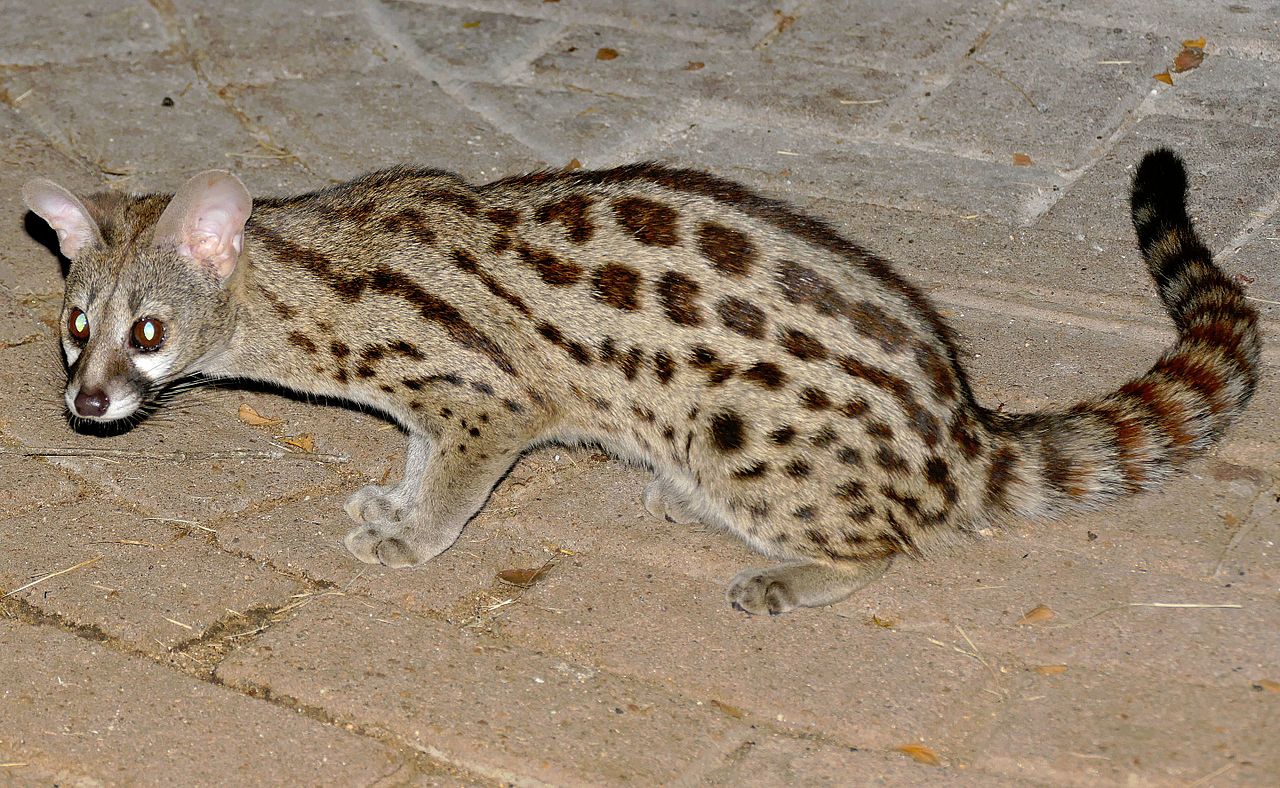
Cape Genet (Genetta tigrina) lives in open savanna across Sub-Saharan Africa. It feeds on small mammals insects. Its conservation status is Least Concern.
Fascinating facts about the Cape Genet
- Some individuals living in areas with more than 375 mm (14.8 in) annual precipitation are darker than individuals from drier areas. Adult males measure 460-580 mm (18-23 in) in head-body length, have tails 390-459 mm (15.4-18.1 in) long and weigh 1.6-2.1 kg (3.5-4.6 lb). Females are slightly smaller, 427-560 mm (16.8-22.0 in) body length, tails 385-432 mm (15.2-17.0 in) and weigh 1.36-1.870 kg (3.00-4.12 lb).
- Cape genets are opportunistic omnivores that hunt rodents such as African vlei rats, rock rats, mice and birds, but their stomachs also contain seeds, leaves, grass, beetles, grasshoppers, crickets, locusts and termites. They even scavenge fish on the beach and eat insects, spiders and scorpions. Eating grass may aid digestion, dislodge hair in the intestines, induce vomiting to get rid of ingested toxins, relieve throat inflammation and stomach irritation. This flexible diet lets them thrive across seasons, turning from a rodent-focused hunter in winter to an insect-eating forager in summer, stabilising prey populations and dispersing seeds.
- Gestation lasts about 70 days, after which females give birth to litters that contain two newborns weighing roughly 70 g. In captivity, pairs regularly produce two-young litters, while wild records show newborn weights between 61 g and 82 g. Kits open their eyes after 10 days, their canine teeth emerge at four weeks, and they are weaned at about 2.5 months. By seven months they hunt independently, reaching adult size by one year.
- Cape genets, ranging from the Western Cape to KwaZulu-Natal and the Lesotho border, and extending into Namibia, Botswana, Zimbabwe, Mozambique, Swaziland and Lesotho. They avoid arid zones, occurring only where annual rainfall exceeds 450 mm, preferring riparian forest, well-watered savanna woodlands and fynbos with dense vegetation cover. Their presence in dozens of protected areas and in cultivated human-settled landscapes shows how a species can thrive when permanent water and cover are available.
- Cape genets are nocturnal, solitary hunters that spend daylight hours perched high in trees, rock overhangs or caves. They combine speed and stealth on the ground, can leap 3-4 m between branches, and swing their legs laterally to correct missteps on narrow limbs. Scent marking is done by depositing anal-sac secretions, and males sometimes perform hand-stands to spread the musky odor on vertical surfaces. Their vocal repertoire mirrors cats, including purrs, meows, hisses and yaps.
Sources
Every fact above was checked against these pages, and kept only where one of them states it.
At a glance
RangeSub-Saharan Africa
HabitatOpen savanna
DietSmall mammals insects
About the Cape Genet
In the shadowy underbrush of southern Africa's woodlands, the Cape Genet weaves a secret life, its tawny coat and white-tipped fur blending seamlessly into the dappled moonlight as it pads silently through the night. With eyes aglow like lanterns in the dark, this solitary and enigmatic creature stalks its prey, a master of stealth and cunning, its long, slender body undulating as it moves with the fluidity of a ghost. As it explores its realm, the Cape Genet embodies the very essence of nocturnal Africa, a mystical and elusive presence that haunts the edges of our perception.
Hear the Cape Genet, and 4,400+ more
Real recorded sounds, 11 nature games and a free Daily 5, 1v1 quiz duels, conservation wins and a safe Kids mode. Free on Feravox.