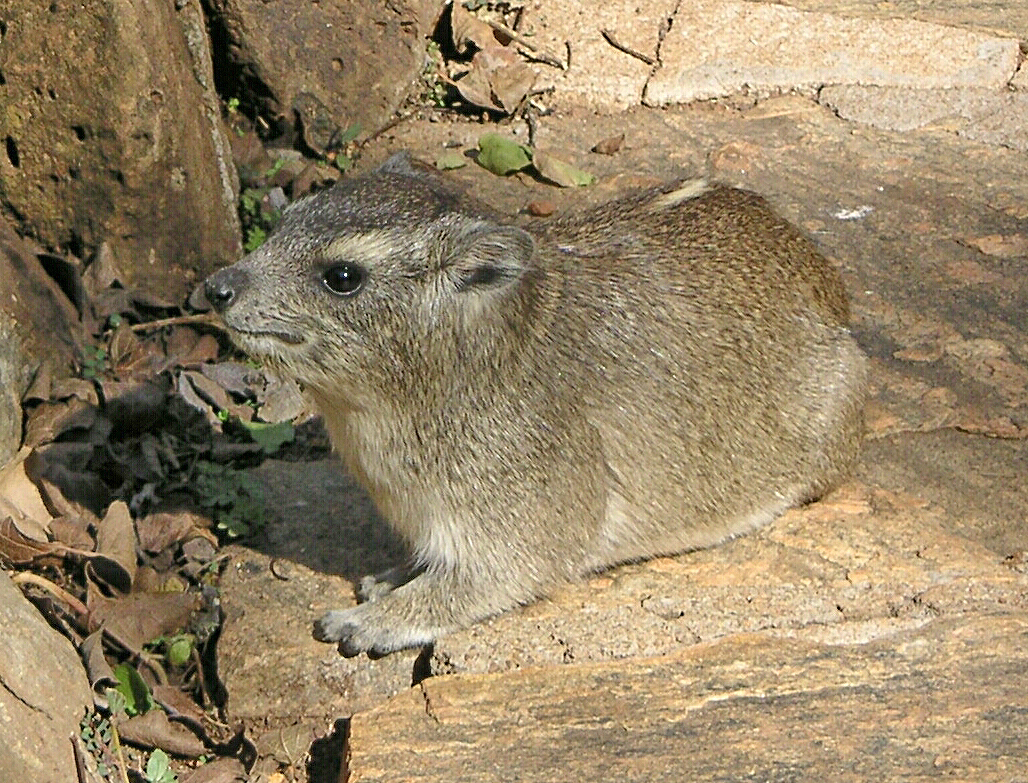
Bush Hyrax (Heterohyrax brucei) lives in rocky outcrops across Sub-Saharan Africa. It feeds on grass and leaves. Its conservation status is Least Concern.
Fascinating facts about the Bush Hyrax
- A dorsal gland about 1.5 cm long sits on the lower back beneath a raised skin patch and releases a yellowish secretion. The colour can range from reddish-ochre to dirty white, but most often appears yellow. This scent marks sexual arousal and also lets mothers recognise their offspring. Not every Heterohyrax species possesses this gland, making it a distinctive trait of the bush hyrax.
- Specialised glands on the flat, naked pads of the bush hyrax's feet secrete moisture that boosts grip on slick rock surfaces. Muscles contract the foot into a cup-like shape, creating a suction-cup effect that lets the animal cling like a tiny suction cup. This adaptation makes them excellent climbers, and even if shot they can remain perpendicular on the rock as if still stuck.
- An umbraculum extends from the iris across the pupil of the bush hyrax's eye, acting like a built-in sunshade. This structure permits the animal to stare directly at the sun while sun-basking without blinding itself, and at the same time it can keep watch for aerial predators. The adaptation therefore supports both thermoregulation and predator awareness.
- The bush hyrax's kidney is uniquely adapted to its arid environment, allowing it to conserve water by excreting urine that is far more concentrated than that of most mammals. This extreme concentration leaves behind a crystalline deposit known as klipstreet or hyraceum, which coats the rock outcrops they inhabit.
- Juvenile bush hyraxes face a steep risk of death, with studies estimating that between 52.4 % and 61.3 % of young individuals die each year. Predation is a major cause, as rock pythons, leopards, birds of prey and mongooses regularly hunt the vulnerable juveniles. This high mortality rate, recorded in a study from 1992-1995, underscores the constant pressure from natural predators on new-born hyraxes.
Sources
Every fact above was checked against these pages, and kept only where one of them states it.
At a glance
RangeSub-Saharan Africa
HabitatRocky outcrops
DietGrass and leaves
About the Bush Hyrax
In the sun-baked rocky outcrops of Africa, the bush hyrax emerges as a diminutive yet resilient monarch, its sturdy frame and sharp claws allowing it to scale vertical faces with ease, as it forages for the tender shoots and leaves that sustain it. With a twitch of its whiskers and a flick of its ears, it navigates its arid kingdom, ever vigilant for the predators that lurk in the shadows. As it moves through its domain, the bush hyrax embodies a quiet, unassuming tenacity, a testament to the enduring power of life in even the most unforgiving of landscapes.
Hear the Bush Hyrax, and 4,400+ more
Real recorded sounds, 11 nature games and a free Daily 5, 1v1 quiz duels, conservation wins and a safe Kids mode. Free on Feravox.