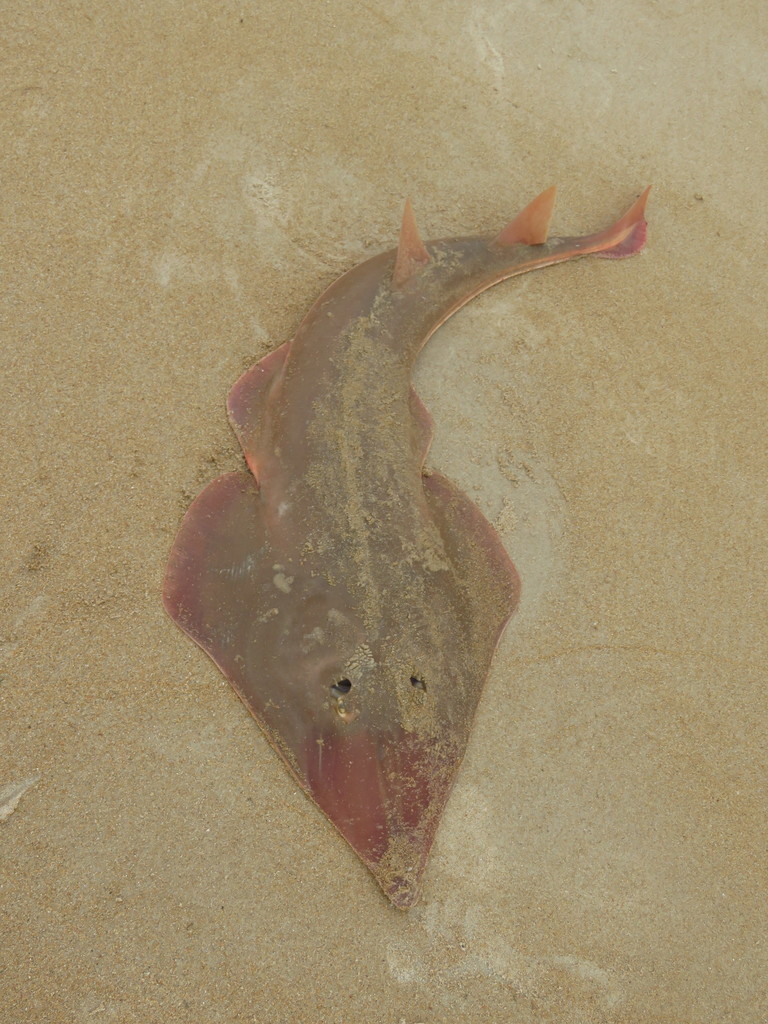
Photo: Diogo Luiz
Feravox · The Voice of the Wild
Brazilian Guitarfish
Pseudobatos horkelii
Critically Endangered
Brazilian Guitarfish (Pseudobatos horkelii) lives in coastal continental shelf across Brazil. It feeds on unspecified diet. Its conservation status is Critically Endangered.
The Brazilian guitarfish, Pseudobatos horkelii, glides along Brazil’s continental shelf in a uniform olive-grey or brown cloak, its dorsal surface broken only by a dark snout patch and long nostrils. Adults typically reach about 60 cm, though some stretch to 138 cm, their crowns flattened or gently convex, giving them the unmistakable guitar-shaped silhouette that defines the Rhinobatidae family. These viviparous rays spend their early months hidden in the warm, shallow waters of the inner shelf, where the females nurture their embryos first from yolk sacs then from uterine secretions, producing litters of four to twelve pups that emerge in February at roughly 29 cm. After birth, the juveniles linger in these nursery grounds, only to be scattered outward as the adults disperse later in the year, a seasonal rhythm that aligns mating in March with the inner-shelf’s productive pulse. A surprising twist in their biology is the exclusive partnership with the parasitic flatworm Acanthobothrium goleketen, a “Good Luck” worm found nowhere else, hinting at a tightly woven ecological web that hinges on the guitarfish’s very presence. When the breeding season wanes, the fish migrate across the inner shelf, becoming vulnerable to pair-trawling, beach seines, and otter-trawls that target both pregnant females and juveniles. Their low fecundity, four-year maturation and modest litter sizes, means each loss reverberates through the population, a stark contrast to the abundant bounty once harvested along southern Brazil’s coast. The once-thriving catches that peaked at 1 804 tonnes in Rio Grande by 1984 have collapsed to a fraction of that, underscoring how overfishing has reshaped the species’ fate.
Real recorded sounds, 11 nature games and a free Daily 5, 1v1 quiz duels, conservation wins and a safe Kids mode. Free on Feravox.