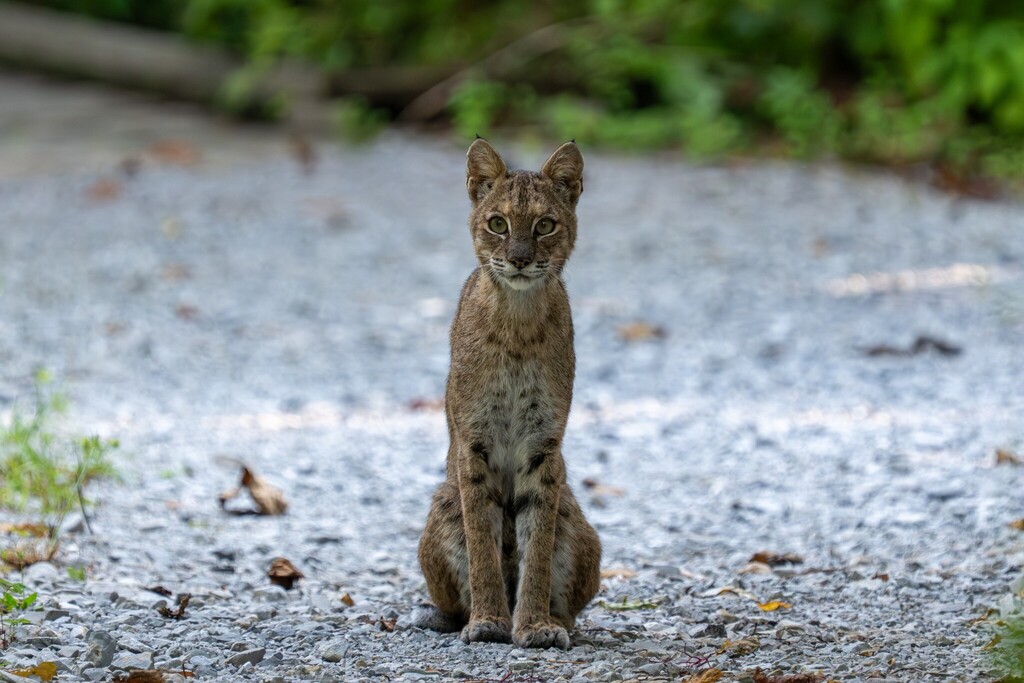
Bobcat (Lynx rufus) lives in swampland across Southern Canada, contiguous United States, Oaxaca (Mexico). Its conservation status is Least Concern.
Fascinating facts about the Bobcat
- Bobcats can stretch up to a foot-long tail-less body, reaching a total length of up to 125 cm (50 in). Adult males weigh between 6.4 kg and 18.3 kg (14-40 lb) while females range from 4 kg to 15.3 kg (8.8-33.7 lb), averaging 9.6 kg (21 lb) and 6.8 kg (15 lb) respectively. The heaviest measured individual tipped the scales at 22.2 kg (49 lb), with unverified reports of 27 kg (60 lb). This size span, echoed by a range of 65-105 cm body length and 4-15 kg weight in other surveys, shows how the species flexes its body plan across habitats, influencing prey choice and predator-prey dynamics.
- Bobcat territories can be as tiny as a city block or as vast as a small town, ranging from 0.596 km² (0.23 sq mi) to 326 km² (126 sq mi). In Kansas, resident males patrol roughly 21 km² (8 sq mi) while females hold less than half that space; transients swell to 57 km² (22 sq mi) with fuzzy borders, and kittens occupy just about 8 km² (3 sq mi). Such flexibility lets individuals match home-range size to prey abundance and competition, shaping how densely bobcats can populate a landscape.
- On Kiawah Island, a bobcat population once stable collapsed after rodenticide exposure. Three cats died in 2019, and over the next four years twelve more perished, driving the survival rate down to 39 %. The remaining group numbers fewer than 20 individuals, each testing positive for at least two anticoagulant compounds. This cocktail of poisons, found in blood and liver, threatens not only individual health but the very existence of the local subpopulation.
- Bobcats trace their roots back to the Eurasian lynx, crossing the Bering Land Bridge as early as 2.6 million years ago. The Lynx lineage split from Puma, Prionailurus and Felis about 7.15 million years ago, with the bobcat branch diverging roughly 3.24 million years ago. Fossils place the species' first appearance at 1.8 million years ago, and a southern wave later gave rise to the modern bobcat around 20,000 years ago.
Sources
Every fact above was checked against these pages, and kept only where one of them states it.
At a glance
RangeSouthern Canada, contiguous United States, Oaxaca (Mexico)
HabitatSwampland
DietSmall mammals rodents
About the Bobcat
In the dappled twilight of the forest, the bobcat is a phantom, its tawny coat blending seamlessly with the shadows as it pads silently through the underbrush, its ears twitching with an almost supernatural awareness of its surroundings. With eyes that burn like embers, this solitary hunter navigates the secret world of the woodland, its paws barely disturbing the leaf litter as it stalks its prey with a patience that is both captivating and unnerving. As it moves, its tail twitches with a subtle language all its own, a testament to the bobcat's enigmatic and elusive nature.
Hear the Bobcat, and 4,400+ more
Real recorded sounds, 11 nature games and a free Daily 5, 1v1 quiz duels, conservation wins and a safe Kids mode. Free on Feravox.
More wild cats to discover