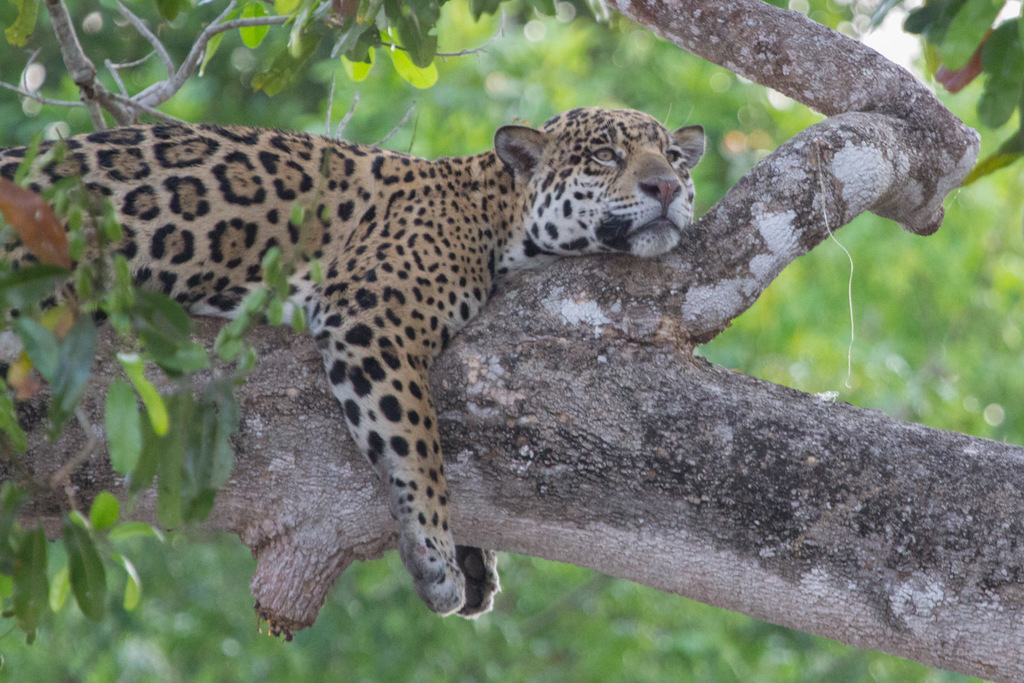
Jaguar (Panthera onca) lives in tropical rainforest across Central and South America. It feeds on peccaries and capybaras. Its conservation status is Near Threatened.
Fascinating facts about the Jaguar
- The jaguar's bite is so powerful it can smash through the hard shells of turtles and tortoises, a feat few predators achieve. When hunting mammals it often snaps the skull between the ears, sending a lethal shock straight to the brain. This killing technique is backed by a bite force that ranks third among all felids, only behind the tiger and lion, and a 100 kg individual can generate nearly 5 kN of pressure at the canines, enough to crush bone with ease.
- Reaching up to 1.85 m from nose to tail base and weighing as much as 158 kg, the jaguar is the largest cat native to the Americas and the third-largest cat on Earth after the tiger and lion. Its shoulder height ranges between 57 and 81 cm, giving it a compact yet muscular build. While most individuals fall within a 56-96 kg weight window, the biggest males push the upper extreme, underscoring the species' impressive size gradient across its range.
- Jaguars possess some of the strongest jaws in the feline family, delivering the third-highest bite force among all cats. Their bite force at the canine tip averages 887 N, and a 100 kg individual can exert nearly 5 kN, enough to break bone and crush turtle shells. This formidable power, surpassed only by the tiger and lion, enables the jaguar to tackle a wide range of prey, from large mammals to heavily armoured reptiles.
- The first documented black jaguar in northern Mexico was captured by a camera trap in the Sierra Madre Occidental mountains in 2004. Black jaguars, a melanistic morph, have also been photographed in Costa Rica's Alberto Manuel Brenes Biological Reserve, the Cordillera de Talamanca, Barbilla National Park and eastern Panama.
- In 1999 researchers estimated the jaguar's historic range at about 19 000 000 km², stretching from the southern United States through Central America to southern Argentina. By the turn of the 21st century that range had shrunk to roughly 8 750 000 km², with the greatest losses recorded in the southern United States, northern Mexico, northern Brazil and southern Argentina.
Sources
Every fact above was checked against these pages, and kept only where one of them states it.
At a glance
RangeCentral and South America
HabitatTropical rainforest
DietPeccaries and capybaras
About the Jaguar
In the dappled shadows of the tropical forest, the jaguar moves with a silent purpose, its tawny coat blending seamlessly with the sun-drenched underbrush as it pads effortlessly across the forest floor. With eyes that burn like embers, this majestic predator navigates its domain with a quiet confidence, its powerful muscles rippling beneath its sleek skin as it stalks its prey with a patient, calculated precision. As it glides through the trees, its very presence seems to embody the wild, untamed spirit of the American wilderness, a testament to the enduring power and beauty of this near-threatened icon.
Hear the Jaguar, and 4,400+ more
Real recorded sounds, 11 nature games and a free Daily 5, 1v1 quiz duels, conservation wins and a safe Kids mode. Free on Feravox.
More wild cats to discover