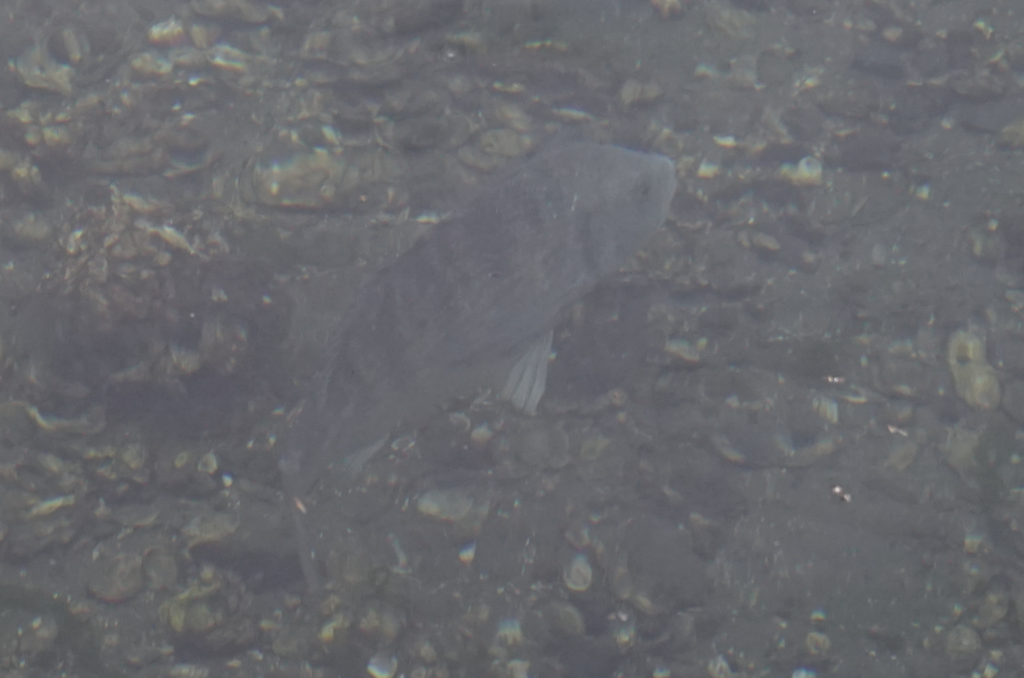
Photo: iNaturalist
Feravox · The Voice of the Wild
Blackhead Seabream
Acanthopagrus schlegelii
Least Concern
Blackhead Seabream (Acanthopagrus schlegelii) lives in shallow rocky reefs across Northwestern Pacific. It feeds on molluscs and polychaetes. Its conservation status is Least Concern.
The blackhead seabream, Acanthopagrus schlegelii, glides through the sheltered bays and shallow rocky reefs of the northwestern Pacific, its sleek body cloaked in a muted black-grey mantle that shimmers silver along the belly. Light-colored dorsal, caudal, anal and pelvic fins contrast with faint vertical stripes that run the length of its form, while a distinctive round spot crowns the upper edge of the operculum. Growing to a standard length of up to 50 cm (20 in), this ray-finned fish is built for both agility and endurance, its dorsal fin supported by 11 or 12 spines and 11 soft rays, and an anal fin bearing 3 spines and 8 soft rays. In the dimming light of early evening, the blackhead seabream gathers in coastal waters to spawn, a ritual triggered by the falling light levels that cue its protandrous hermaphroditic cycle. Males, which dominate the younger size classes, can live to 20 years, while females may reach 28 years, underscoring a life history tuned to the seasonal rhythms of spring and summer. Their predatory diet of molluscs and polychaete worms reflects a keen foraging instinct, but perhaps the most surprising trait is their ability to thrive in brackish waters down to 50 m (160 ft), bridging the gap between marine and estuarine ecosystems, a flexibility that fuels their prominence in regional fisheries and aquaculture.
Real recorded sounds, 11 nature games and a free Daily 5, 1v1 quiz duels, conservation wins and a safe Kids mode. Free on Feravox.