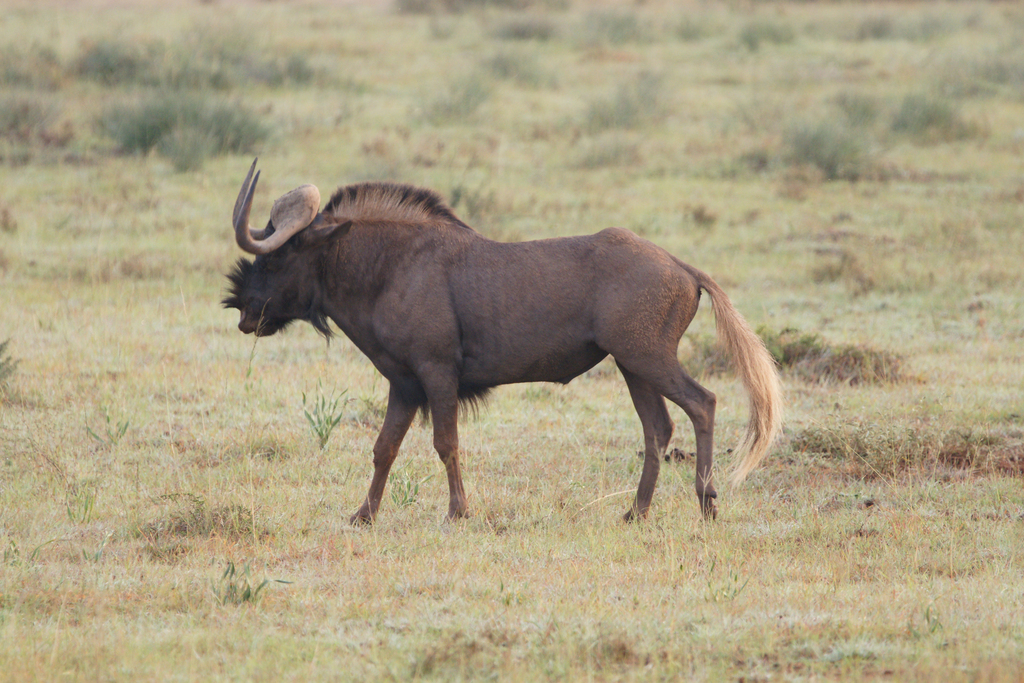
Black Wildebeest (Connochaetes gnou) lives in open savanna across Southern Africa. It feeds on grass and leaves. Its conservation status is Least Concern.
Fascinating facts about the Black Wildebeest
- A single calf is usually born after a gestational period of about 8.5 months, emerging at roughly 11 kg,. Within minutes the newborn can stand and run, a vital skill when lions and hyenas stalk the herd.
- By the 19th century the black wildebeest was almost completely exterminated, hunted to near-zero because of its hide and meat value. Intensive re-introduction programmes from captive stock have now restored populations across South Africa, Lesotho, Eswatini, Namibia and Kenya. The species is now at Least Concern status.
- Unlike its blue cousin, the black wildebeest no longer undertakes the massive seasonal migrations that once shaped African savannas. A recent study found that all 24 large-ungulate species examined have lost migration routes, and the black wildebeest's historic movements across the Drakensberg have vanished.
- At up to 2.2 m long and weighing as much as 157 kg, the black wildebeest its horns curve forward like hooks and can reach 78 cm. It can sprint at 80 km/h.
- Female herds typically contain 14 to 32 individuals, but the largest recorded herd numbered 330 head at Willem Pretorius Game Reserve. Such numbers swell when forage is abundant.
Sources
Every fact above was checked against these pages, and kept only where one of them states it.
At a glance
RangeSouthern Africa
HabitatOpen savanna
DietGrass and leaves
About the Black Wildebeest
As the black wildebeest, also known as the white-tailed gnu, traverses the sun-baked savannah, its dark, slate-grey coat glistens like polished stone, and its shaggy mane ripples in the gentle breeze, a testament to its rugged yet majestic beauty. With each powerful stride, it propels itself forward, its sharp hooves pounding out a primal rhythm on the dry earth, as if driven by an ancient instinct to roam the open grasslands. In its annual migrations, this remarkable creature embodies the very essence of wild freedom, a symbol of the unbridled spirit that still courses through the African wilderness.
Common questions
What does the Black Wildebeest eat?
Diet: grass and leaves.
Where does the Black Wildebeest live?
Habitat: open savanna. Range: Southern Africa.
Is the Black Wildebeest endangered?
The Black Wildebeest is listed as Least Concern on the IUCN Red List.
How can I learn about the Black Wildebeest?
Feravox has a two-minute lesson on the Black Wildebeest: five facts and five questions. See the lesson
Hear the Black Wildebeest, and 4,400+ more
Real recorded sounds, 11 nature games and a free Daily 5, 1v1 quiz duels, conservation wins and a safe Kids mode. Free on Feravox.