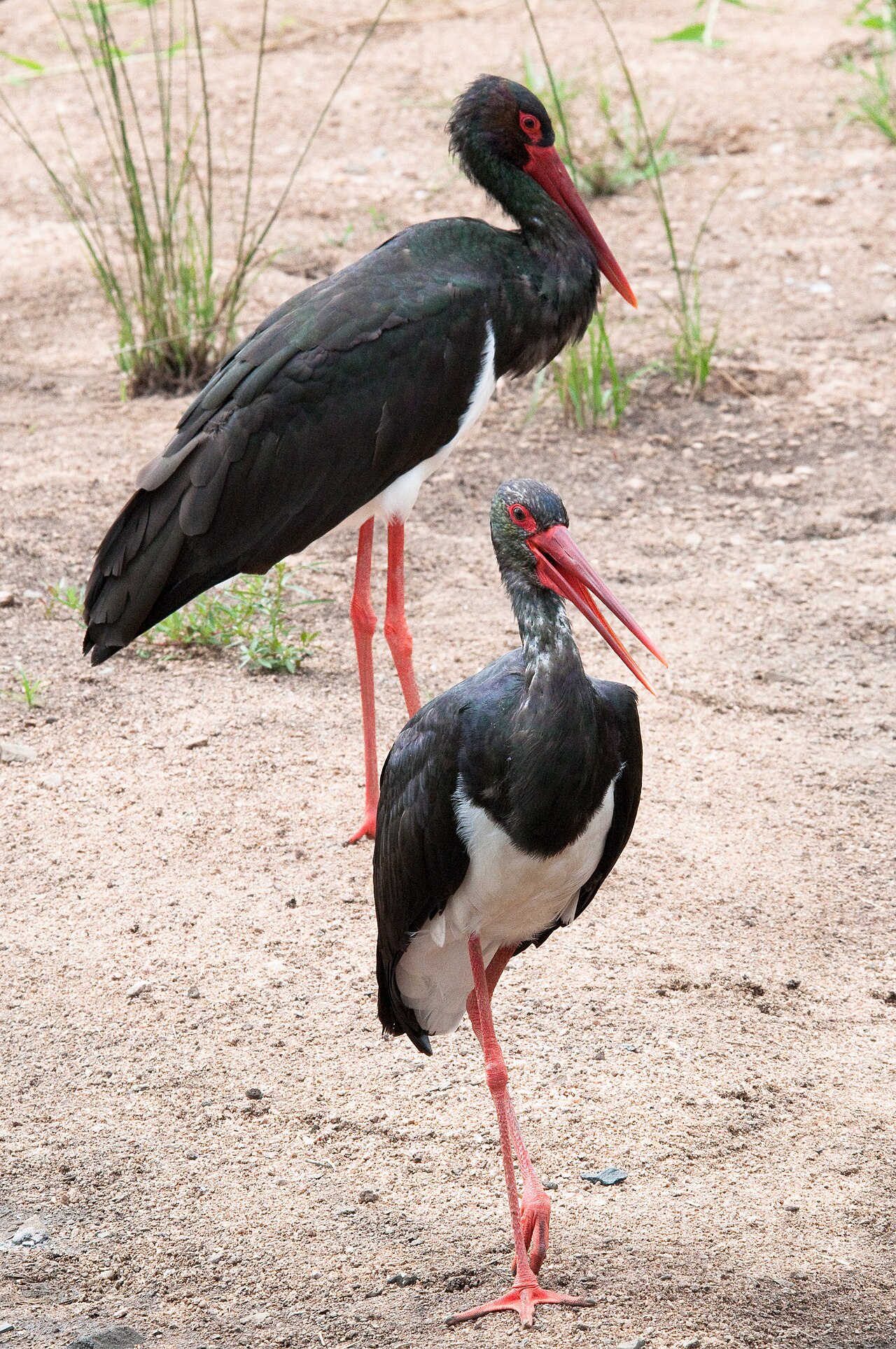
Black Stork (Ciconia nigra) lives in wetland areas across Sub-Saharan Africa, Europe, Asia. It feeds on fish and frogs. Its conservation status is Least Concern.
Fascinating facts about the Black Stork
- Measuring on average 95 to 100 cm (37 to 39 in) from beak tip to tail and boasting a 145-to-155 cm (57-to-61 in) wingspan, the black stork weighs around 3 kg (6.6 lb) and can stand as tall as 102 cm (40 in). Its slender, black-plumed silhouette makes it a wader in marshes. It can soar and sustain long migratory flights, and it wades in shallow water to stalk prey.
- When the western migration route is taken, black storks fly roughly 5,667 km (3,521 mi) and need about 37 days to reach Sub-Saharan Africa; the eastern route stretches to about 7,000 km (4,300 mi) and can take up to 80 days. They avoid the open Mediterranean by squeezing through the narrowest sea gaps, Gibraltar, the Bosphorus, the Sinai or the 145 km wide Strait of Sicily, using thermals that only form over land. These long, narrow detours illustrate how the species' reliance on rising warm air shapes its entire migratory geography.
- In Estonia, black storks chose nesting trees that averaged 25.6 ± 5.2 m (84 ± 17 ft) tall, with trunks 66 ± 20 cm (26 ± 8 in) wide, and 90 % of those trees were at least 80 years old. Similar studies in Greece found preferred pines over 90 years old on steep, stream-side sites. Such reliance on ancient, towering trees means that loss of old-growth forest directly reduces available breeding platforms, making forest preservation essential for the species' reproductive success.
- The black stork's diet is dominated by fish, small cyprinids, pikes, roaches, eels, perch and loaches, but it also snaps up amphibians, small reptiles, crabs, mammals and insects. It wades patiently in shallow water, sometimes shading the surface with its wings while hunting, and can even forage on dry land when prey are scarce. This opportunistic, visual hunting style lets it exploit a wide range of wetland habitats.
- The IUCN lists the black stork as Least Concern, yet its global population of 32,000-44,000 individuals is declining because of habitat loss and poaching. In Malta, a key Mediterranean stop-over, black storks are strictly protected under the EU Birds Directive. This contrast shows that legal protection alone cannot halt mortality without effective enforcement.
Sources
Every fact above was checked against these pages, and kept only where one of them states it.
At a glance
RangeSub-Saharan Africa, Europe, Asia
HabitatWetland areas
DietFish and frogs
About the Black Stork
As the Black Stork soars across the mist-shrouded wetlands, its sleek, ebony silhouette slices through the dawn air with effortless precision, its long, slender wings beating in a slow, hypnotic rhythm. With each deliberate stroke, it seems to embody the very essence of patience and stealth, a masterful hunter navigating the murky shallows in search of unsuspecting prey. In its stately, deliberate movements, we find a reflection of the wild, unspoiled beauty that this majestic bird inhabits, a world of primeval mystery and ancient, unbroken traditions.
Hear the Black Stork, and 4,400+ more
Real recorded sounds, 11 nature games and a free Daily 5, 1v1 quiz duels, conservation wins and a safe Kids mode. Free on Feravox.