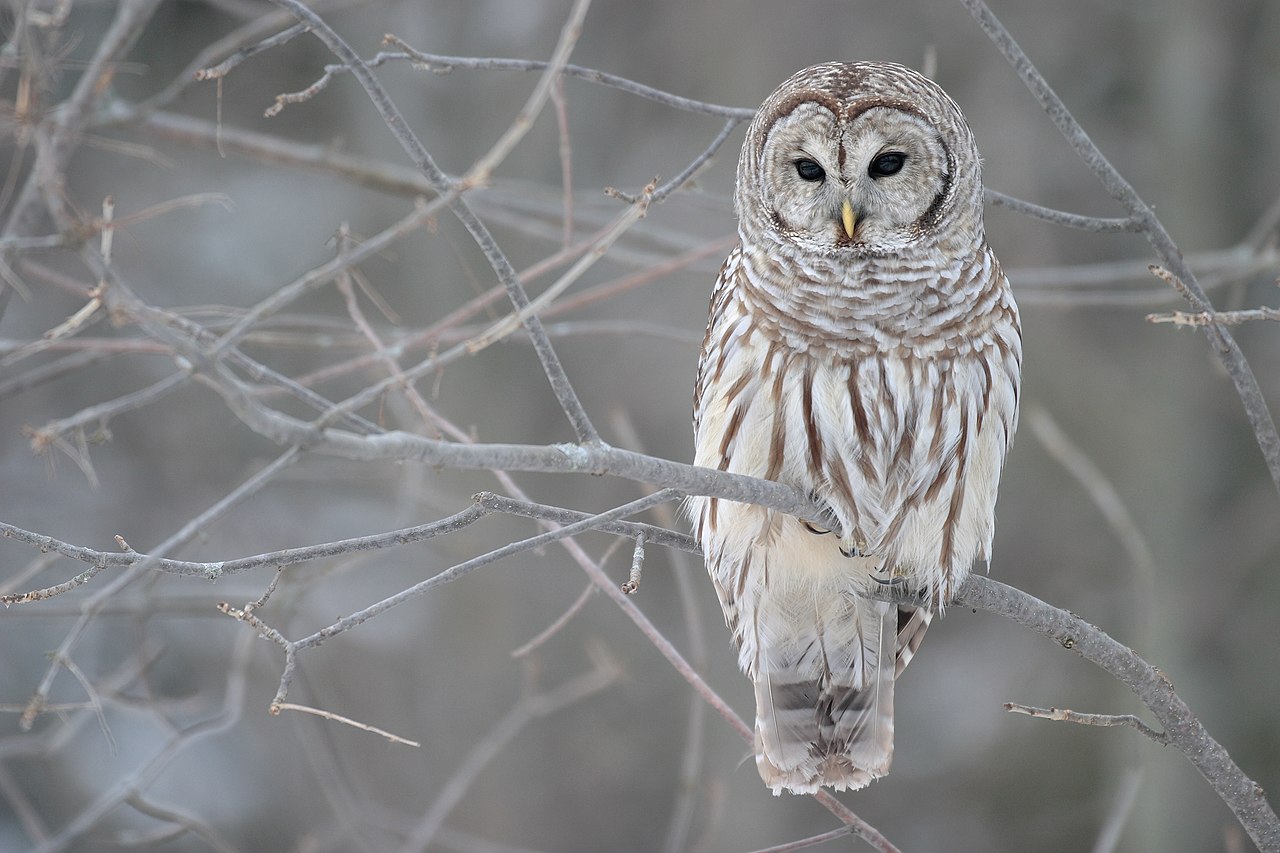
Barred Owl (Strix varia) lives in mature forests, open woodlands across Eastern North America. It feeds on small mammals birds. Its conservation status is Least Concern.
Hear the Barred Owl
A real field recording of the Barred Owl, made in the wild.
Barred owls have marched westward across the continent, turning a once-eastern specialist into an invasive force on the Pacific Northwest. Their historic barrier, the treeless Great Plains, fell as settlers suppressed wildfires and planted trees, letting forests sprout along the Missouri River and later across southern Canada. This new wood-filled corridor let them leap from the Yellowstone to the Musselshell, then stitch eastern and western populations together. The result: a booming western presence that now competes directly with the endangered spotted owl, prompting biologists to call for culling to protect the native species.
Male barred owls can be a third lighter than their sisters, a striking example of reverse sexual dimorphism among raptors. In the nominate subspecies, average male weights range from 621.9 g to 681 g, while females average between 801 g and 909.5 g, giving females up to 1,150 g at the high end. Wing chords also differ: males measure 303-340 mm versus 318-357 mm in females.
When a barred owl calls, its eight-note hoot can travel half a mile through a forest night. The classic chant is a series of eight accented hoots, and playback experiments in Virginia showed 80 % of owls answered the call. Even the rarer "legato" or "ascending" variations echo across the woods, with 56 % of studied birds using the ascending type and 36 % ending on the final notes.
Barred owls need big, hollow trees to raise their young, tying their fate to old-growth forests. They nest in cavities of large trees, though in the Pacific Northwest they will also use second-growth holes, a flexibility that fuels their westward surge. Their dependence on such cavities makes them vulnerable where old trees are cut.
A wild barred owl can outlive most birds of prey, with the longest recorded individual reaching 18 years and 2 months. They begin breeding at about two years old, laying two to three eggs that hatch after 28-33 days. After hatching, the female broods for three weeks while the male supplies food; fledging occurs at six weeks, and parental care can stretch to six months.
Sources
Every fact above was checked against these pages, and kept only where one of them states it.
In the misty veil of dawn, the barred owl emerges, its soft, feathery plumage a masterful disguise as it glides silently through the forest, its piercing gaze scanning the underbrush for the slightest stirring of life. With wings as still as a ghost, it drifts effortlessly, a phantom of the woodland, its haunting, whistled calls echoing through the trees like a mournful serenade. As it alights upon a branch, its wise, round eyes seem to hold a deep understanding of the secrets that lie within the shadows of its domain.
Advertisement
Hear the Barred Owl, and 4,400+ more
Real recorded sounds, 11 nature games and a free Daily 5, 1v1 quiz duels, conservation wins and a safe Kids mode. Free on Feravox.