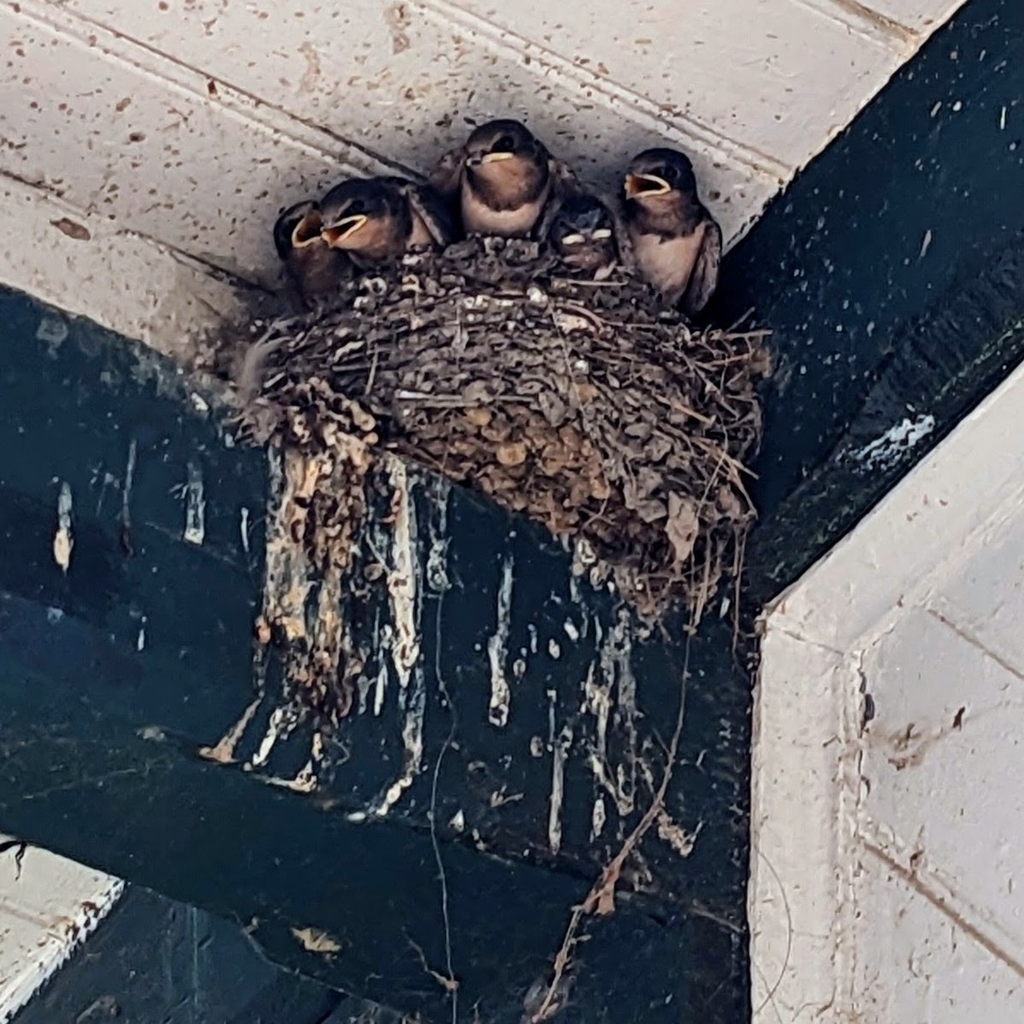
Barn Swallow (Hirundo rustica) lives in open fields across Europe, Asia, Africa and the Americas. It feeds on insects and spiders. Its conservation status is Least Concern.
Hear the Barn Swallow
A real field recording of the Barn Swallow, made in the wild.
The nominate European subspecies has been recorded covering up to 11,660 km on its annual migration, wintering across Africa, Arabia and the Indian subcontinent. Such extreme journeys link continents, moving insects-eating birds from temperate farms to tropical savannas.
A single roost in Nigeria once held an estimated 1.5 million barn swallows, a living cloud that swarms over reed beds to overwhelm predators. These massive gatherings synchronize arrival to flood the air with birds, making it hard for African hobbies to catch individual prey. The sheer number shows how colonial nesting and communal roosting provide safety in numbers for a species that otherwise nests in exposed human structures.
Barn swallow nests are built from mud pellets in about two weeks, and old nests become prized assets because rebuilding takes that long each season. The species prefers open country with low vegetation and nearby water, nesting in barns, stables or under bridges where a sheltered ledge is available. This reliance on human-made structures has allowed the swallow to expand its range.
Males with longer tail streamers live longer and resist disease better, so females gain indirect fitness benefits by choosing such mates. Longer tails also correlate with larger white tail spots, which are less damaged by feather-eating lice, further signalling health. This sexual selection drives tail length differences across latitudes, with northern European males having the longest streams, illustrating how a single trait can shape survival and reproduction.
Barn swallows eat up to 99 % insects, catching flies, grasshoppers, dragonflies and beetles on the wing, and can feed their chicks up to 400 times a day. Their aerial foraging at 7-8 m above water or ground follows tractors and livestock, turning farm activity into a buffet.
Sources
Every fact above was checked against these pages, and kept only where one of them states it.
As the sun rises over the rolling hills, a barn swallow darts through the air, its sleek, iridescent feathers glimmering like polished jewels as it chases after insects with reckless abandon. With a fluid, aerodynamic motion, it swoops and dives, its long, forked tail streaming behind it like a banner, as it navigates the thermal currents with an effortless ease that belies its tiny size. In this whirlwind of motion, the barn swallow is a mesmerizing embodiment of the unbridled joy and freedom of flight.
Advertisement
Hear the Barn Swallow, and 4,400+ more
Real recorded sounds, 11 nature games and a free Daily 5, 1v1 quiz duels, conservation wins and a safe Kids mode. Free on Feravox.