Photo: Jay Pruett
Feravox · The Voice of the Wild
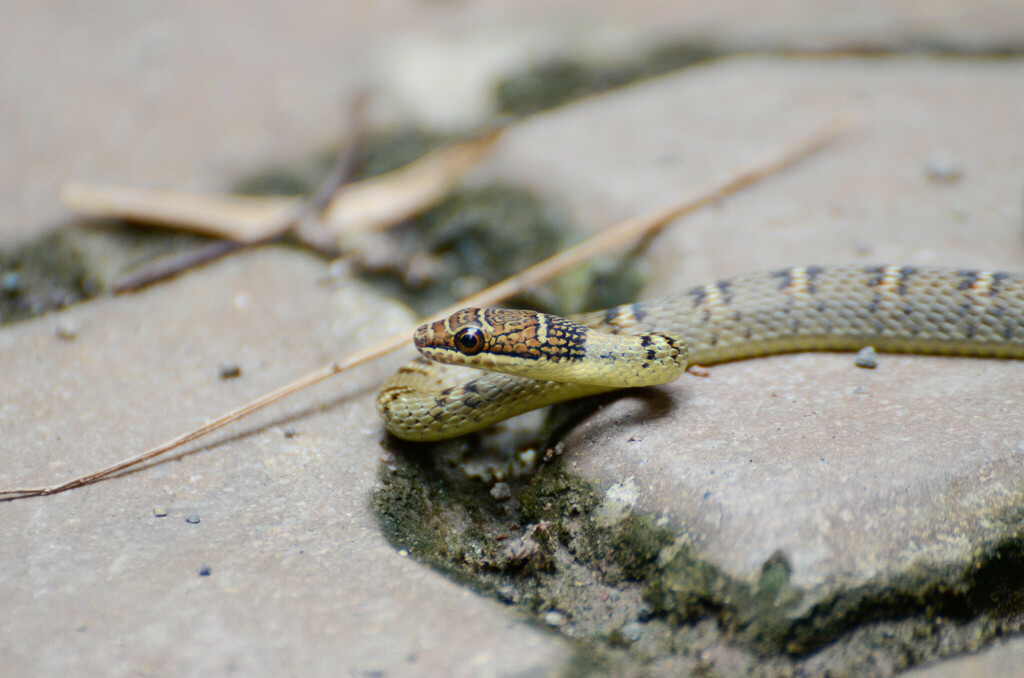
Banded Flying Snake
Chrysopelea pelias
Least Concern
Banded Flying Snake (Chrysopelea pelias). Its conservation status is Least Concern.
The banded flying snake, Chrysopelea pelias, is a sleek, arboreal colubrid draped in twin dark bars that flash across its glossy, olive-green scales as it darts among the humid canopies of Southeast Asia. Its elongated body, capable of expanding laterally by uncurling its ribs, transforms into a thin, aerodynamic ribbon that lets the snake glide up to a hundred metres from the treetop, a feat shared by all members of its genus. In the moist forests of Indonesia, Malaysia, Brunei, Singapore, Thailand, and Myanmar, it spends its days perched on low branches, scanning for prey, and its nights coiled around foliage, ready to launch into the night sky. An oviparous species, the female deposits a clutch of eggs in hidden leaf litter, where the warm, damp microclimate ensures successful incubation. Beyond its remarkable gliding, the twin-barred tree snake displays a curious launch posture: it leaps upward in a distinctive, almost upright stance that differs from other limbless vertebrates, hinting at an evolutionary stepping-stone toward aerial locomotion. Though it shares its range with the more common paradise tree snake, Chrysopelea pelias remains less frequently encountered, its elusive nature adding to the mystique of a creature that silently bridges the gap between ground-bound reptiles and the airy realm of gliders.
Real recorded sounds, 11 nature games and a free Daily 5, 1v1 quiz duels, conservation wins and a safe Kids mode. Free on Feravox.