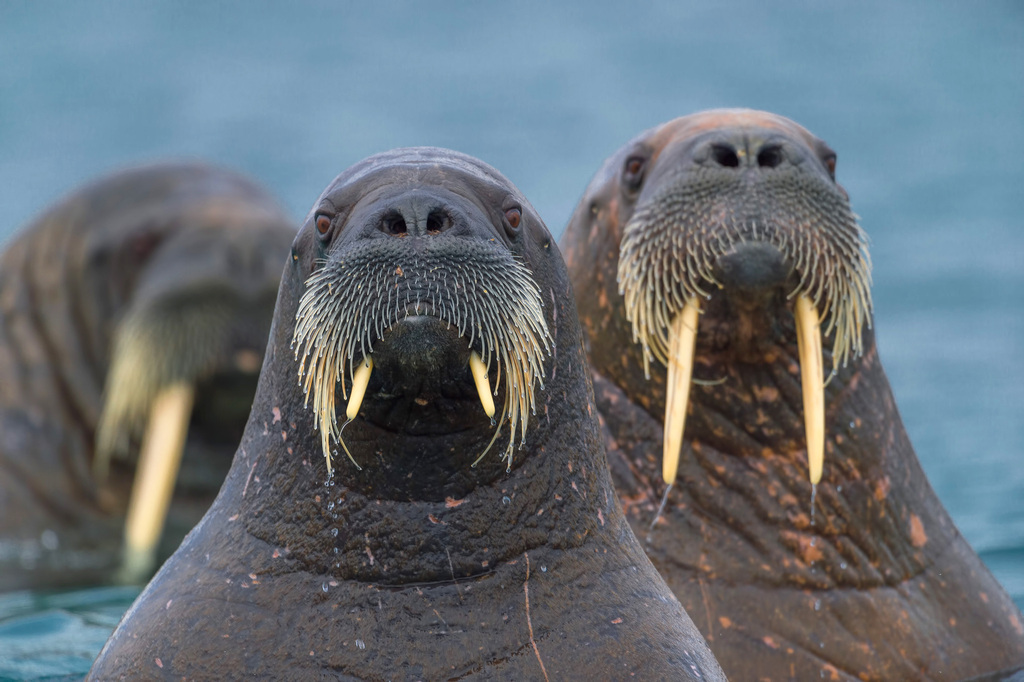
Atlantic Walrus (Odobenus rosmarus rosmarus) lives in arctic sea ice, coastal beaches across Arctic Ocean and sub-Arctic seas of the North Atlantic. Its conservation status is Near Threatened.
Fascinating facts about the Atlantic Walrus
- Atlantic bulls tip the scales at about 900 kg (2,000 lb), roughly a tenth lighter than their Pacific cousins that can top 2,000 kg (4,400 lb). Atlantic males are 10-20% smaller yet still massive, big enough to rival elephant seals.
- Walrus tusks can grow up to a full metre (3 ft 3 in) and weigh as much as 5.4 kg (12 lb), with males sporting slightly longer, thicker versions. They break through up to 20 cm of ice and act as levers for hauling the animal onto floes.
- A walrus's whisker carpet holds 400-700 stiff vibrissae arranged in 13-15 rows, each up to 30 cm (12 in) long. Packed with nerves and blood vessels, they can feel objects as thin as 3 mm and as narrow as 2 mm, letting the animal sift through the dark seafloor for clams without seeing them.
- Female walruses give birth only every two years because ovulation is halted until the calf is fully weaned. With a gestation of 15-16 months and calves weighing 45-75 kg at birth, this makes the walrus the pinniped with the lowest reproductive rate.
- After centuries of commercial hunting that drove numbers down, Atlantic walrus groups remain fragmented and far below historic levels. Although protections have allowed some rebound, today the Atlantic subspecies exists in scattered, low-density colonies.
Sources
Every fact above was checked against these pages, and kept only where one of them states it.
At a glance
RangeArctic Ocean and sub-Arctic seas of the North Atlantic
HabitatArctic sea ice, coastal beaches
DietClams, mussels, and other benthic invertebrates
About the Atlantic Walrus
On Arctic beaches where the wind cuts like a blade, Atlantic walruses pile together by the thousand, a mass of tusks and blubber that seems almost prehistoric. These deep-diving giants use sensitive whiskers to detect clams hidden in total darkness on the seafloor. As sea ice vanishes, their ancient rhythms of life are being forced onto shrinking shores.
Common questions
What does the Atlantic Walrus eat?
Diet: clams, mussels, and other benthic invertebrates.
Where does the Atlantic Walrus live?
Habitat: arctic sea ice, coastal beaches. Range: Arctic Ocean and sub-Arctic seas of the North Atlantic.
Is the Atlantic Walrus endangered?
The Atlantic Walrus is listed as Near Threatened on the IUCN Red List.
Hear the Atlantic Walrus, and 4,400+ more
Real recorded sounds, 11 nature games and a free Daily 5, 1v1 quiz duels, conservation wins and a safe Kids mode. Free on Feravox.
Atlantic Walrus photographed on Feravox
More ocean life to discover