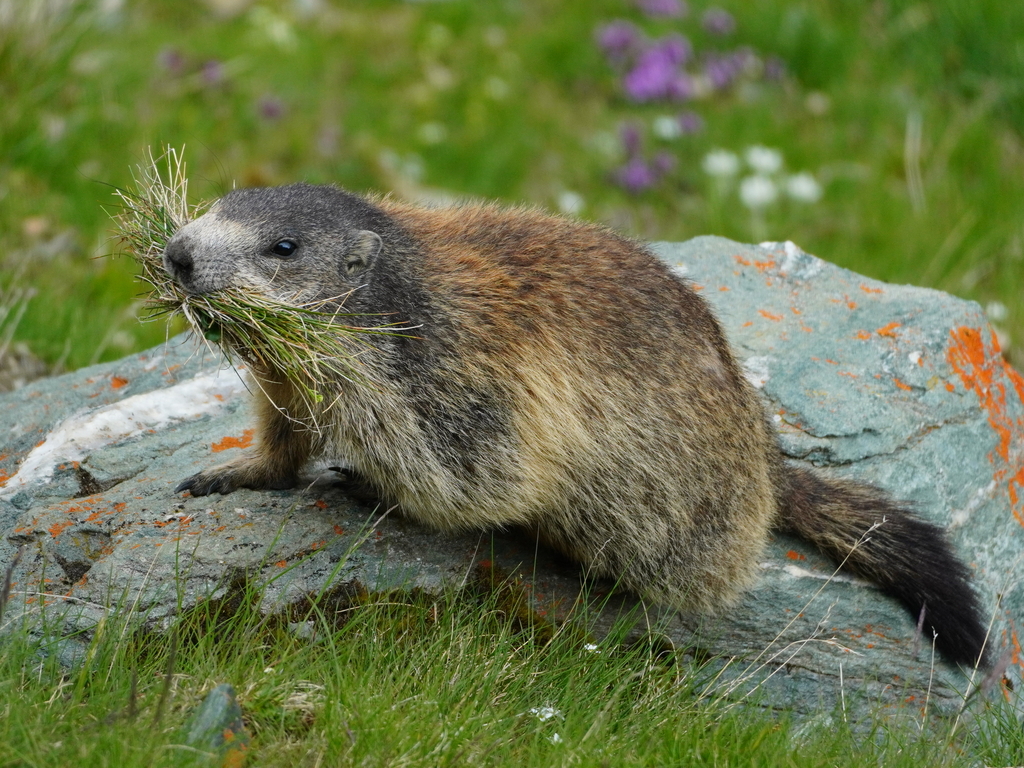
Alpine Marmot (Marmota marmota) lives in alpine mountain meadows across Central European mountains. It feeds on grass and leaves. Its conservation status is Least Concern.
Fascinating facts about the Alpine Marmot
- Alpine marmots cling to Europe's highest pastures, thriving between 800 m and 3,200 m (2,600-10,500 ft) across the Alps, Carpathians, Tatras and Northern Apennines. After vanishing at the end of the Pleistocene, they were re-introduced in 1948 to the Pyrenees, where they have re-established successfully. This altitude-locked niche ties their fate to shrinking alpine meadows as climate warms.
- Born of a cold-steppe ancestor, the alpine marmot endured a severe genetic bottleneck during its Alpine colonisation, losing most of its genetic diversity. Scientists now rank it among the least genetically diverse wild mammals, a legacy of its Ice-Age adaptation that slowed genomic change.
- An adult alpine marmot measures 43-73 cm (17-29 in) in body length with a 13-20 cm (5-8 in) tail, and its weight swings dramatically with the seasons, from a lean 1.9 kg after spring emergence to a hefty 8 kg before hibernation. In the fall, males average 4,540 g and females 4,355 g, while spring weights drop to about 3,000 g for males and 2,900 g for females. This seasonal fat gain fuels the nine-month winter fast and illustrates how tightly their physiology is tuned to alpine cycles.
- When winter bites, alpine marmots hunker in deep burrows, slashing their heart rate to five beats per minute and breathing just 1-3 breaths per minute. Their body temperature can plunge from a warm 97 °F to a frigid 5 °F, matching the surrounding air. Huddling together creates passive heat exchange, and larger groups enjoy higher survival odds. These extreme physiological slow-downs let a single fat reserve last the entire season, but younger individuals often run out of energy and starve.
- Alpine marmots live in tight-knit family colonies of 15-20 individuals, each centered on a dominant breeding pair. Their burrow systems stretch 8-10 ft, ending in a spacious den where the whole group huddles through winter. Colonies defend territories with loud whistles and scent marking, and each adult helps regulate the nest's temperature by cuddling the young. In the wild they can live 15-18 years, a long lifespan for a rodent that underscores the importance of protecting multi-generational family sites.
Sources
Every fact above was checked against these pages, and kept only where one of them states it.
At a glance
RangeCentral European mountains
HabitatAlpine mountain meadows
DietGrass and leaves
About the Alpine Marmot
In the majestic expanse of the Alpine meadows, the marmot reigns as a whimsical monarch, its shrill whistle piercing the crisp mountain air as it scurries with purpose, its sturdy legs propelling it across the rocky terrain with an endearing awkwardness. With a twitch of its fluffy tail and a flick of its ear, the marmot navigates its kingdom, ever vigilant for the telltale signs of predators lurking in the shadows. As it pauses to survey its surroundings, the marmot's bright, inquisitive eyes sparkle with a deep connection to this breathtaking landscape, a true embodiment of the unfettered joy of wild existence.
Hear the Alpine Marmot, and 4,400+ more
Real recorded sounds, 11 nature games and a free Daily 5, 1v1 quiz duels, conservation wins and a safe Kids mode. Free on Feravox.
Alpine Marmot photographed on Feravox