Red-billed Quelea: a two-minute wildlife lesson
This little seed-eater is thought to be the most numerous wild bird on Earth. After breeding, its numbers may peak at about 1.5 billion.
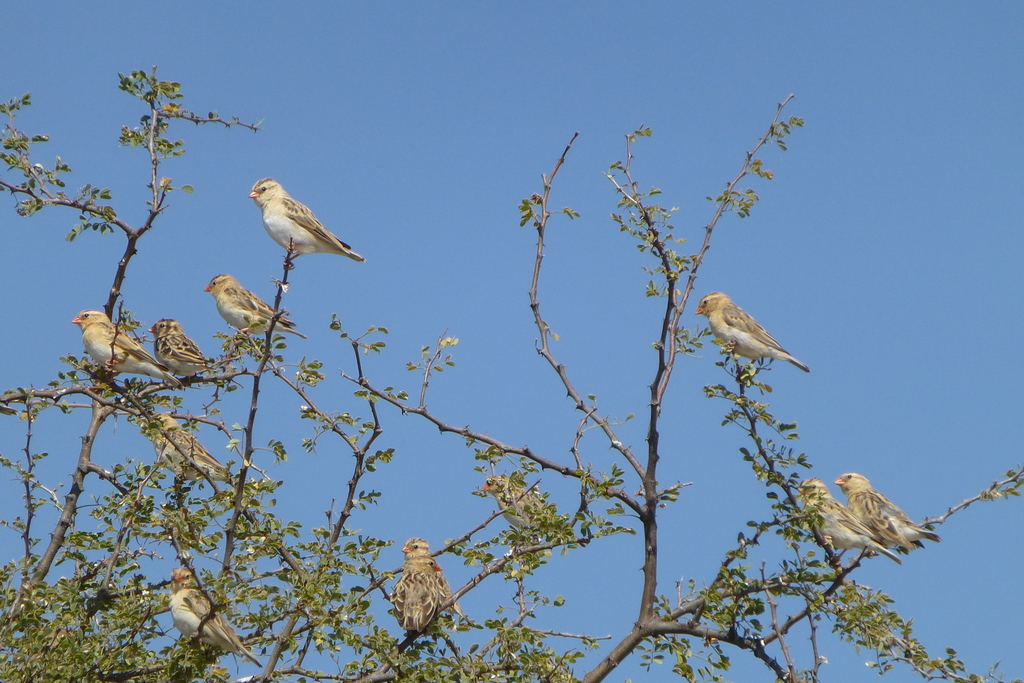
Birds of Asia, Africa and Australia · day 2 of 7
Five facts
- This little seed-eater is thought to be the most numerous wild bird on Earth. After breeding, its numbers may peak at about 1.5 billion.
- A feeding flock looks like a rolling cloud: birds at the back keep hopping over those in front to reach the next patch of seeds.
- The male weaves a ball-shaped nest from six to seven hundred strips of fresh grass. Once he has won a female, it can be finished in two days.
- Its colonies can hold millions of nests. More than 6,000 nests have been counted in just one tree.
- It breeds in a rush: the eggs hatch after nine or ten days, and the chicks leave the nest at about two weeks old.
The quiz
1. About how many red-billed queleas may there be after the breeding season?
- About 15,000
- About 2 million
- About 150
- About 1.5 billion (correct)
Its numbers may peak at an estimated 1.5 billion birds.
2. How does a flock move while it feeds?
- It stays still and waits for seeds to blow in
- Birds at the back hop over those in front (correct)
- Each bird feeds alone, far from the others
- It follows one leader in a single line
Birds at the rear keep leapfrogging the front, like a rolling cloud.
3. About how many grass strips go into one quelea nest?
- Six to seven hundred (correct)
- Five to ten
- About fifty
- Around ten thousand
Each nest uses about six to seven hundred fresh grass strips.
4. How many quelea nests have been counted in a single tree?
- About 10
- About 60
- More than 6,000 (correct)
- Just one
Over 6,000 nests have been counted in one tree.
5. How long do quelea eggs take to hatch?
- About two months
- Nine or ten days (correct)
- Six weeks
- One day
Incubation takes nine or ten days, one of the shortest cycles in birds.
More about the Red-billed Quelea
Same week
Today’s lesson is waiting
Two minutes a day, a new wild animal. Free on iPhone, Android and the web.
Hear them, don't just read about them
Feravox is a free wildlife app: 4,400+ species with real recorded sounds, 11 nature games and a free Daily 5, 1v1 quiz duels, conservation wins, and a safe Kids mode.