Feravox · The Voice of the Wild
Indigo Bunting: a two-minute wildlife lesson
Indigo buntings often migrate at night and steer by the stars. In tests under a planetarium sky, they still chose the right direction.
Bright Little Birds · day 6 of 7
Five facts
- Indigo buntings often migrate at night and steer by the stars. In tests under a planetarium sky, they still chose the right direction.
- They don't need one special star. When scientists took away the Big Dipper or the North Star, the birds were hardly bothered.
- Most of them fly straight across the Gulf of Mexico, a trip of about 966 km from Florida. A bunting of 18 g or more could do it without stopping.
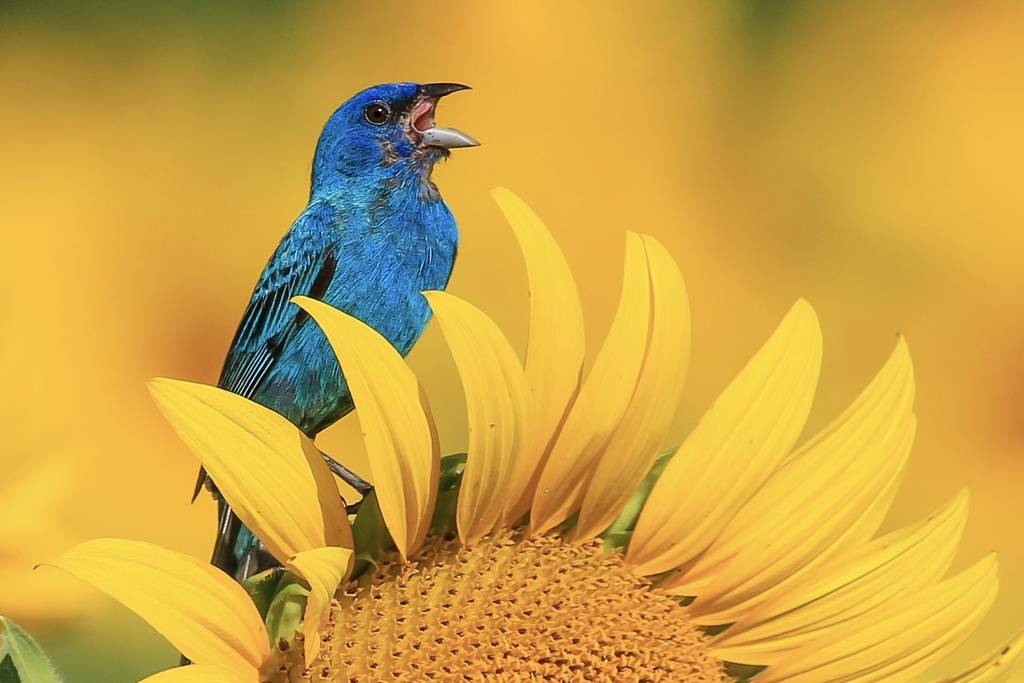
- The male is bright blue only in summer. In autumn his new feathers have brown edges that overlap, so he looks mostly brown all winter.
- This little bird rarely drinks. It usually gets all the water it needs from the seeds, insects and berries it eats.
The quiz
1. What do indigo buntings use to find their way when migrating at night?
- The stars (correct)
- The smell of the sea
- Car headlights
- The sound of rivers
They often migrate at night and use the stars to navigate.
2. What happened when the Big Dipper or the North Star was removed from their sky?
- They flew in circles
- They stopped migrating for good
- They were hardly affected (correct)
- They flew north instead
Removing those stars had minimal effect, so they do not rely on single stars.
3. How far is the flight across the Gulf of Mexico from Florida?
- About 10 km
- About 966 km (correct)
- About 50 km
- About 20,000 km
The trip across the Gulf from Florida is about 966 km.
4. What colour does the male look in winter?
- Bright red
- Pure white
- Bright yellow
- Mostly brown (correct)
Brown feather edges overlap and make him look mostly brown.
5. Where does the indigo bunting get most of its water?
- From snow
- From morning dew only
- From its food (correct)
- From drinking every hour
It rarely drinks and gets enough water from its diet.
Same week
Today’s lesson is waiting
Two minutes a day, a new wild animal. Free on iPhone, Android and the web.
Hear them, don't just read about them
Feravox is a free wildlife app: 4,400+ species with real recorded sounds, 11 nature games and a free Daily 5, 1v1 quiz duels, conservation wins, and a safe Kids mode.
Nature documentaries
Blue Planet III2026 · BBC OnePlanet Earth III2023 · BBC OneBlue Planet II2017 · BBC OnePlanet Earth II2016 · BBC OneFrozen Planet II2022 · BBC OneSeven Worlds, One Planet2019 · BBC OneMammals2024 · BBC OneSecret Garden2026 · BBC OneWild Isles2023 · BBC OneOur Planet2019 · NetflixOur Planet II2023 · NetflixThe Blue Planet2001 · BBC One