Feravox · The Voice of the Wild
Indian Rhinoceros: a two-minute wildlife lesson
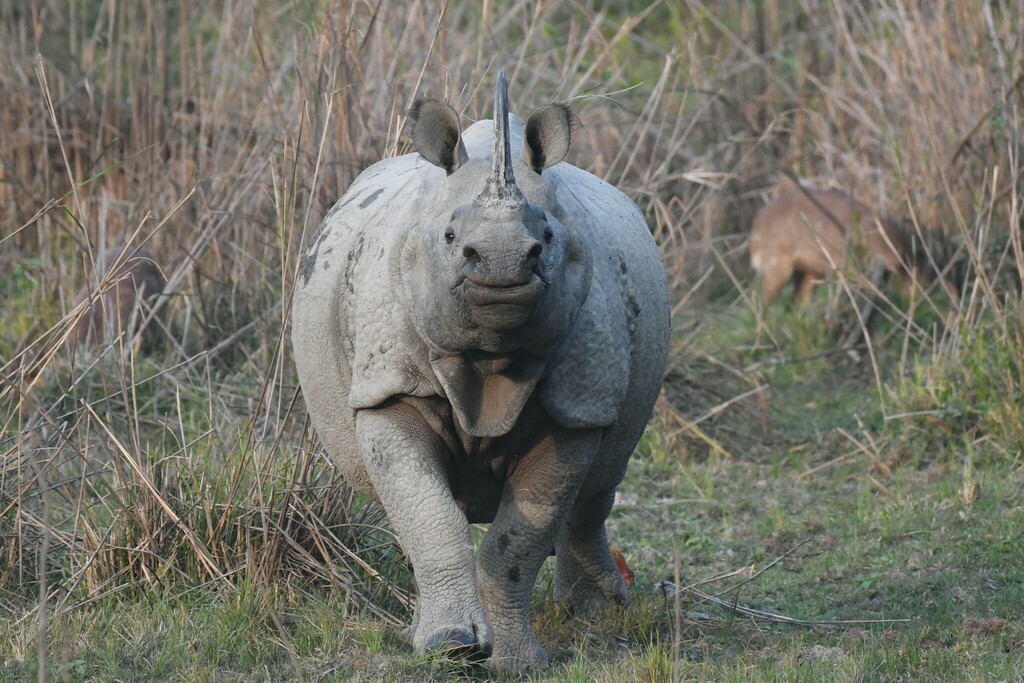
Its armour-like skin folds look pink because of the many blood vessels beneath. The folds help it control its body temperature.
Hooves and Horns · day 3 of 7
Five facts
- Its armour-like skin folds look pink because of the many blood vessels beneath. The folds help it control its body temperature.
- Newborn calves have no horn. It is made of pure keratin, like our nails, and only starts to show after about six years.
- Grass too tall to reach? The rhino walks right over it and uses its weight to bend it down to its mouth. Mothers do this for their calves.
- Rhinos are chatty. Scientists have noted at least 10 different calls, including honks, bleats, roars, shrieks and moo-grunts.
- Heavy but quick: this rhino is an excellent swimmer and can run at up to 55 km/h for short bursts.
The quiz
1. What gives the rhino's skin folds their pink colour?
- Pink mud
- Blood vessels underneath (correct)
- Sunburn
- Flowers it eats
Many blood vessels under the folds make them look pinkish.
2. When does an Indian rhino's horn start to show?
- At birth
- After one week
- After about six years (correct)
- Only in old age
Calves are born without a horn; it shows after about six years.
3. How does a rhino eat grass that is too tall?
- It walks over it to bend it down (correct)
- It waits for the wind
- It rears up on its back legs
- It asks a calf to pull it
It straddles the plant and pushes it down with its body weight.
4. How many different calls have scientists noted in Indian rhinos?
- Only 1
- Exactly 2
- None, they are silent
- At least 10 (correct)
At least 10 distinct calls have been identified, from snorts to moo-grunts.
5. How fast can an Indian rhino run for a short time?
- Up to 5 km/h
- Up to 55 km/h (correct)
- Up to 150 km/h
- Up to 300 km/h
It can reach 55 km/h for short periods.
More about the Indian Rhinoceros
Same week
Today’s lesson is waiting
Two minutes a day, a new wild animal. Free on iPhone, Android and the web.
Hear them, don't just read about them
Feravox is a free wildlife app: 4,400+ species with real recorded sounds, 11 nature games and a free Daily 5, 1v1 quiz duels, conservation wins, and a safe Kids mode.
Nature documentaries
Blue Planet III2026 · BBC OnePlanet Earth III2023 · BBC OneBlue Planet II2017 · BBC OnePlanet Earth II2016 · BBC OneFrozen Planet II2022 · BBC OneSeven Worlds, One Planet2019 · BBC OneMammals2024 · BBC OneSecret Garden2026 · BBC OneWild Isles2023 · BBC OneOur Planet2019 · NetflixOur Planet II2023 · NetflixThe Blue Planet2001 · BBC One