Feravox · The Voice of the Wild
Eared Grebe: a two-minute wildlife lesson
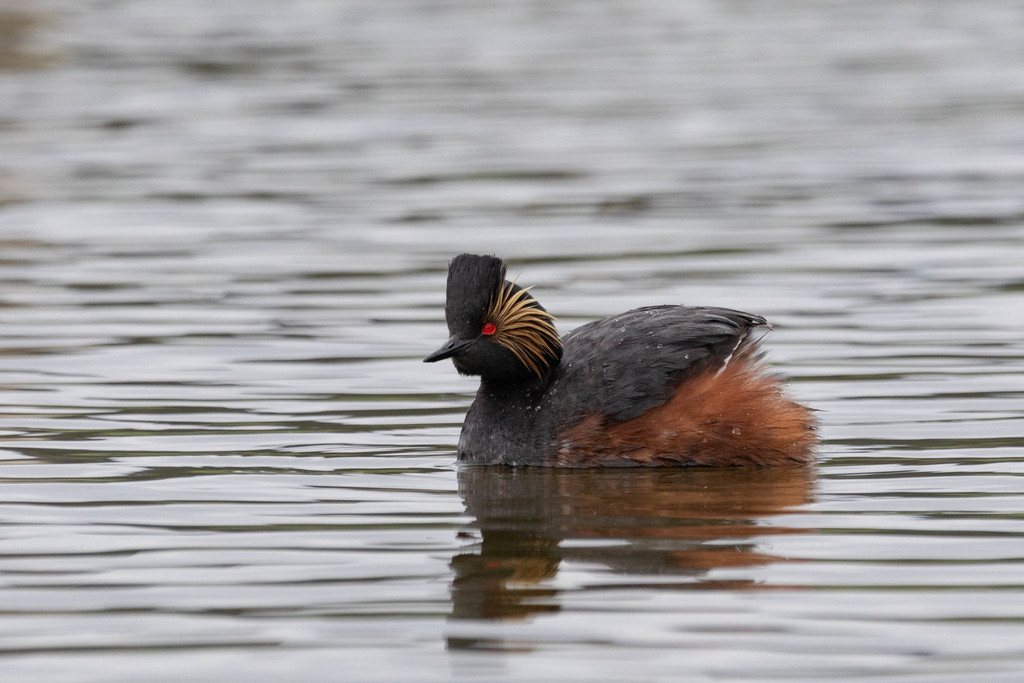
In breeding season it sports golden plumes on either side of its head, which gave it the name "eared grebe". Its neck turns all black.
On the Lake · day 2 of 7
Five facts
- In breeding season it sports golden plumes on either side of its head, which gave it the name "eared grebe". Its neck turns all black.
- Its nest floats on the lake, tied to water plants. Most of it sits underwater, with the bottom of the cup level with the surface.
- Newly hatched chicks can already swim, but they mostly ride on their parents' backs for four days. Later, each parent takes care of half the brood.
- On very salty lakes it feasts on brine shrimp. It probably presses them against the roof of its mouth to squeeze out the extra water.
- It is a poor flier and avoids flying whenever it can. Yet when it migrates, it can travel as far as 6,000 km to reach rich feeding areas.
The quiz
1. Why is it called the "eared" grebe?
- It has very large ears
- It has golden plumes on each side of its head (correct)
- It can hear fish underwater
- It flaps its head when it swims
In breeding plumage it shows a golden spray of plumes on each side of the head.
2. Where does the eared grebe build its nest?
- High in a tree
- In a hole in a bank
- Floating on the lake, anchored to plants (correct)
- On a rocky cliff
Its floating nest is anchored to the lake by plants.
3. Where do newly hatched grebe chicks spend most of their first four days?
- On their parents' backs (correct)
- Alone in the nest
- Under a rock
- On the shore
They rarely swim at first and stay on their parents' backs for four days.
4. What does the grebe mostly eat on very salty lakes?
- Seaweed
- Large fish
- Seeds
- Brine shrimp (correct)
When moulting on salty lakes, it feeds mostly on brine shrimp.
5. How far can an eared grebe travel on migration?
- Up to 6,000 km (correct)
- Only 5 km
- About 100 m
- It never migrates
Although it hates flying, it can cover as much as 6,000 km when migrating.
Same week
Today’s lesson is waiting
Two minutes a day, a new wild animal. Free on iPhone, Android and the web.
Hear them, don't just read about them
Feravox is a free wildlife app: 4,400+ species with real recorded sounds, 11 nature games and a free Daily 5, 1v1 quiz duels, conservation wins, and a safe Kids mode.
Nature documentaries
Blue Planet III2026 · BBC OnePlanet Earth III2023 · BBC OneBlue Planet II2017 · BBC OnePlanet Earth II2016 · BBC OneFrozen Planet II2022 · BBC OneSeven Worlds, One Planet2019 · BBC OneMammals2024 · BBC OneSecret Garden2026 · BBC OneWild Isles2023 · BBC OneOur Planet2019 · NetflixOur Planet II2023 · NetflixThe Blue Planet2001 · BBC One