Feravox · The Voice of the Wild
Common Collared Lizard: a two-minute wildlife lesson
To escape a predator, the collared lizard can rear up and sprint on its hind legs, at speeds of around 26 km/h.
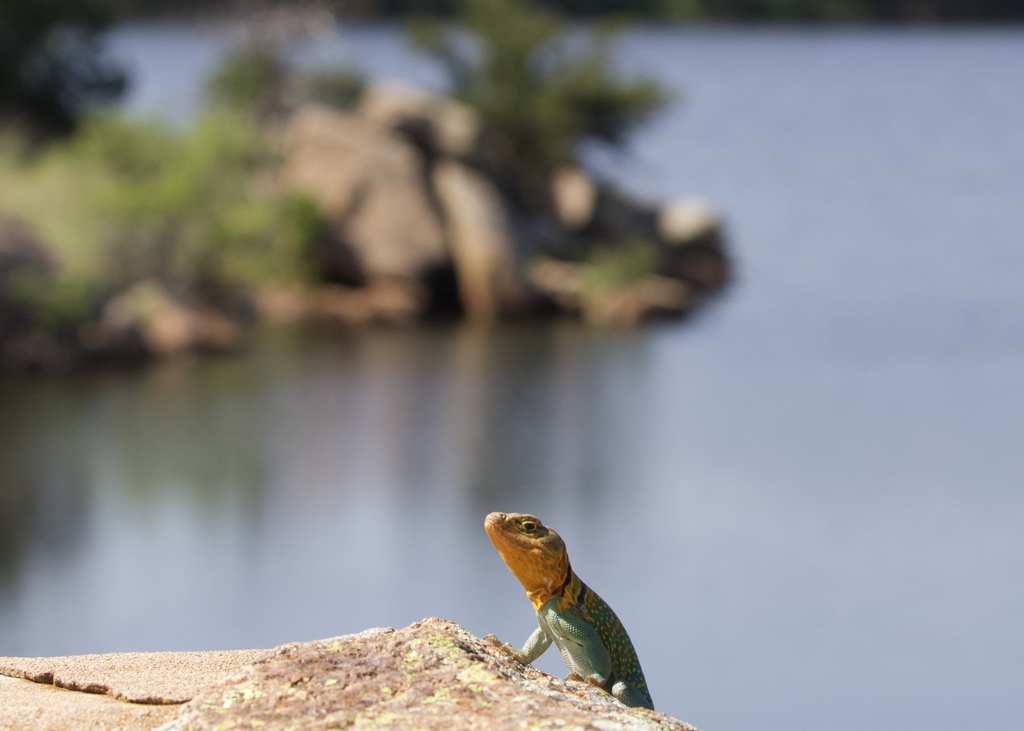
Lizards · day 7 of 7
Five facts
- To escape a predator, the collared lizard can rear up and sprint on its hind legs, at speeds of around 26 km/h.
- Its name comes from the black bands around its neck and shoulders, which look just like a collar.
- In Oklahoma it is called the mountain boomer, maybe after canyon winds people mistook for an animal's call. In fact, this lizard makes no sound.
- A male treats his next-door neighbours calmly, but he chases a stranger off his territory straight away.
- When a female is carrying eggs, faint orange spots on her head grow bright, then fade again after she lays them.
The quiz
1. How does a collared lizard often run from predators?
- By rolling into a ball
- On its hind legs (correct)
- By gliding from rocks
- By swimming away
It can sprint on its hind legs to escape predators.
2. Where does the collared lizard's name come from?
- Its habit of wearing leaves
- Black bands around its neck (correct)
- A scientist named Collard
- A frill that pops open
Black bands around its neck and shoulders look like a collar.
3. What sound does the mountain boomer really make?
- A loud boom
- A high whistle
- None: it is silent (correct)
- A deep croak
Despite the name, collared lizards are silent.
4. How does a male collared lizard react to a stranger on his territory?
- He ignores it
- He shares his food
- He leaves his territory
- He is hostile right away (correct)
He is calmer with neighbours but hostile to strangers without hesitation.
5. What happens to a female's orange head spots while she carries eggs?
- They grow brighter (correct)
- They turn blue
- They disappear for good
- They spread to her tail
The spots brighten, then fade after she lays her eggs.
Same week
Today’s lesson is waiting
Two minutes a day, a new wild animal. Free on iPhone, Android and the web.
Hear them, don't just read about them
Feravox is a free wildlife app: 4,400+ species with real recorded sounds, 11 nature games and a free Daily 5, 1v1 quiz duels, conservation wins, and a safe Kids mode.
Nature documentaries
Blue Planet III2026 · BBC OnePlanet Earth III2023 · BBC OneBlue Planet II2017 · BBC OnePlanet Earth II2016 · BBC OneFrozen Planet II2022 · BBC OneSeven Worlds, One Planet2019 · BBC OneMammals2024 · BBC OneSecret Garden2026 · BBC OneWild Isles2023 · BBC OneOur Planet2019 · NetflixOur Planet II2023 · NetflixThe Blue Planet2001 · BBC One