Feravox · The Voice of the Wild
Black Mamba: a two-minute wildlife lesson
The black mamba is not actually black. Its name comes from the inside of its mouth, which it shows when it feels threatened.
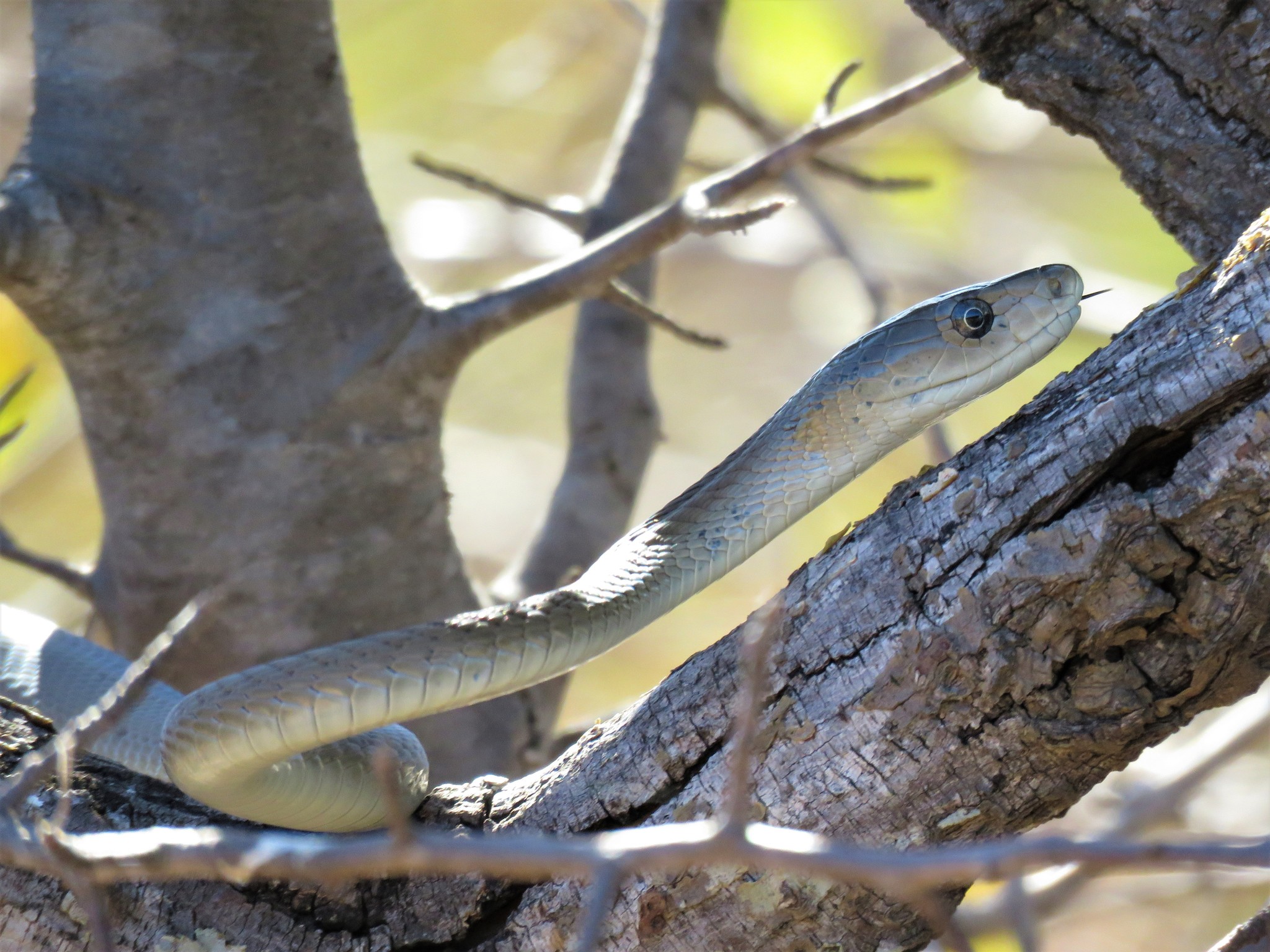
Snakes · day 2 of 7
Five facts
- The black mamba is not actually black. Its name comes from the inside of its mouth, which it shows when it feels threatened.
- Among venomous snakes, only the king cobra is longer than the black mamba, which is the longest in Africa.
- A black mamba can sprint at up to 16 km/h across open ground, though only in brief bursts.
- On the ground it travels with head and neck held up. It hides in termite mounds, old burrows, rock cracks and holes in trees.
- A female lays 6 to 17 eggs. The young may grow fast, reaching 2 m after their first year.
The quiz
1. Where does the black mamba's name come from?
- Its black scales
- The inside of its mouth (correct)
- Its black eyes
- Its night hunting
Its name refers to the dark inside of its mouth, which it shows when it feels threatened.
2. Which venomous snake is longer than the black mamba?
- The king cobra (correct)
- The Egyptian cobra
- The puff adder
- None, it is the longest
Among venomous snakes, only the king cobra is longer.
3. How fast can a black mamba sprint over open ground?
- Up to 60 km/h
- Up to 6 km/h
- Up to 100 km/h
- Up to 16 km/h (correct)
It can sprint at up to 16 km/h, though only for brief bursts.
4. Where does a black mamba shelter?
- In termite mounds, burrows and rock crevices (correct)
- In hollow logs only
- On the open sand
- In deep lakes
It shelters in termite mounds, old burrows, rock cracks and holes in trees.
5. How long can a young black mamba be after its first year?
- 20 cm
- 10 m
- 2 m (correct)
- 6 m
Hatchlings may grow quickly, reaching 2 m after their first year.
Same week
Today’s lesson is waiting
Two minutes a day, a new wild animal. Free on iPhone, Android and the web.
Hear them, don't just read about them
Feravox is a free wildlife app: 4,400+ species with real recorded sounds, 11 nature games and a free Daily 5, 1v1 quiz duels, conservation wins, and a safe Kids mode.
Nature documentaries
Blue Planet III2026 · BBC OnePlanet Earth III2023 · BBC OneBlue Planet II2017 · BBC OnePlanet Earth II2016 · BBC OneFrozen Planet II2022 · BBC OneSeven Worlds, One Planet2019 · BBC OneMammals2024 · BBC OneSecret Garden2026 · BBC OneWild Isles2023 · BBC OneOur Planet2019 · NetflixOur Planet II2023 · NetflixThe Blue Planet2001 · BBC One