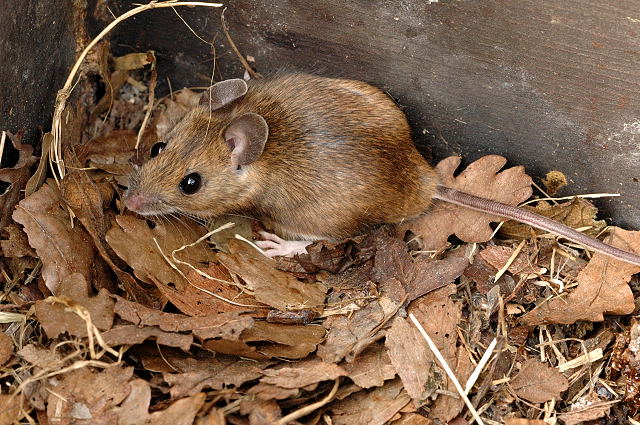
Yellow-necked Field Mouse (Apodemus flavicollis) lives in temperate forests across Europe and Asia. It feeds on seeds and insects. Its conservation status is Least Concern.
Fascinating facts about the Yellow-necked Field Mouse
- The yellow-necked mouse was finally recognised as a separate species in 1894, ending decades of confusion with the wood mouse. This taxonomic split highlighted the distinctive band of yellow fur that circles its neck, a trait absent in its close relative. It also has slightly larger ears and is generally a bit bigger overall, features that help field biologists tell the two apart in the wild.
- If a predator clamps onto its tail, the mouse's tail skin readily detaches and slides away, allowing it to escape the grasp. This defence works against a range of hunters, including owls, foxes and weasels that commonly prey on it. In addition to shedding its tail skin, the mouse can leap powerfully to evade attackers, giving it a further chance to flee into the surrounding vegetation.
- In parts of Eastern Europe the yellow-necked mouse can reach densities of up to a hundred individuals per hectare, indicating how common it becomes where suitable habitat exists. Its extensive range across Europe and western Asia, from mountainous woodlands to gardens, supports these high local numbers. The overall population remains stable and faces no specific threats, so the IUCN classifies the species as Least Concern on its Red List.
- The yellow-necked mouse can pass the virus that causes tick-borne encephalitis to people while remaining unaffected itself. It also serves as a natural reservoir for the Dobrava hantavirus, which can trigger severe haemorrhagic fever with renal syndrome in humans. Studies have shown the mouse transmits the encephalitis virus yet stays immune, and together with the striped field mouse it harbours the Dobrava Orthohantavirus in the wild.
Sources
Every fact above was checked against these pages, and kept only where one of them states it.
At a glance
RangeEurope and Asia
HabitatTemperate forests
DietSeeds and insects
About the Yellow-necked Field Mouse
In the whispering grasslands, the yellow-necked field mouse weaves a secret life, its tawny fur blending seamlessly with the sun-kissed landscape as it darts between hiding places with an air of quiet urgency. With each fleeting glimpse, we catch the flash of its eponymous yellow neck patch, a burst of vibrant colour that hints at the rich, hidden world of this diminutive but resilient creature. As it navigates the intricate network of field and forest, the yellow-necked field mouse embodies a delicate balance of stealth and curiosity, its very existence a testament to the enduring beauty of the natural world.
Hear the Yellow-necked Field Mouse, and 4,400+ more
Real recorded sounds, 11 nature games and a free Daily 5, 1v1 quiz duels, conservation wins and a safe Kids mode. Free on Feravox.