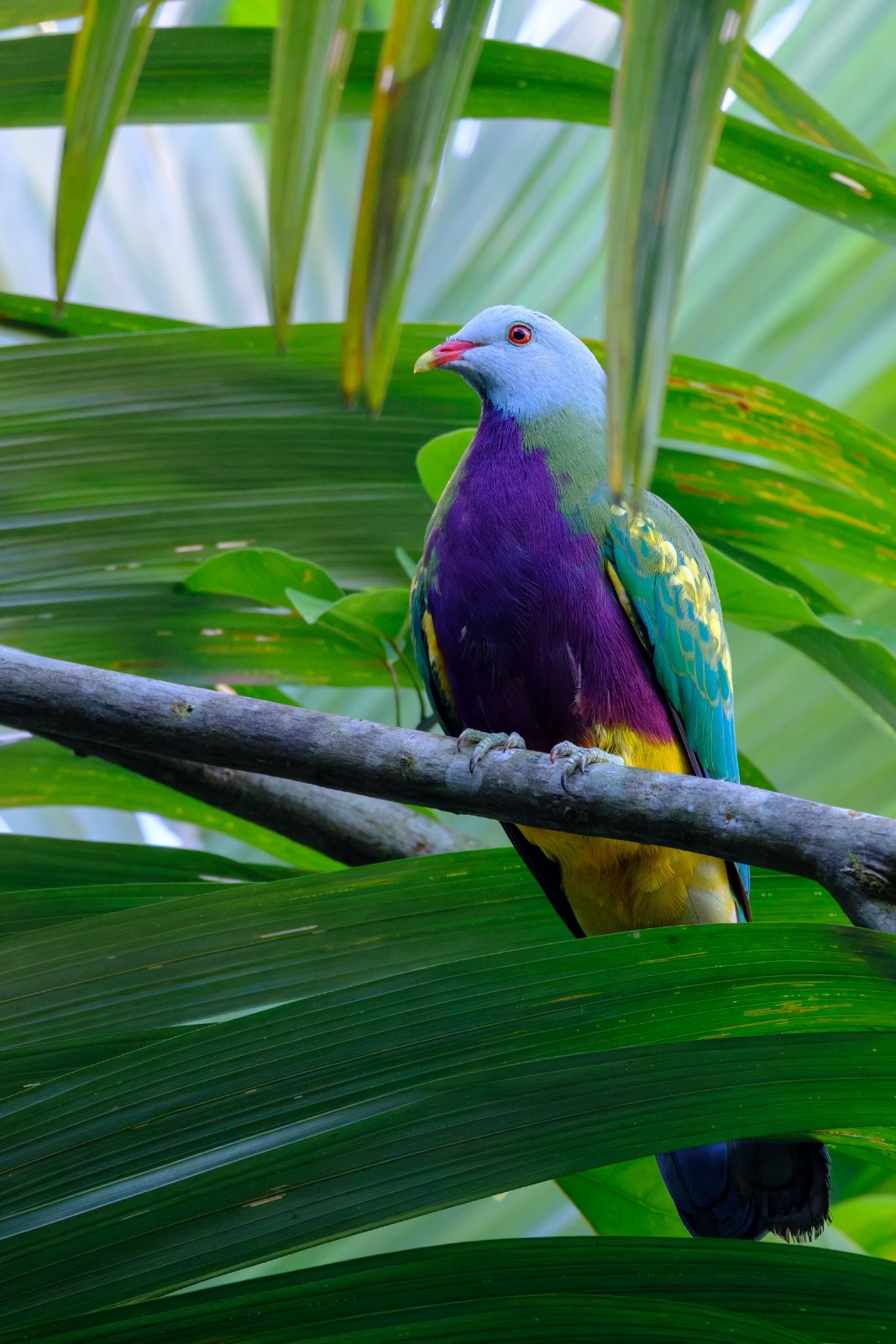
Wompoo Fruit Dove (Ptilinopus magnificus) lives in tropical rainforest canopy across Eastern Australia. It feeds on fruits, figs, and berries. Its conservation status is Least Concern.
Fascinating facts about the Wompoo Fruit Dove
- At up to 45 cm (18 in) long, the wompoo fruit dove still slips through the rainforest canopy unnoticed thanks to its quiet habits. Its striking purple neck, chest and upper belly contrast with a yellow lower belly and green underparts, yet the bird remains hard to spot among leaves. The species was first described in 1821 by Dutch zoologist Coenraad Jacob Temminck, who originally placed it in the genus Columba. A 2014 molecular study reshuffled its classification, moving it from Ptilinopus to the genus Megaloprepia.
- When fruit is plentiful, wompoo fruit doves gather in large flocks, each bird capable of swallowing a spherical fruit about 2 cm (0.79 in) in diameter, roughly the size of a marble. Researchers measured this as a fruit volume of 5 cm³ (0.31 cu in). Their diet leans heavily on figs such as Ficus macrophylla, especially from October through March, the late dry and wet seasons. They also take palm fruits, cinnamon-tree berries, and occasional insects.
- Both male and female wompoo fruit doves share nest building duties, using forked twigs to construct a sturdy platform not far above the ground. The pair lays a single white egg, and both parents incubate and care for the chick. If the first chick perishes, the duo will attempt a second brood within the same breeding season.
- The wompoo fruit dove enjoys a broad distribution from the Raja Ampat Islands of northwest New Guinea to central south New South Wales in Australia, occupying diverse rainforest zones. Five subspecies are recognised, each tied to specific islands or coastal regions, such as M. m. puella on the Raja Ampat Islands and M. m. magnifica from southeast Queensland to central south New South Wales.
- Despite its vivid plumage, the wompoo fruit dove is listed as Least Concern on the IUCN Red List, reflecting its widespread and common status across a large range. Its diet shifts with seasonal fruit availability. The species relies on fruiting trees.
Sources
Every fact above was checked against these pages, and kept only where one of them states it.
At a glance
RangeEastern Australia
HabitatTropical rainforest canopy
DietFruits, figs, and berries
About the Wompoo Fruit Dove
The Wompoo Fruit Dove (Ptilinopus magnificus) is a striking arboreal bird that commands attention across the rain‑forests of eastern Australia, New Guinea and the islands of the Torres Strait. Measuring up to 45 cm in length, it boasts a plush plumage of deep violet‑blue on the crown and nape, a glossy emerald back, and a broad, iridescent orange‑yellow throat that glows like sunrise through the canopy. Its large, slightly hooked bill is perfectly adapted for plucking ripe fruit from the dense foliage, while the soft, feathered legs give it a graceful, almost silent presence as it weaves among the towering trees. In the humid understory, the dove’s low, resonant coo reverberates, a call that signals both territory and the presence of abundant food, and its courtship displays involve elaborate wing‑flutters and the exchange of bright fruit offerings between mates.
Beyond its visual splendor, the Wompoo Fruit Dove plays a pivotal ecological role as a seed‑disperser, swallowing whole figs, berries and drupes and later excreting viable seeds far from the parent tree, thus shaping forest regeneration. A surprising trait lies in its ability to digest the toxic latex of certain rainforest fruits that would deter most birds, thanks to a specialized gut microbiome that neutralises the compounds. This adaptation not only expands its dietary niche but also makes the dove a critical conduit for the propagation of otherwise under‑utilised plant species, linking the health of the forest to the bird’s own survival.
Common questions
What does the Wompoo Fruit Dove eat?
Diet: fruits, figs, and berries.
Where does the Wompoo Fruit Dove live?
Range: Eastern Australia.
Is the Wompoo Fruit Dove endangered?
The Wompoo Fruit Dove is listed as Least Concern on the IUCN Red List.
Hear the Wompoo Fruit Dove, and 4,400+ more
Real recorded sounds, 11 nature games and a free Daily 5, 1v1 quiz duels, conservation wins and a safe Kids mode. Free on Feravox.
Wompoo Fruit Dove photographed on Feravox
More other animals to discover