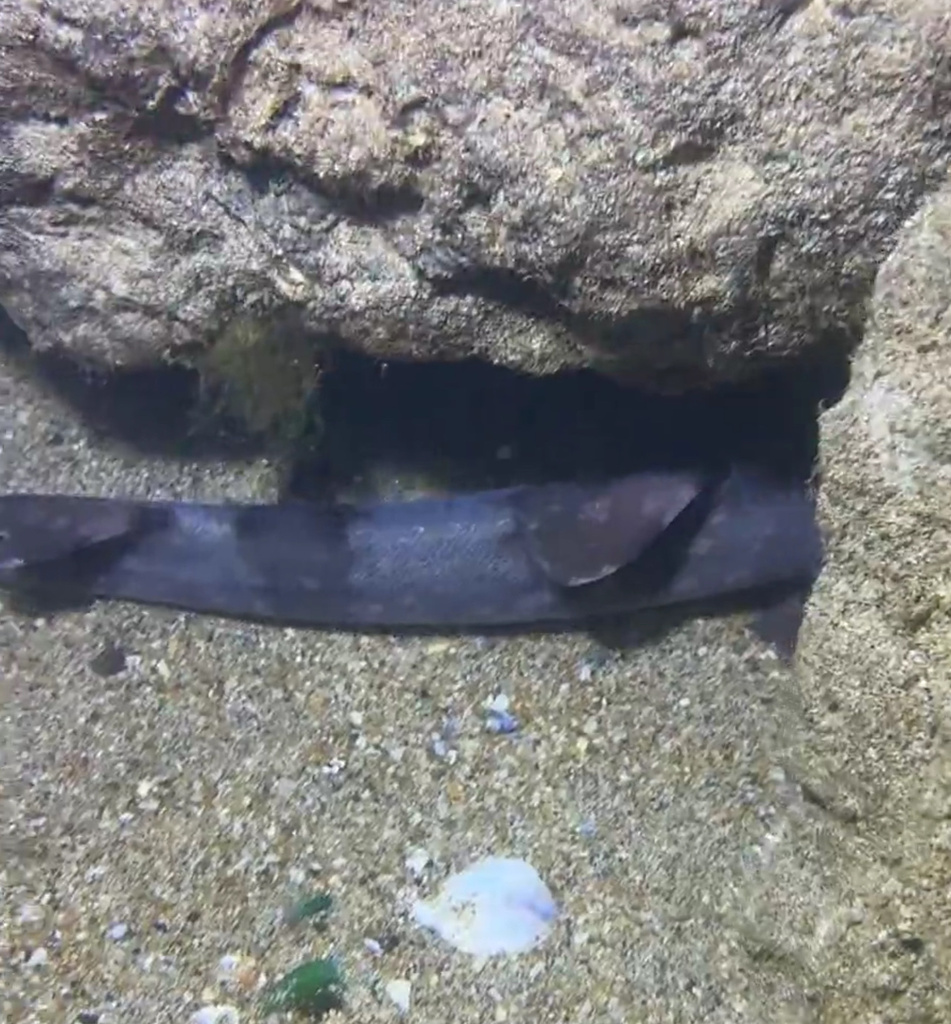
Photo: TonyT
Feravox · The Voice of the Wild
Whitespotted Bamboo Shark
Chiloscyllium plagiosum
Near Threatened
Whitespotted Bamboo Shark (Chiloscyllium plagiosum) lives in coral reef across Japan to India. It feeds on small fish and invertebrates. Its conservation status is Near Threatened.
The whitespotted bamboo shark (Chiloscyllium plagiosum) glides along Pacific coral reefs, its slender body nearing a metre in length and its skin a tapestry of purple and pink spots framed by dark bands on a stark white canvas. Its dorsal fins boast convex posterior margins, and a unique coloration noted by marine biologist Ruthie Delaney makes it instantly recognizable among carpet sharks. By day it rests on the seabed, propping its head and trunk on bent and depressed pectoral fins, while at night it becomes a stealthy predator, using tiny, medially-crowned teeth to grasp soft fish or pivot them into crushing plates for hard-shelled crabs. Electroreceptors along its snout, ampullae of Lorenzini, detect the faint electric fields of buried prey. A surprising twist in its biology emerged in July 2002 at Detroit’s Belle Isle Aquarium, where a female laid a clutch that hatched without any apparent fertilization, marking the first recorded instance of parthenogenesis in this species. The shark continues its nocturnal forays across waters from Japan to India.
Real recorded sounds, 11 nature games and a free Daily 5, 1v1 quiz duels, conservation wins and a safe Kids mode. Free on Feravox.