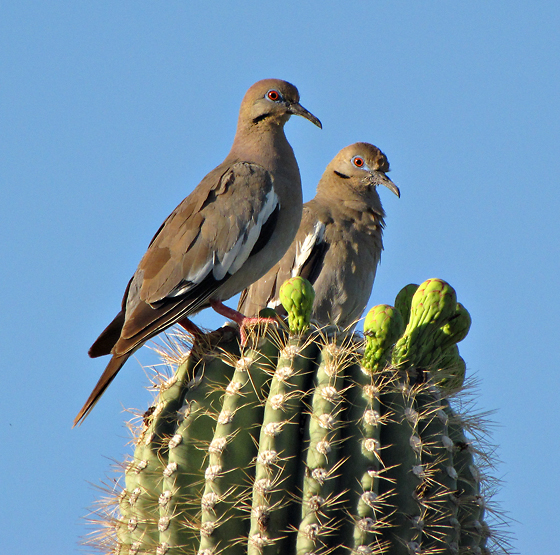
White-Winged Dove (Zenaida asiatica) lives in desert scrublands across South-western United States, Mexico, Central America, Caribbean. Its conservation status is Least Concern.
Hear the White-Winged Dove
A real field recording of the White-Winged Dove, made in the wild.
It is hunted for sport, and is the second most shot game bird in the United States. The species suffered a sharp population collapse in the 1960s and 1970s, likely because major nesting colonies were lost. After that decline the numbers rebounded and, even with ongoing habitat loss and hunting, the dove has shown a strong ability to thrive in human-altered landscapes.
Normally, up to 4 000 birds are seen migrating, but in Texas a flock of up to a million birds was recorded, dwarfing the usual groups. Their migrations in the region run from April through June, with a peak in May, and the birds depart from September to October. While some migratory gatherings can reach 4 000 individuals, most are far smaller, often fewer than 50 birds, showing how extraordinary the Texas count was.
Colonial nesting sites can be immense, ranging from 5 hectares up to well over 1 000 hectares, and they pack an extraordinary 500 to 1 000 nests into each hectare. By contrast, outside of these colonies the dove nests at a sparse density of fewer than 10 nests per hectare. This stark difference highlights how the birds concentrate in large, dense colonies when suitable habitat is available.
When water is scarce the white-winged dove will travel long distances, often flying 25 miles or more to locate a source. In the desert it can survive solely on the moisture contained in the fruit of the saguaro cactus, which it drinks directly. This dependence on cactus water ties the bird's range tightly to the distribution of the iconic cactus, especially in arid scrub and desert habitats.
The dove's call has been likened to the English phrase "who cooks for you", a description first given by David Sibley. Males perch on dedicated spots to emit the coo, and the vocalisations are most frequent during the breeding season, peaking in May and June. Calls are typically heard just before dawn or in the late afternoon, providing a distinctive soundscape in their habitats.
Sources
Every fact above was checked against these pages, and kept only where one of them states it.
RangeSouth-western United States, Mexico, Central America, Caribbean
HabitatDesert scrublands
DietSeeds and fruits
About the White-Winged Dove
As the sun rises over the arid landscape, the White-Winged Dove stirs to life, its gentle coos echoing through the desert air as it takes to the skies with a soft, rustling beat of its wings. With a effortless glide, it navigates the scrubby terrain, its pale brown plumage blending seamlessly into the dusty surroundings, yet its snowy wing bars flashing like tiny beacons as it banks and turns with an elegant, fluid motion. In this harsh yet beautiful world, the White-Winged Dove is a symbol of resilience and adaptability, thriving in a landscape that would be unforgiving to many other creatures.
Advertisement
Hear the White-Winged Dove, and 4,400+ more
Real recorded sounds, 11 nature games and a free Daily 5, 1v1 quiz duels, conservation wins and a safe Kids mode. Free on Feravox.