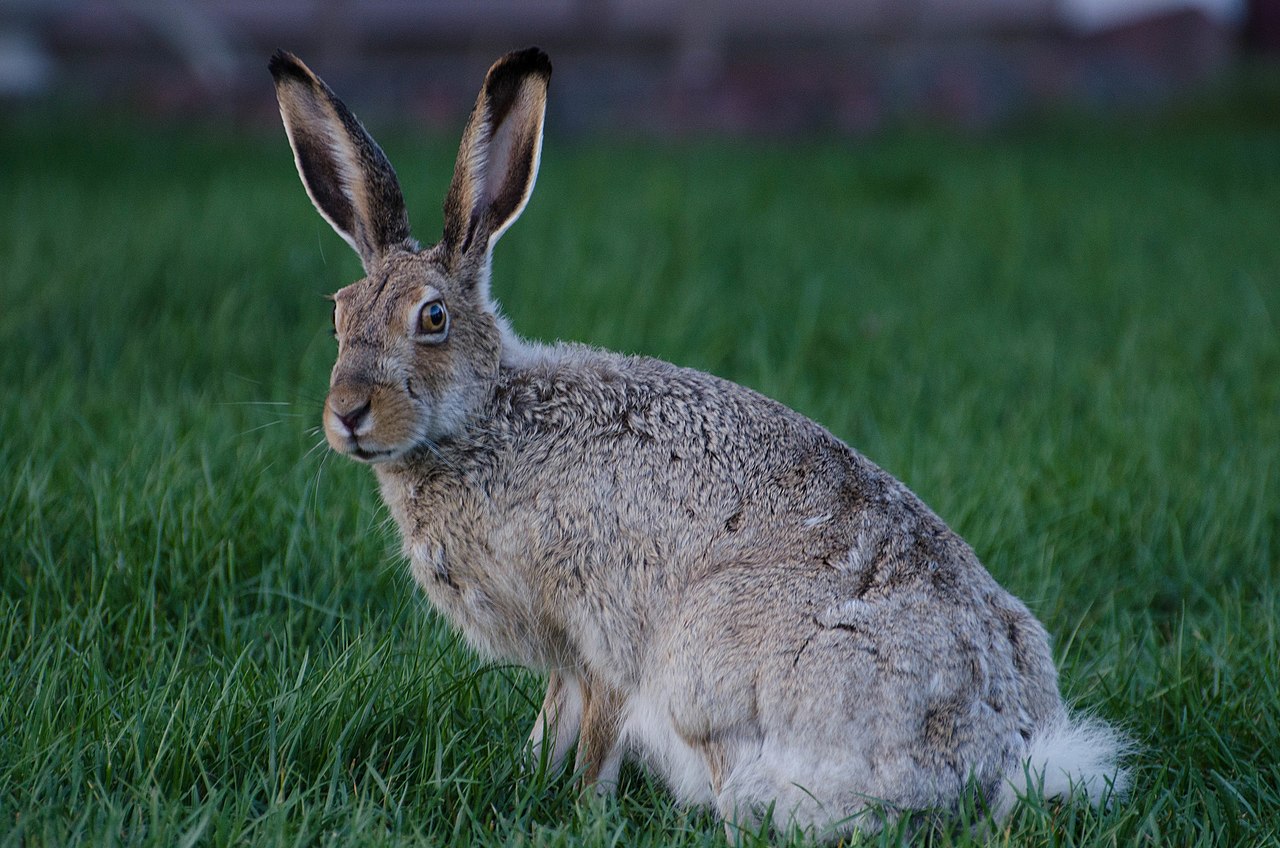
White-tailed Jackrabbit (Lepus townsendii) lives in open grasslands across Western North America. It feeds on grass and leaves. Its conservation status is Least Concern.
Fascinating facts about the White-tailed Jackrabbit
- The white-tailed jackrabbit is the biggest jackrabbit on record, reaching an adult length of 22 to 26 inches (56-65 cm). Individuals weigh between 5.5 and 9.5 lb (2.5-4.3 kg), giving them a solid bulk compared with other hares. Its tail adds another 2.6-4.0 inches (6.6-10.2 cm) of length, while the ears measure 3.9-4.4 inches (10-11.3 cm) from notch to tip, enhancing its keen hearing. This combination of size and proportion makes it stand out among its relatives.
- While most white-tailed jackrabbits fall within the 5.5-9.5 lb (2.5-4.3 kg) weight range, exceptional individuals have been documented in Saskatchewan that exceed 20 lb (9 kg). These outliers are more than twice the mass of a typical adult, illustrating the species' capacity for considerable size variation across its range. Such heavy specimens are rare but highlight the hare's potential to grow far larger than the average.
- When alarmed, the white-tailed jackrabbit can reach speeds of up to 55 km/h and launch itself as far as 5 m in a single bound, allowing rapid escape from predators. If spotted, it often darts away in a zigzag pattern, using its powerful hind legs to maintain momentum. This high-speed, erratic flight, combined with its cryptic colouration, makes it a difficult target for many of its mammalian and avian hunters.
- White-tailed jackrabbits are normally quiet, making almost no vocalisations during their daily activities. When a predator catches or wounds one, it lets out a sharp, shrill scream that can be heard for a short distance. This sudden sound is a last-ditch alarm rather than a regular call. Because the species lives alone, there is little need for routine vocal communication among individuals.
- In the northern part of its range the white-tailed jackrabbit undergoes a complete autumn moult, shedding its brown summer coat for a white winter pelage that covers the whole body. The only part that retains darker colour is the ears, which stay brown on the outer surface while the inner side remains white. This seasonal colour change helps the hare blend with snowy surroundings, improving its camouflage against predators.
Sources
Every fact above was checked against these pages, and kept only where one of them states it.
At a glance
RangeWestern North America
HabitatOpen grasslands
DietGrass and leaves
About the White-tailed Jackrabbit
Across the vast, sun-scorched expanses of North America's grasslands, the White-tailed Jackrabbit roams with an air of quiet elegance, its oversized ears twitching with every subtle nuance of sound as it bounds effortlessly, a blur of brown and white fur, its powerful hind legs propelling it in great, arcing leaps. With eyes ever-vigilant for the lurking presence of predators, this gentle giant navigates its domain with a unique blend of caution and abandon, its very existence a testament to the enduring power of adaptation in the wild. As it vanishes into the distance, its white tail bobbing like a spectral flag, the jackrabbit leaves behind a haunting impression of fleeting beauty and resilience.
Hear the White-tailed Jackrabbit, and 4,400+ more
Real recorded sounds, 11 nature games and a free Daily 5, 1v1 quiz duels, conservation wins and a safe Kids mode. Free on Feravox.