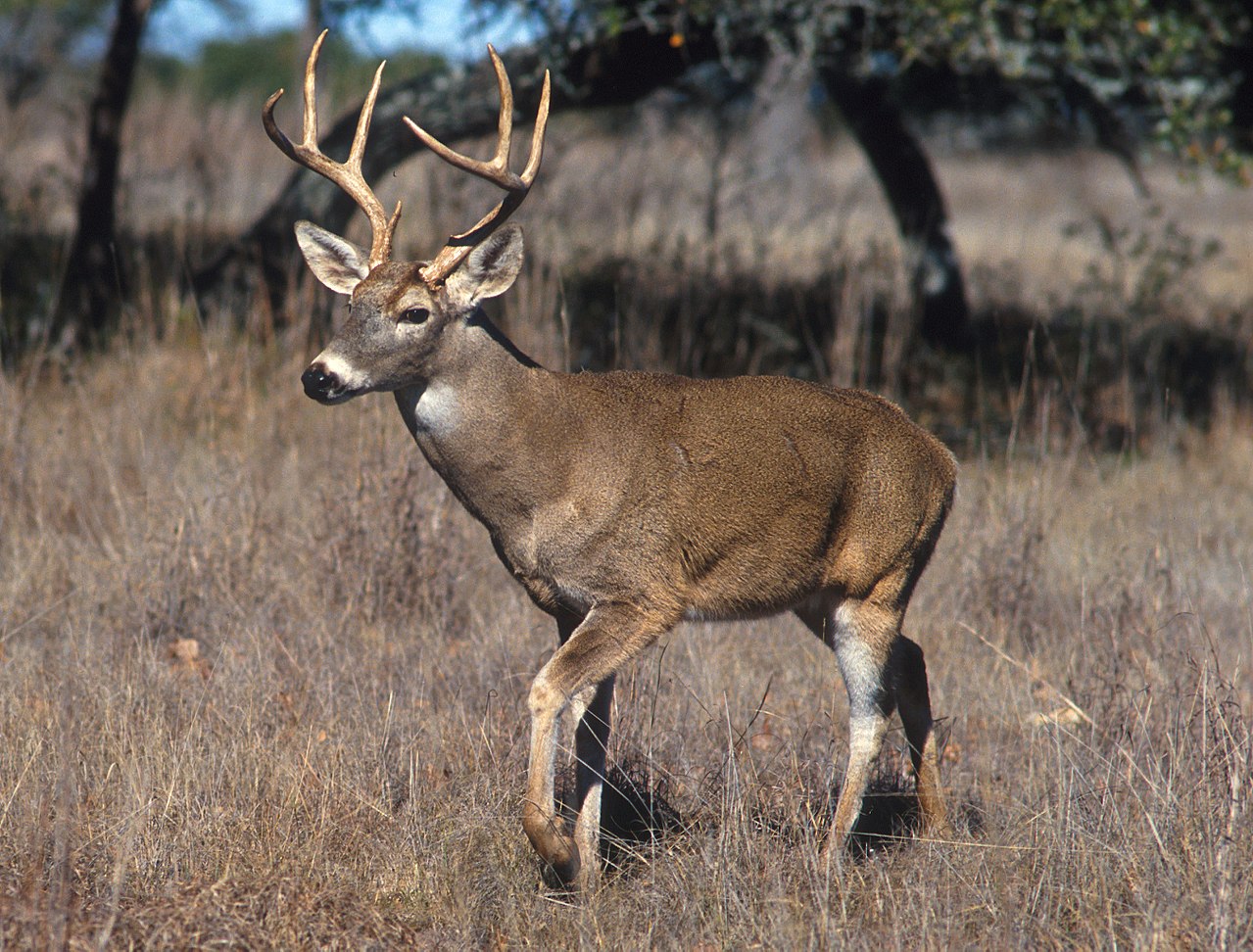
White-tailed Deer (Odocoileus virginianus) lives in forest across Eastern North America. It feeds on grass and leaves. Its conservation status is Least Concern.
Hear the White-tailed Deer
A real field recording of the White-tailed Deer, made in the wild.
The heaviest white-tailed buck ever recorded was taken near Tofte, Minnesota in 1926, weighing 183 kg (403 lb) after field-dressing and estimated at a staggering 232 kg (511 lb) when alive. Such giants live at the northern edge of the species' range, Minnesota, Ontario and Manitoba, where colder climates drive larger body size under Bergmann's rule.
A buck's antlers can span from a modest 8 cm to a massive 60 cm (3-25 in) across the inside spread, a range shaped by nutrition, age and genetics. While larger antlers often signal a well-fed, mature male, the spread alone does not reliably indicate age because local food quality can produce big racks on relatively young bucks.
When sheep were removed from Ecuador's Antisana páramo, the high-altitude grasslands began to recover, and shy white-tailed deer quickly returned, drawn by the resurgence of grasses and shrubs. Their comeback acted as a living barometer of ecosystem health, preceding the return of top predators like pumas. This cascade shows how a single herbivore can signal the restoration of habitat structure.
White-tailed deer see the world through a horizontally slit pupil, granting them superior night vision and rapid visual processing that outpaces humans. This eye design, combined with dichromatic color perception, lets them detect motion in low light while rendering reds and oranges, like hunter's orange, virtually invisible. It explains why bright orange clothing is a safety measure for hunters, reducing accidental shootings.
Texas alone shelters more white-tailed deer than any other state, province or Latin American country, an estimated 5.3 million individuals roam its grasslands, farms and forests. where bucks are raised for oversized antlers and breeding stock.
Sources
Every fact above was checked against these pages, and kept only where one of them states it.
As the first light of dawn creeps across the forest, a white-tailed deer steps silently into the underbrush, its large brown eyes watchful and alert, its coat a masterful blend of tawny and grey that allows it to vanish into the dappled shade. With a gentle bounding gait, it moves through the trees, its slender legs carrying it effortlessly across the leaf-strewn terrain, its white tail flicking back and forth like a metronome as it navigates the hidden pathways of its forest home. In this fleeting moment, the deer embodies the very essence of wildness, a symbol of the untamed beauty that still thrives in the secret places of our world.
Advertisement
Hear the White-tailed Deer, and 4,400+ more
Real recorded sounds, 11 nature games and a free Daily 5, 1v1 quiz duels, conservation wins and a safe Kids mode. Free on Feravox.