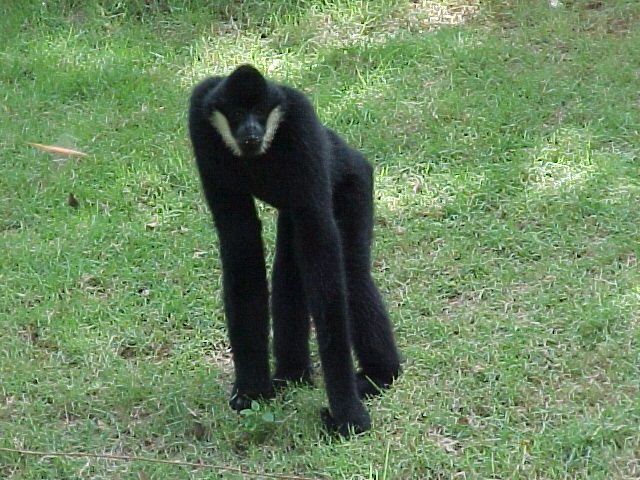
White-cheeked Gibbon (Nomascus leucogenys) lives in tropical rainforest across Southeast Asia. It feeds on fruits and leaves. Its conservation status is Critically Endangered.
Fascinating facts about the White-cheeked Gibbon
- Only a handful of groups remain: 57 groups were counted in Laos's Nam Et-Phou Louey park in 2019, while Vietnam hosts at least 22 groups in Pù Mát and a booming 64 groups with 182 individuals in Xuan Lien reserve as of 2020, up from just 41 groups and 127 individuals recorded in 2011. Those numbers show a fragile recovery in some pockets, underscoring how every lost group pushes the whole species closer to extinction.
- Their arms are built for the sky: the gibbon's forelimbs measure 1.2 to 1.4 times the length of its hind-limbs, a proportion that exceeds even other gibbons. Muscles in the thighs and shoulders are especially heavy, giving them greater bodily strength for swinging.
- Their duets sound like a symphony: a female launches a series of 15 to 30 notes that rise in pitch, then a male answers with a rapid, frequency-modulated call. Each cycle lasts under 20 seconds but repeats for five to 17 minutes, growing louder each round. These elaborate songs cement pair bonds and signal territory.
- Reproduction runs on a tight clock: females cycle every 22 days, gestation lasts 200-212 days, and newborns weigh about 480 g (17 oz). Offspring reach sexual maturity at seven or eight years, and wild individuals have been recorded living at least 28 years.
- Mining threatens their home: the Nam Xam National Biodiversity Conservation Area on the Laos-Vietnam border, a refuge for the critically endangered gibbon, sits amid a surge of rare-earth mines, 27 identified since 2022, with 23 inside protected zones. In 2024, cyanide and acidic spills in Laos's Houaphanh and Luang Prabang provinces killed fish in rivers.
Sources
Every fact above was checked against these pages, and kept only where one of them states it.
At a glance
RangeSoutheast Asia
HabitatTropical rainforest
DietFruits and leaves
About the White-cheeked Gibbon
In the lush, emerald canopies of Southeast Asia's ancient forests, the white-cheeked gibbon embodies a symphony of elegance and agility, its slender form swooping effortlessly through the trees with a mesmerizing grace. As it moves, its haunting melodies echo through the mist-shrouded valleys, a poignant reminder of the beauty and fragility of this critically endangered species. With each soaring leap, the gibbon seems to defy gravity, its very existence a testament to the awe-inspiring wonders that still await us in the unspoiled depths of our planet's most threatened ecosystems.
Hear the White-cheeked Gibbon, and 4,400+ more
Real recorded sounds, 11 nature games and a free Daily 5, 1v1 quiz duels, conservation wins and a safe Kids mode. Free on Feravox.