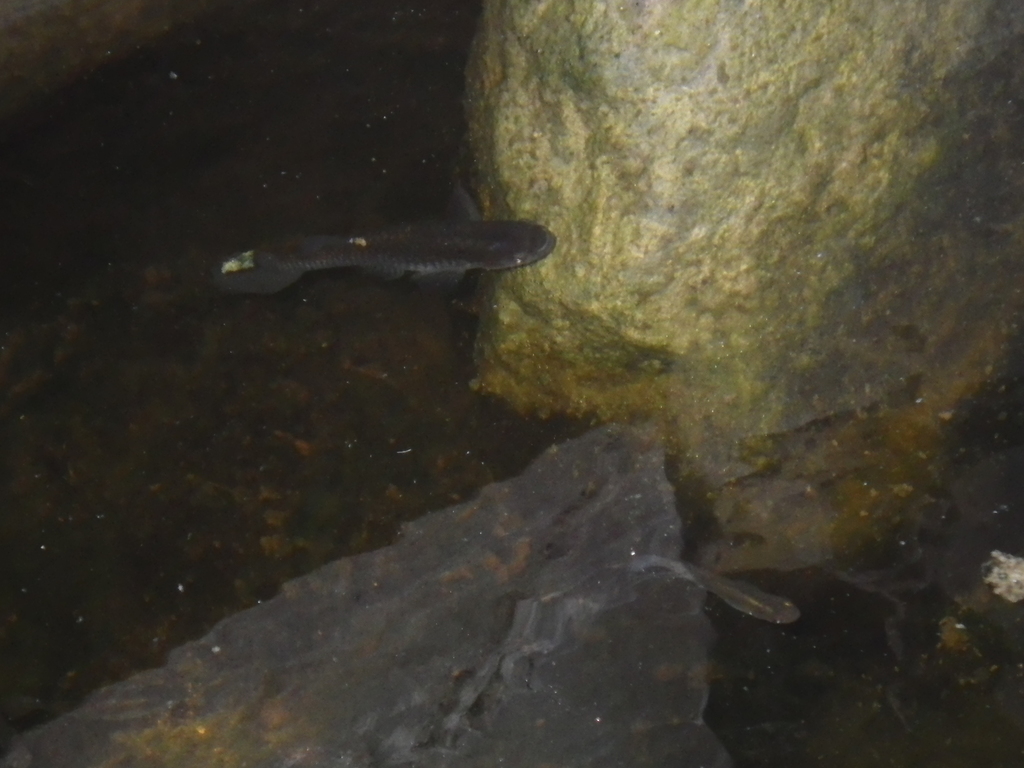
Western Mosquitofish (Gambusia affinis) lives in freshwater habitats across Eastern North America. It feeds on insects and plankton. Its conservation status is Least Concern.
Fascinating facts about the Western Mosquitofish
- Female western mosquitofish grow to about the length of a standard pencil, 7 cm (2.8 in), while males stay under half that size at 4 cm (1.6 in). This stark size gap lets you tell the sexes apart in the field, with the larger, gravid females also showing a dark spot near the rear of their belly. Because the females are bigger, they can carry up to 60 newborns at once, making each female a tiny, mobile mosquito-eating factory.
- A single mosquitofish can gulp an astonishing 42 %, 167 % of its own body weight in food each day. In practice that means it could eat up to hundreds of mosquito larvae. This voracious appetite helps slash mosquito numbers locally, but it also means the fish will devour any small invertebrate it can find, reshaping the whole pond food web.
- Mosquitofish mature at breakneck speed: males become sexually active in just 43-62 days, and early-season females can reproduce after only 21-28 days. When water warms from 20 °C to 30 °C, the age at first reproduction drops dramatically from 191 days to just 56 days, and the time between broods shrinks to 19-23 days. This rapid turnover lets populations explode in warm, nutrient-rich habitats.
- Western mosquitofish can survive in water that is twice as salty as the ocean and can tolerate brief spikes up to 42 °C (108 °F). Their ability to live where oxygen is low and salinity is high. This hardiness is a key reason they have become the most widespread freshwater fish on the planet.
- Introduced worldwide to eat mosquito larvae, mosquitofish often backfire: in Australia they are classified as a noxious pest because they may outcompete native invertebrate predators of mosquito larvae, sometimes worsening mosquito problems. Species-distribution models show they are expanding into new tropical zones in Asia, a shift that threatens fresh-water ecosystems far beyond their original range. Their invasive success highlights how a tiny fish can become a global ecological troublemaker.
Sources
Every fact above was checked against these pages, and kept only where one of them states it.
At a glance
RangeEastern North America
HabitatFreshwater habitats
DietInsects and plankton
About the Western Mosquitofish
In the warm, sun-dappled waters of its native habitats, the Western Mosquitofish darts and weaves with nimble aplomb, its iridescent scales flashing like tiny lanterns as it navigates the intricate tapestry of aquatic plants and hidden crevices. With a voracious appetite for mosquito larvae, this tiny predator plays a vital role in maintaining the delicate balance of its ecosystem, its very presence a testament to the intricate web of relationships that underpins the natural world. As it glides effortlessly through the water, its slender body undulating with each swift movement, the Western Mosquitofish embodies the quiet, unassuming beauty of a creature perfectly adapted to its environment.
Hear the Western Mosquitofish, and 4,400+ more
Real recorded sounds, 11 nature games and a free Daily 5, 1v1 quiz duels, conservation wins and a safe Kids mode. Free on Feravox.