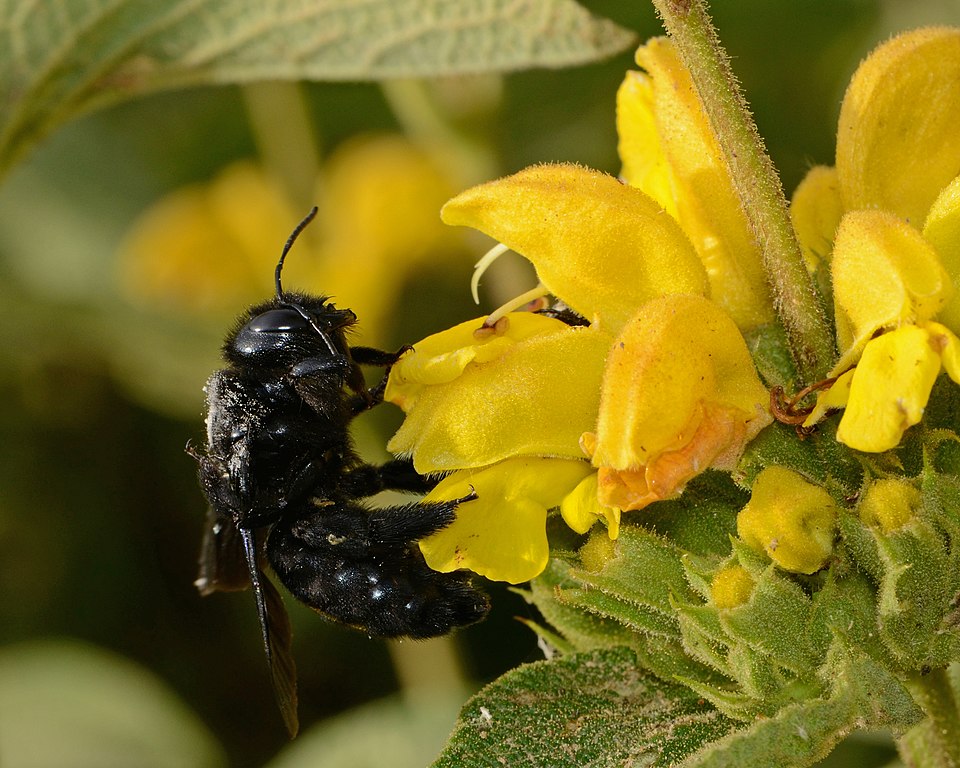
Violet Carpenter Bee (Xylocopa violacea) lives in warm temperate regions across Europe. It feeds on nectar and pollen.
Fascinating facts about the Violet Carpenter Bee
- The violet carpenter bee is the common European species of carpenter bee and is one of the largest bees in Europe. It also occurs naturally in Asia, with its distribution extending from western Europe eastward across Asia to central China, only in regions north of the 30° latitude line.
- The species lives only above 30° latitude, reaching from Europe across Asia to central China. A 2006 sighting in Cardigan, Wales, and records in Northamptonshire and Worcestershire by 2010 show its presence further north in the UK.
- The violet carpenter bee was first recorded breeding in England in 2007, when a colony was found in Leicestershire. This breakthrough was quickly followed by additional observations, with the species being recorded in Northamptonshire and Worcestershire by 2010. These successive records illustrate how the bee is steadily establishing new breeding sites further north in the British Isles.
- Indian reports of the bee often mix it up with other black carpenter species. In India, any all-black species of Xylocopa are referred to by the common name "bhanvra" (or "bhomora" - ভোমোৰা - in Assamese), and reports and sightings of bhanvra are commonly misattributed to this species.
- Adults spend winter hidden in abandoned tunnels inside dead wood, emerging again in spring. Hibernation is undertaken by the adults in wood where there are abandoned nest tunnels.
Sources
Every fact above was checked against these pages, and kept only where one of them states it.
At a glance
RangeEurope
HabitatWarm temperate regions
DietNectar and pollen
About the Violet Carpenter Bee
In the warm, sun-drenched landscapes of its native habitats, the Violet Carpenter Bee moves with a quiet purpose, its iridescent body glimmering like a fragment of amethyst as it flits from flower to flower. With a gentle hum, it alights upon the delicate petals of its preferred blooms, its long tongue uncoiling to drink in the sweet nectar that sustains it, a masterful and efficient forager in a world of vibrant colors and enticing scents. As it flies, its powerful wings beat at a hypnotic pace, a mesmerizing blur of motion that belies the remarkable precision with which it navigates its surroundings.
Hear the Violet Carpenter Bee, and 4,400+ more
Real recorded sounds, 11 nature games and a free Daily 5, 1v1 quiz duels, conservation wins and a safe Kids mode. Free on Feravox.
More insects and spiders to discover