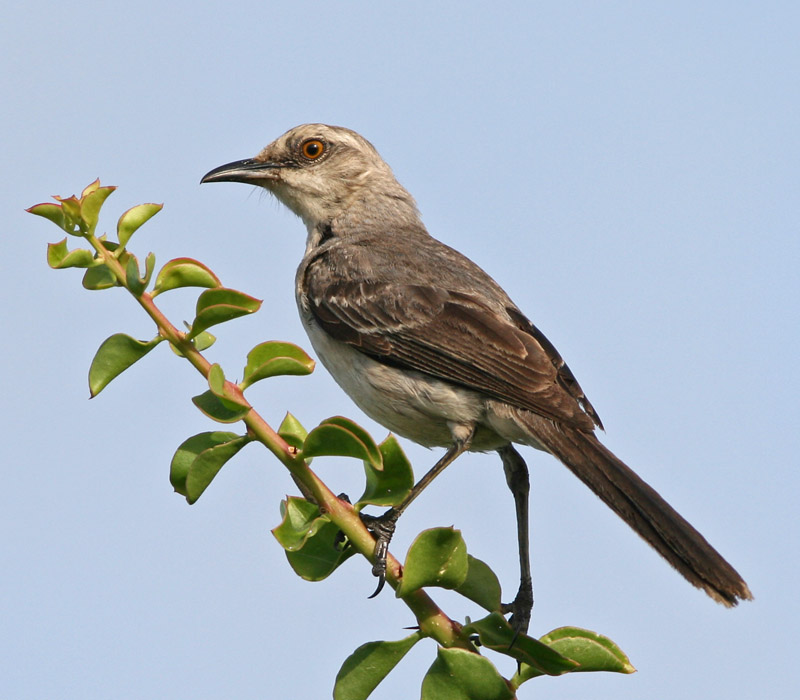
Tropical Mockingbird (Mimus gilvus) lives in tropical dry forest across Central and South America. It feeds on insects and fruit. Its conservation status is Least Concern.
Fascinating facts about the Tropical Mockingbird
- Adult tropical mockingbirds measure just 23 to 25.5 cm (9.1 to 10.0 in) long, yet the ten recognized subspecies span a noticeable size gap. The largest, M. g. magnirostris, not only tops the length chart but also carries a significantly heavier bill, while M. g. tolimensis is larger than the nominate form.
- The tropical mockingbird thrives from sea level up to lofty heights: it regularly reaches about 2,500 m (8,200 ft) in Central America and the northern Andes, has been recorded as high as 2,600 m (8,500 ft) in Colombia, and even 3,100 m (10,200 ft) in northern Ecuador.
- A true opportunist, the tropical mockingbird forages on the ground, low vegetation, and even snatches swarming termites mid-flight. Its omnivorous menu lists spiders, grasshoppers, beetles, seeds, small fruits, larger cultivated fruits like mangoes and sapodillas, lizards, bird and lizard eggs, feeder scraps, and human food. This dietary breadth lets it flourish in scrublands, parks, and farms, turning human-altered landscapes into reliable buffet tables.
- Breeding season stretches from the late wet period into the early wet season, often yielding three broods. The monogamous pair builds a low shrub nest of coarse twigs lined with soft material, laying two to four eggs, usually three. The female incubates for 13-15 days, while both parents and sometimes older siblings (helpers) feed the chicks for up to 19 days, extending care after fledging.
- The IUCN lists the tropical mockingbird as Least Concern, noting it is Its range is even expanding northward in the Lesser Antilles, though habitat loss and illegal trapping have shrunk its presence in southeastern Brazil.
Sources
Every fact above was checked against these pages, and kept only where one of them states it.
At a glance
RangeCentral and South America
HabitatTropical dry forest
DietInsects and fruit
About the Tropical Mockingbird
In the sun-drenched landscapes of the tropics, the mockingbird reigns supreme, its melodic voice weaving a rich tapestry of sound as it flits effortlessly between the vibrant blooms of its native habitat. With each fluid motion, its sleek, grey-brown form seems to embody the very essence of agility, as if the gentle trade winds themselves had taken on a life of their own. As it sings, its remarkable mimicry echoes through the trees, a dazzling display of vocal virtuosity that has captivated the hearts of all who have been fortunate enough to hear it.
Hear the Tropical Mockingbird, and 4,400+ more
Real recorded sounds, 11 nature games and a free Daily 5, 1v1 quiz duels, conservation wins and a safe Kids mode. Free on Feravox.