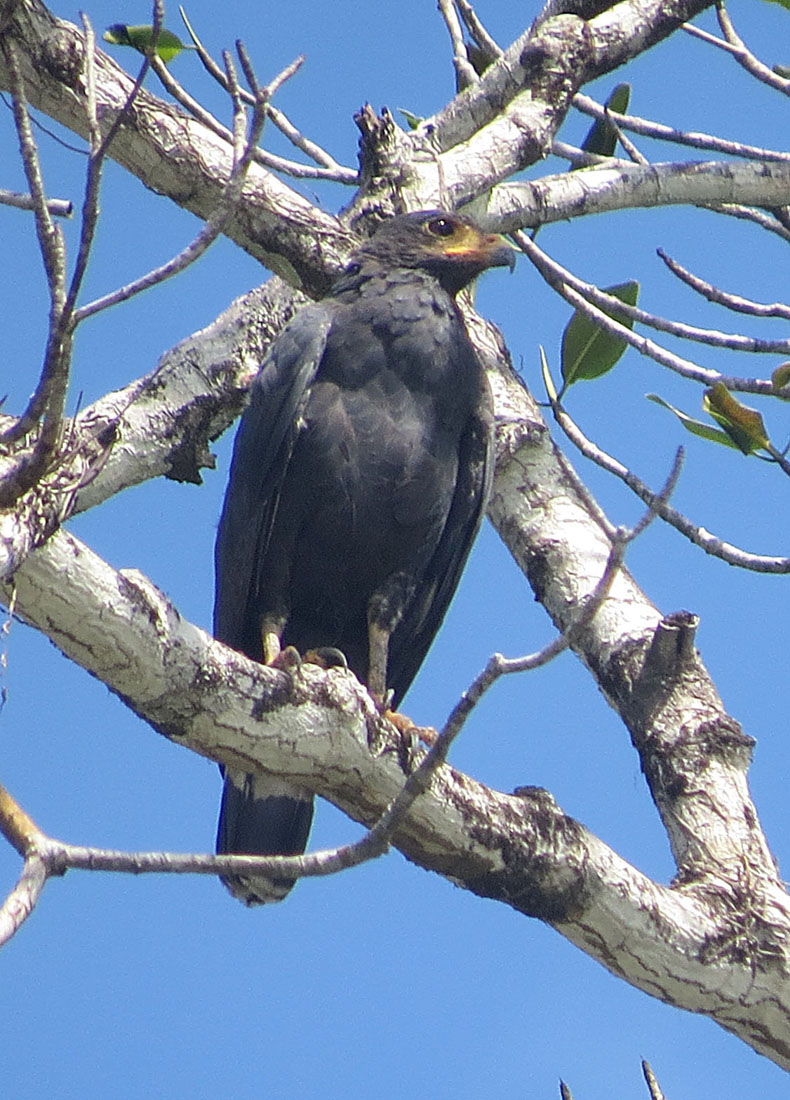
Common Black Hawk (Buteogallus anthracinus) lives in tropical rainforest across North America. It feeds on fish and crustaceans. Its conservation status is Least Concern.
Hear the Common Black Hawk
A real field recording of the Common Black Hawk, made in the wild.
The common black hawk's diet is dominated by crabs, especially land crabs, which it catches in mangrove swamps and estuaries. It also takes crayfish and a wide range of small vertebrates such as fish, frogs, turtle hatchlings, lizards, snakes and even young or injured birds and mammals. Carrion in the form of dead fish and eggs are eaten when available, and the hawk adds insects like grasshoppers, caterpillars and wasp larvae to round out its meals.
The species builds a platform nest of sticks high in trees, usually mangroves, positioning it anywhere from fifteen to one hundred feet above the ground. These nests are broad stick platforms that the hawk often re-uses year after year, gradually expanding them as the birds return. Because the nests are repeatedly occupied, they can become considerably larger than the original structure, providing a stable base for the single or few eggs laid each season.
In Sonoma County, California, the common black hawk has been observed to hybridise naturally with the red-shouldered hawk, a different genus of hawk. This rare event shows that the two species can interbreed despite their taxonomic separation, producing hybrid offspring in the wild. Such natural hybridisation between different genera of hawks is noted as an uncommon phenomenon in the avian world.
The common black hawk produces a distinctive piping call that sounds like spink-speenk-speenk-spink-spink-spink, a pattern that repeats rapidly when the bird vocalises. This sharp, metallic note is most often heard as the hawk circles high above mangrove swamps and estuaries, where it spends much of its time soaring with occasional lazy wing flaps.
The common black hawk is primarily a coastal, resident bird of mangrove swamps, estuaries and the nearby dry open woodland, favouring these wetland habitats for feeding and nesting. Its range extends from the southwestern United States through Central America to Venezuela, Peru, Trinidad and the Lesser Antilles, showing it occupies the warmer parts of the Americas.
Sources
Every fact above was checked against these pages, and kept only where one of them states it.
As the Common Black Hawk soars through the misty dawn skies, its sleek, dark silhouette slices effortlessly across the landscape, a master of the thermal currents that lift it high above the forest canopy. With wings outstretched, it rides the updrafts with an air of quiet confidence, its piercing gaze scanning the terrain below for the telltale glint of water or the rustle of unsuspecting prey. In this realm of shadow and light, the Black Hawk reigns supreme, a phantom of the skies, its very presence a reminder of the wild beauty that still thrives in our world.
Advertisement
Hear the Common Black Hawk, and 4,400+ more
Real recorded sounds, 11 nature games and a free Daily 5, 1v1 quiz duels, conservation wins and a safe Kids mode. Free on Feravox.