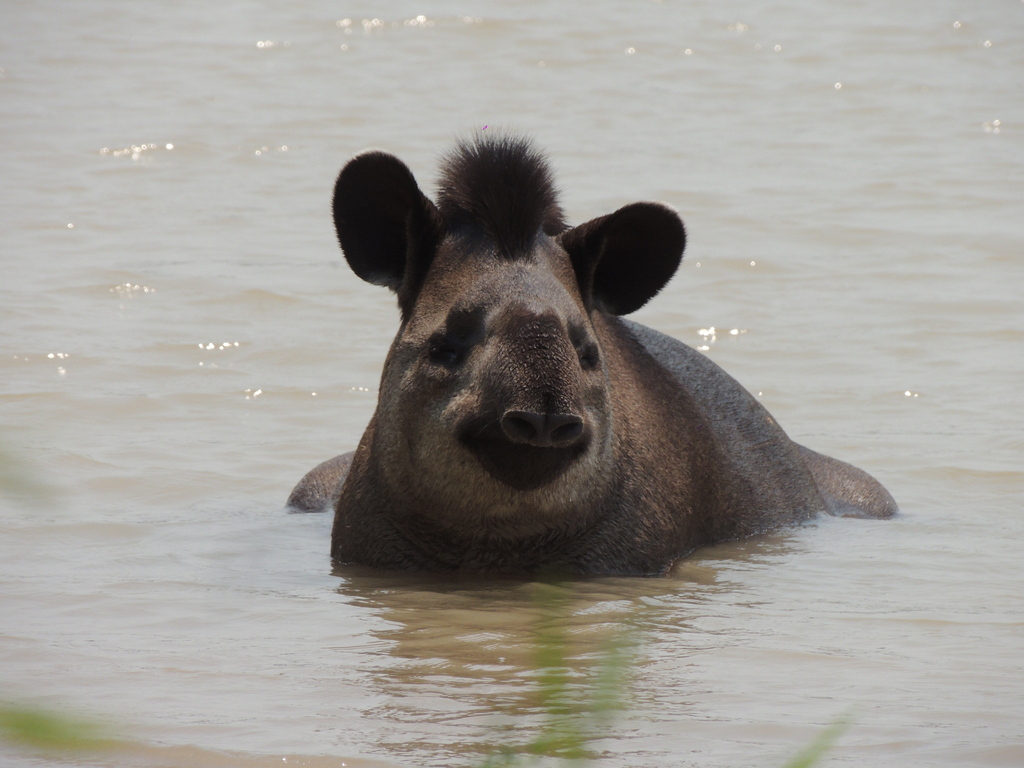
Tapir (Tapirus terrestris) lives in tropical rainforest across Central and South America. It feeds on leaves and fruits. Its conservation status is Vulnerable.
Fascinating facts about the Tapir
- A South American tapir can stretch up to 2.5 m long, about the length of a midsize car, and tip the scales at roughly 225 kg, comparable to a small SUV. Reported adult weights span 150 kg to 320 kg, showing a wide size range across individuals. This massive bulk makes it the largest surviving native land mammal in the Amazon.
- Tapirs live about a quarter-century in the wild, with lifespans of 25 to 30 years, yet they face a gauntlet of predators. Only the black caiman, the critically endangered Orinoco crocodile, jaguars and cougars are large enough to take them, and even green anacondas have been recorded as attackers. Their size and thick hide let them fend off threats with a powerful bite.
- The tapir's conservation status is precarious: the U.S. Fish and Wildlife Service listed it as endangered on June 2 1970, while the IUCN classifies it as Vulnerable. After a century-long absence, a lone individual was photographed in Rio de Janeiro in 2024, the first sighting there since 1914, signaling that restored forests can again support large mammals.
- A recent molecular survey found that 53.3 % of tested tapirs carried the zoonotic protozoan Balantioides coli, with 24 of 45 fecal samples testing positive. This parasite, which can infect humans, underscores the tapir's role as a reservoir for emerging diseases and the need for health monitoring in both wild and captive populations to protect animal and public health.
- Female tapirs carry a single calf for almost a year, 13 months (390-395 days), before giving birth to a newborn that weighs about 15 lb (6.8 kg). Gestation can range from 335 to 439 days, reflecting flexibility in reproductive timing.
At a glance
RangeCentral and South America
HabitatTropical rainforest
DietLeaves and fruits
About the Tapir
In the dappled shadows of the South American rainforest, the tapir moves with a quiet purpose, its sturdy legs carrying it silently across the forest floor as it searches for the tender shoots and leaves that sustain it. With a snout that twitches like a sensitive finger, it probes the undergrowth, uncovering hidden treasures in a world of ancient trees and whispering leaves. As it vanishes into the misty depths of the forest, the tapir leaves behind a trail of subtle signs, a reminder of its elusive presence in a realm where humans rarely tread.
Hear the Tapir, and 4,400+ more
Real recorded sounds, 11 nature games and a free Daily 5, 1v1 quiz duels, conservation wins and a safe Kids mode. Free on Feravox.