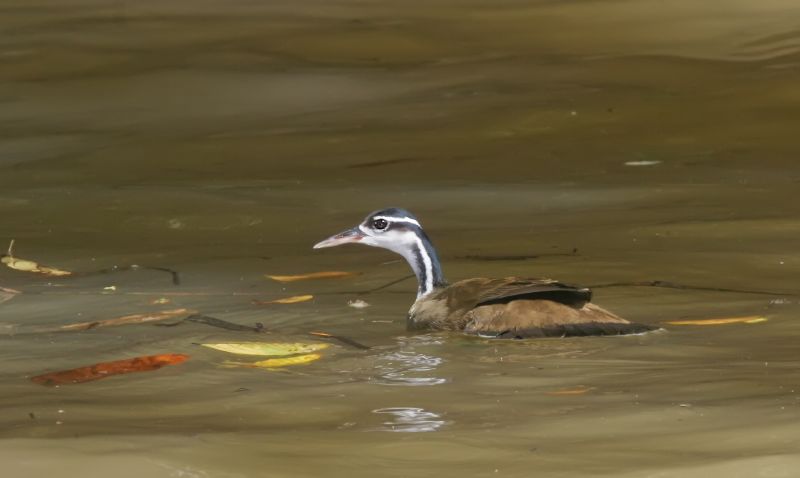
Sungrebe (Heliornis fulica) lives in freshwater wetlands across Central America. It feeds on insects and crustaceans. Its conservation status is Least Concern.
Fascinating facts about the Sungrebe
- Male sungrebes literally become walking nurseries: a shallow, ovular pocket of muscular skin under each wing forms a pouch that can hold one or two chicks, and long, curved feathers act as guard rails to keep the babies from falling out even while the father dives or flies. This unique parental pouch lets the male feed, clean and protect altricial hatchlings until they can swim on their own, a level of care unseen in any other bird.
- Female sungrebes are slightly smaller but more powerfully built than males: females average 27 cm (11 in) in length, a wing length of 13.77 cm (5.42 in) and weigh 130-140 g (4.6-4.9 oz), while males average 30 cm (12 in) long, a wing length of 14.1 cm (5.6 in) and weigh 110-140 g. This dimorphism means the female can display brighter orange-rufous cheek patches and a scarlet lower mandible during breeding, traits that likely help her attract the heavily caregiving male.
- The sungrebe is pushing its range northward like a quiet explorer: historically it was never found north of central Veracruz, but by the 1940s it had colonized all of Veracruz and even San Luis Potosí. Today it is moving further into Tamaulipas, and a lone individual was recorded on 13 November 2008 at Bosque del Apache National Wildlife Refuge in New Mexico, marking the first U.S. record for the species.
- A 14-million-year-old humerus from North Carolina shows that sungrebe ancestors once roamed far beyond their tropical homes: the fossil, attributed to Heliornis aff. fulica, is the earliest known finfoot fossil and suggests the lineage was present in North America well before the Great American Interchange that linked the continents.
- Sungrebe breeding is a race against time: clutches contain two to four eggs that hatch after an unusually short incubation of only 10 to 11 days. Both parents share incubation duties, with the female on the nest most of the day and night and the male taking over the middle of the day, after which he scoops the helpless chicks into his pouch for care.
Sources
Every fact above was checked against these pages, and kept only where one of them states it.
At a glance
RangeCentral America
HabitatFreshwater wetlands
DietInsects and crustaceans
About the Sungrebe
In the serene depths of tropical wetlands, the Sungrebe glides with effortless elegance, its slender legs paddling beneath the surface as it navigates the murky waters with an air of quiet confidence. With its richly mottled plumage blending seamlessly into the dappled shade, this enigmatic bird moves unseen, its large, dark eyes ever-vigilant for the slightest stirrings of aquatic life. As it slips through the vegetation, the Sungrebe's delicate, whistled calls weave a haunting melody into the stillness, a testament to its status as a master of the hidden, watery realm.
Hear the Sungrebe, and 4,400+ more
Real recorded sounds, 11 nature games and a free Daily 5, 1v1 quiz duels, conservation wins and a safe Kids mode. Free on Feravox.