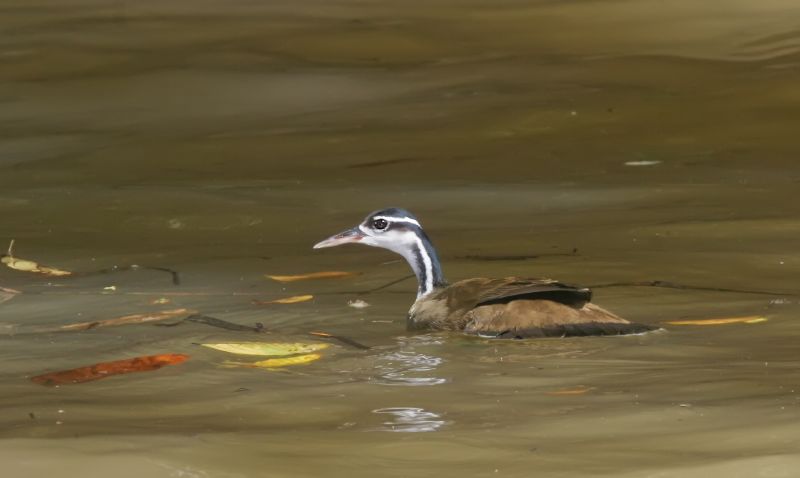
Sun Grebe (Heliornis fulica) lives in freshwater wetlands across Central America. It feeds on insects and crustaceans. Its conservation status is Least Concern.
Fascinating facts about the Sun Grebe
- Male sungrebes carry their hatchlings in a skin-fold pouch under each wing, a trait no other bird has. The pouch is a shallow, ovular pocket formed by pleats of well-muscled skin, buffered by a wall of long, curved feathers that hold the chicks in place even while the male dives or flies. After hatching the male transfers the altricial chicks to this pocket, feeds them and removes waste until they can swim on their own. This unique parental care lets the vulnerable newborn stay dry and protected in a watery world.
- Females are slightly smaller but more robust than males, a rare reversal of typical bird dimorphism. Females tend to have a body length of 27 cm (11 in), a wing length of 13.77 cm (5.42 in), and an average mass of 130-140 g (4.6-4.9 oz). Males average 30 cm (12 in) in length, a wing length of 14.1 cm (5.6 in), and a mass of 110-140 g. This size gap, combined with brighter facial patches in females, hints that females may court males, flipping the usual bird-courtship script.
- The sungrebe's range is creeping northward in Mexico and even into the United States. Historically the species was found no farther north than central Veracruz, but by the 1940s it had established populations throughout Veracruz and into San Luis Potosí. An individual was sighted on 13 November 2008 on the Marsh Loop at Bosque del Apache National Wildlife Refuge in New Mexico, USA, the first historical record of sungrebes in the United States.
- A 14-million-year-old fossil humerus from North Carolina ties the sungrebe's ancestors to ancient North America, far beyond its modern tropical range. The fossil, attributed to Heliornis aff. fulica, is the earliest known finfoot fossil and suggests that finfeet were present in North America well before the Great American Interchange.
- Sungrebe eggs hatch after just 10 to 11 days. The clutch usually contains two to four eggs, each round with a buffy-white base speckled with dark cinnamon, ruddy brown and pale purple spots.
Sources
Every fact above was checked against these pages, and kept only where one of them states it.
At a glance
RangeCentral America
HabitatFreshwater wetlands
DietInsects and crustaceans
About the Sun Grebe
In the serene expanse of tropical wetlands, the Sun Grebe glides with effortless elegance, its slender neck and legs slicing through the water as it pursues its aquatic prey with stealthy precision. With a soft, melodious call, it announces its presence, a fleeting glimpse of its iridescent plumage catching the eye like a shaft of sunlight dancing across the ripples. As it moves through its domain, the Sun Grebe embodies a captivating blend of refinement and resilience, a true marvel of evolutionary adaptation in the sun-drenched realms it calls home.
Hear the Sun Grebe, and 4,400+ more
Real recorded sounds, 11 nature games and a free Daily 5, 1v1 quiz duels, conservation wins and a safe Kids mode. Free on Feravox.