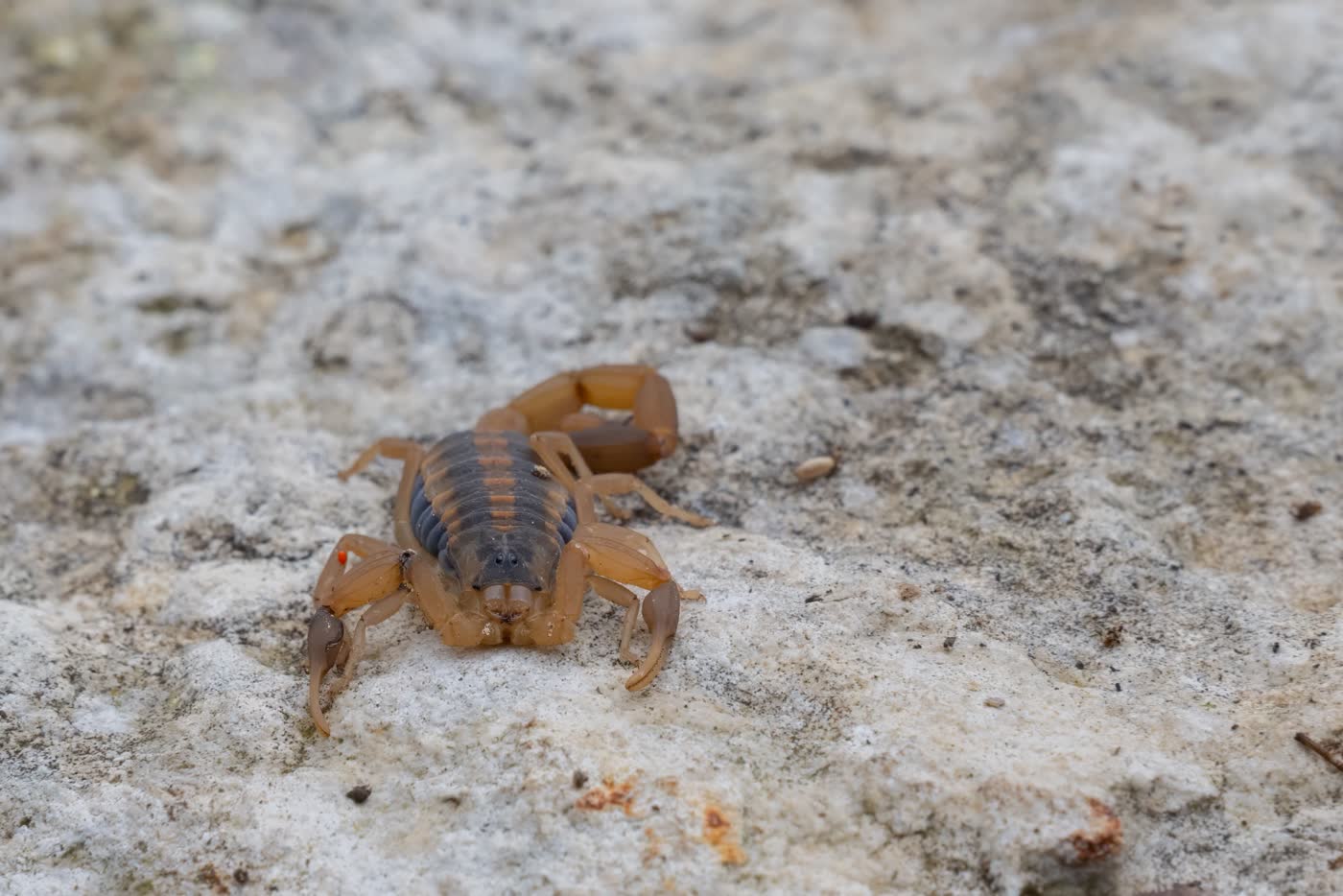
Striped Bark Scorpion (Centruroides hentzi) lives in deserts, forests, and urban areas from California to Texas and south into Mexico. Its conservation status is Least Concern.
Fascinating facts about the Striped Bark Scorpion
- In the southeastern United States, Hentz striped scorpions live from Florida up through southern Georgia's coastal plain and even the barrier islands, spilling into North and South Carolina when humans accidentally move them. They hide under logs, stones, leaf litter, and even bark on dead trees as high as 20 feet. They occupy both natural and human-made spaces, including homes.
- Venom in Hentz striped scorpions isn't a one-size-fits-all cocktail; populations separated by geography show significant differences, and males and females each carry distinct toxin blends. After a sting, a scorpion needs at least 14 days to fully regenerate its venom.
- Even tiny predators target the Hentz striped scorpion: the federally endangered Red-capped Woodpecker (Picoides borealis) and the invasive Cuban treefrog (Osteopilus septentrionalis) both eat them, and the first documented case of an assassin bug preying on a scorpion involved Centruroides hentzi and Microtomus purcis.
- Hentz striped scorpions keep the forest floor tidy by hunting insects like cockroaches, termites, and crickets. They slip into houses, where they still hunt the same bugs that bother humans.
- Male Hentz striped scorpions are about 37 mm long and carry 18 pectinal teeth, while females grow slightly larger to 38.9 mm and have 17 teeth.
Sources
Every fact above was checked against these pages, and kept only where one of them states it.
At a glance
RangeCalifornia to Texas and south into Mexico
HabitatDeserts, forests, and urban areas
DietSmall insects, spiders, other arachnids
About the Striped Bark Scorpion
Despite its fearsome reputation, the Striped Bark Scorpion is generally not aggressive towards humans, and will only sting in self-defense. However, its venom is highly toxic, and can cause significant pain and swelling in humans, making it a formidable opponent in the desert ecosystem.
Common questions
What does the Striped Bark Scorpion eat?
Diet: small insects, spiders, other arachnids.
Where does the Striped Bark Scorpion live?
Habitat: deserts, forests, and urban areas. Range: California to Texas and south into Mexico.
Is the Striped Bark Scorpion endangered?
The Striped Bark Scorpion is listed as Least Concern on the IUCN Red List.
Hear the Striped Bark Scorpion, and 4,400+ more
Real recorded sounds, 11 nature games and a free Daily 5, 1v1 quiz duels, conservation wins and a safe Kids mode. Free on Feravox.
Striped Bark Scorpion photographed on Feravox
More wildlife to discover