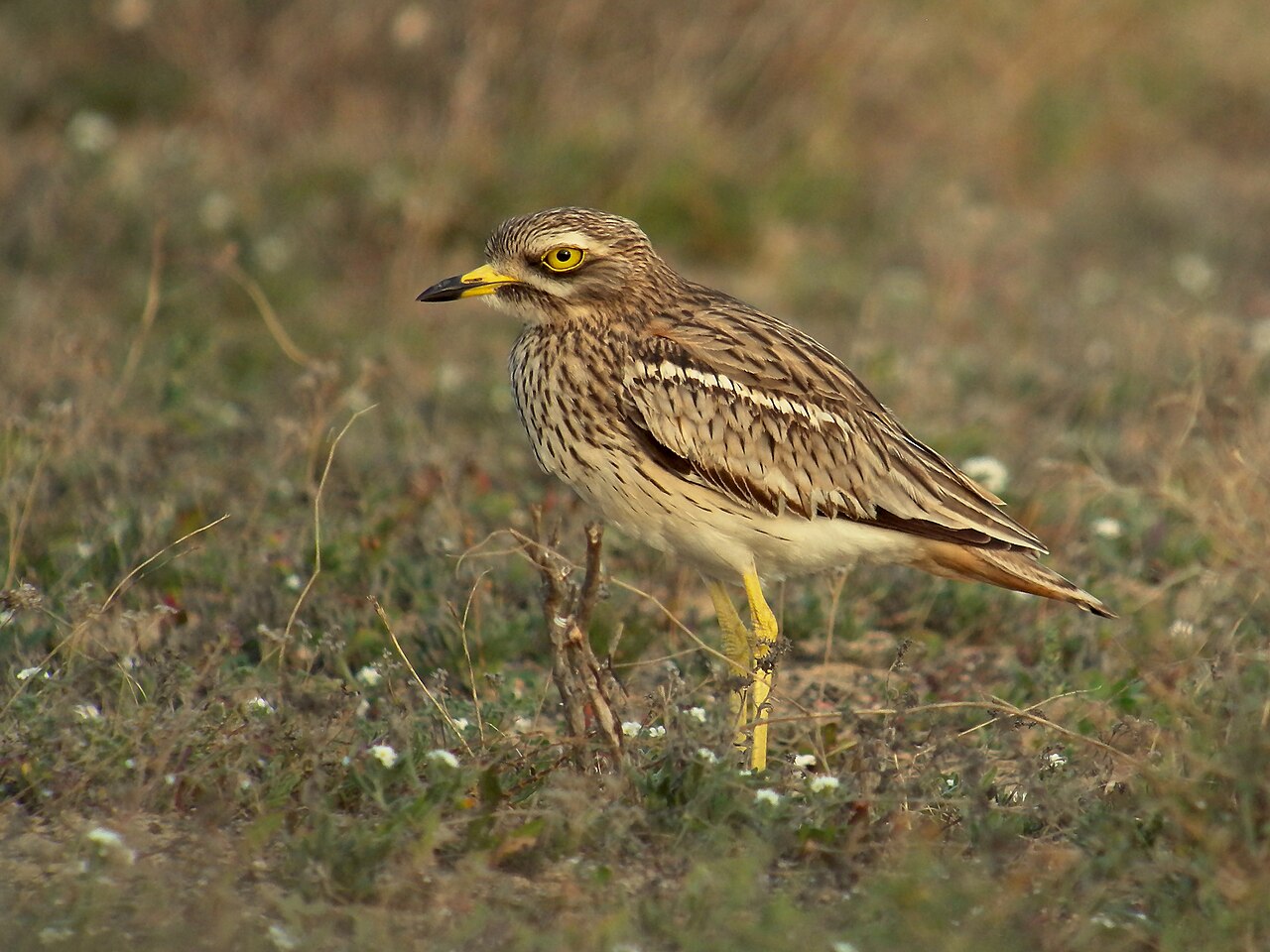
Stone-curlew (Burhinus oedicnemus) lives in dry open areas across Europe Africa. It feeds on insects and worms. Its conservation status is Least Concern.
Hear the Stone-curlew
A real field recording of the Stone-curlew, made in the wild.
At up to 46 cm long and a wingspan reaching 88 cm, the Eurasian stone-curlew can weigh as much as 535 g. That makes it a fairly large wader, though mid-sized by the standards of its family. Its broad wings and hefty body let it launch into a striking, black-and-white-spotted flight that can be seen over open heathland.
The stone-curlew does most of its hunting after dark, singing loud wailing songs that echo curlews across barren fields. Its menu is mainly insects and other small invertebrates, but it will also snap up tiny reptiles, frogs and even rodents when the opportunity arises.
Stone-curlews usually wait until they are three years old before attempting their first nest, then lay two eggs two days apart in a shallow scrape on open ground. Each egg measures about 54 mm × 38 mm, a pale buff speckled with brown or purple-grey. Both parents share incubation duties until the eggs hatch after 24-26 days, and the precocial chicks sprint away from the nest almost immediately, staying under parental care for another 36-42 days.
Although globally listed as Least Concern, some stone-curlew populations are slipping. A French study tracking numbers from 1998 to 2016 recorded a 26 % decline over that 14-year span, linking the drop to intensified agriculture that removes the bare ground the birds need for nesting and foraging. This trend warns that even adaptable species can falter when their open-habitat refuges disappear.
Ring-recovery data show a stone-curlew can live well beyond two decades: a bird banded as a nestling in Suffolk in 1990 was recaptured in the same county in 2012, giving a maximum recorded age of 22 years and 4 months.
Sources
Every fact above was checked against these pages, and kept only where one of them states it.
As the sun sets over the arid landscape, the stone-curlew emerges from its daytime slumber, its large, round eyes scanning the terrain with an unblinking intensity as it sets out to hunt under the cover of darkness. With its long, powerful legs, it strides purposefully across the dry earth, its mottled plumage blending seamlessly into the rocky outcrops and scrubby vegetation, allowing it to move undetected in pursuit of unsuspecting insects and small reptiles. In this harsh yet beautiful world, the stone-curlew reigns as a master of stealth and patience, its haunting, whistled calls echoing through the night air like a plaintive serenade.
Advertisement
Hear the Stone-curlew, and 4,400+ more
Real recorded sounds, 11 nature games and a free Daily 5, 1v1 quiz duels, conservation wins and a safe Kids mode. Free on Feravox.