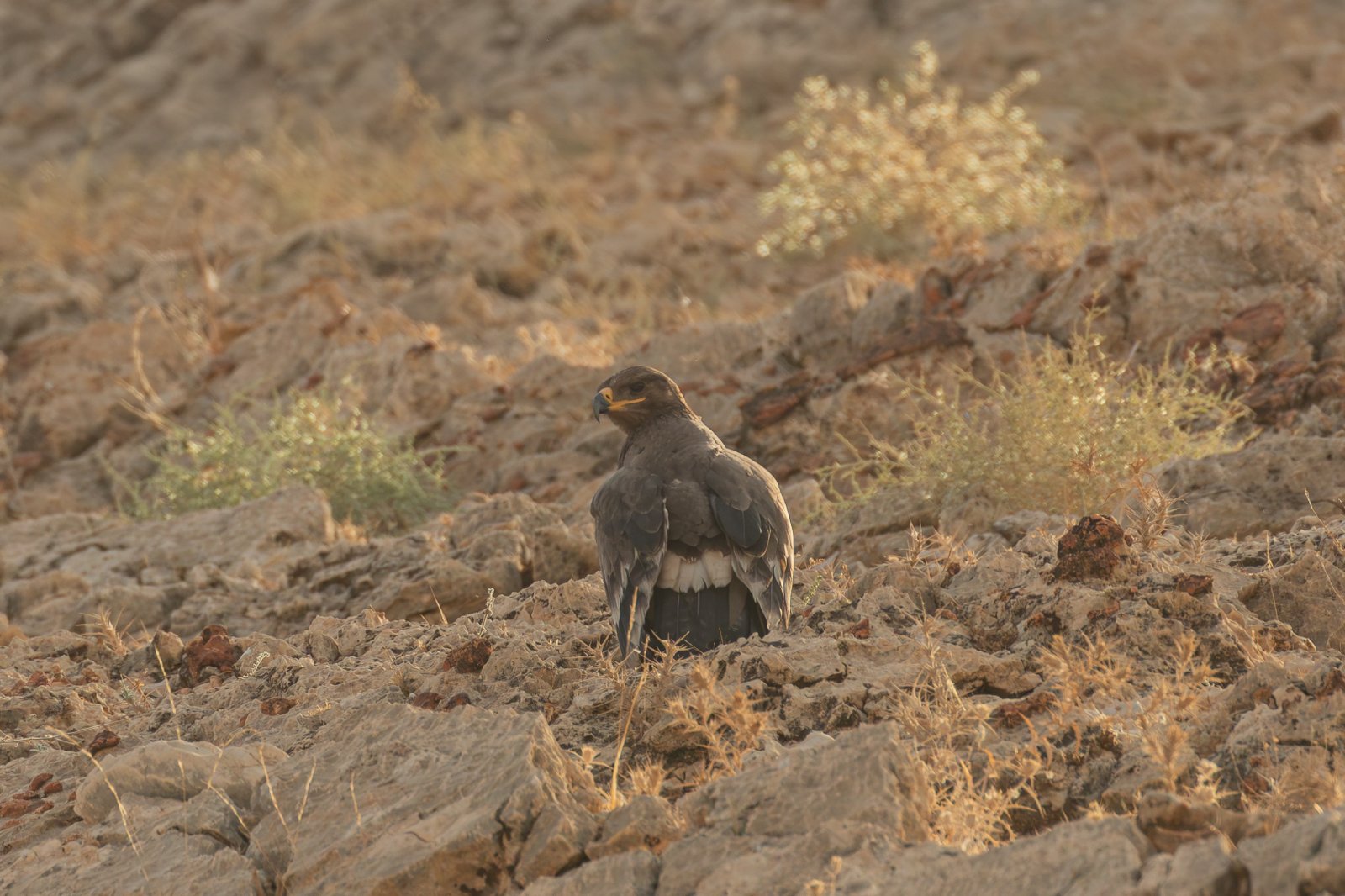
Photo: Jean-Michel Blake
Feravox · The Voice of the Wild
Steppe Eagle
Aquila nipalensis
Endangered
Steppe Eagle (Aquila nipalensis) lives in open steppe across Central Asian steppe. It feeds on ground squirrels, insects, carrion. Its conservation status is Endangered.
The steppe eagle (Aquila nipalensis) is a large, bulky raptor of the booted-eagle subfamily, its legs cloaked in dense feathers that give it a distinctly “booted” silhouette. Dark brown overall, adults display a strikingly long, deep-set gape-line that reaches the rear of the eye, framed by a dark border against a pale chin, and in the eastern part of the range a bold rufous-orange patch crowns the nape. Juveniles are paler, with white-tipped black greater coverts and a conspicuous cream band across the brown medians, gradually fading as the bird ages into the five-year adult plumage. In flight the steppe eagle is unmistakable: broad, square-ended wings held almost parallel, a rounded or wedge-shaped tail about three-quarters the wing-base length, and a wingspan roughly 2.6 times its body length, giving it a heavy, imposing presence over the open steppe. On the treeless steppes these eagles nest on slight rises or outcrops, uniquely building ground-based nests that may sit on flat, open ground. They specialize in hunting ground squirrels on the breeding grounds, supplementing with other small mammals when squirrels are scarce. After fledging, they embark on a massive migration that sweeps past the Middle East, Red Sea and Himalayas, only to adopt a surprisingly passive winter diet of insect swarms, carrion, landfill refuse and semi-altricial young of assorted species. This shift from bold predator to opportunistic scavenger, coupled with their ground-nesting habit, makes the steppe eagle a paradoxical blend of fierce hunting prowess and unassuming winter foraging, a duality that continues to fascinate observers
Real recorded sounds, 11 nature games and a free Daily 5, 1v1 quiz duels, conservation wins and a safe Kids mode. Free on Feravox.