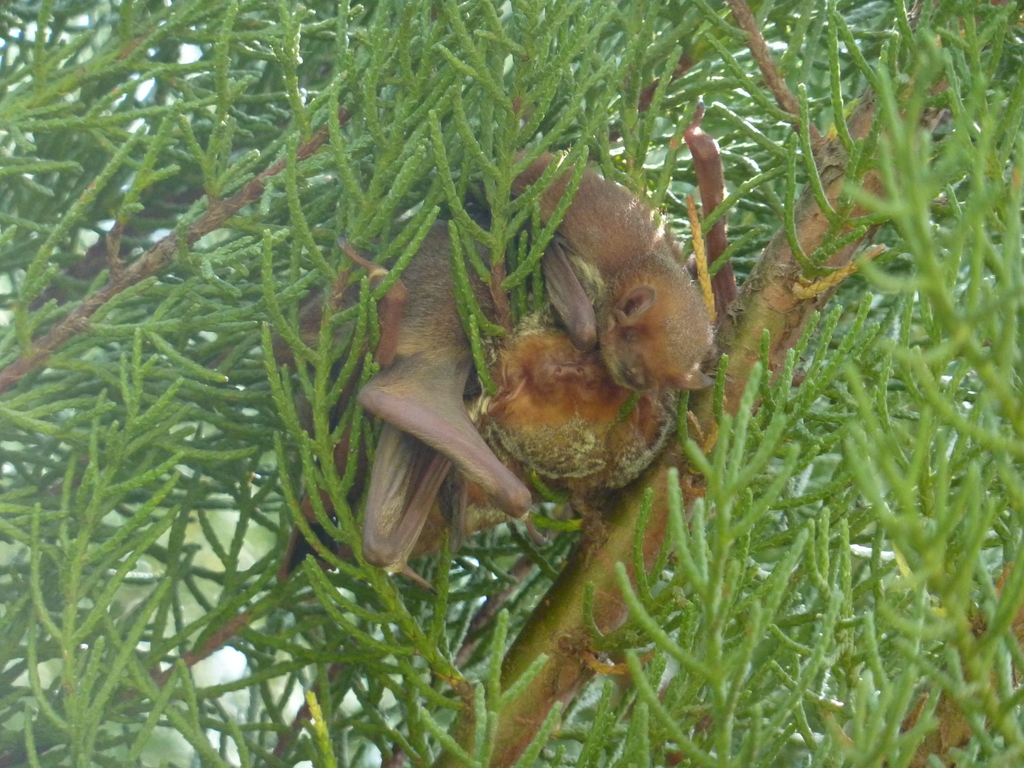
Southern Red Bat (Lasiurus blossevillii) lives in desert scrublands across North America. It feeds on insects & fruit. Its conservation status is Least Concern.
Hear the Southern Red Bat
A real field recording of the Southern Red Bat, made in the wild.
Western red bats stretch just over a tenth of a meter from nose to tail tip, a total length of 103 mm. Their forearms, the wing-bones that power flight, measure between 35 mm and 45 mm, while the ear-to-notch span averages 13 mm. The tail reaches 49 mm and the feet are a modest 10 mm long.
These bats pick their daytime homes high in the canopy, usually 1.5 m to 12 m above ground, clinging to dark, sheltered branches of cottonwoods, willows or sycamores that hug streams. They favor riparian trees, yet they'll also roost in fruit orchards or even slip into caves on occasion.
A female western red bat can give birth to as many as five pups in one litter, with an average of 3.2 babies per pregnancy. After a gestation of 80 to 90 days, the newborns can fly, which takes just 3 to 6 weeks. The species stores sperm through winter, timing birth for early summer when insects are plentiful, ensuring the tiny pups have a buffet of food as they learn to hunt.
Insects make up the entire menu of western red bats, with moths alone accounting for about 26 % of what they eat. They hunt from the treetops down to just above the ground, often launching their foraging flights one to two hours after sunset when nocturnal insects are most active. Though they will feed around streetlights and floodlights in towns, they prefer. Their nightly appetite helps keep moth populations in check, benefiting crops and forests.
Living openly in tree foliage makes western red bats easy targets for a range of predators: Virginia opossums, scrub jays, falcons, owls, Accipiter hawks and even roadrunners have been documented killing them, while domestic cats also pose a threat. By consuming huge numbers of insects each night, these bats act as natural pest control, lowering populations of moths and mosquitoes. Their role as insect predators therefore supports both ecosystem balance and human agriculture.
Sources
Every fact above was checked against these pages, and kept only where one of them states it.
As twilight descends, the southern red bat unfurls its delicate wings, a rusty hue glistening in the fading light, and takes to the evening skies with an effortless elegance. With each flutter, it weaves a intricate dance through the forest canopy, its high-pitched calls echoing softly as it pursues the whirling clouds of insects that sustain it. In this fleeting, crepuscular world, the southern red bat reigns, a master of the half-light, its very existence a testament to the magic that unfolds at the threshold of night.
Advertisement
Hear the Southern Red Bat, and 4,400+ more
Real recorded sounds, 11 nature games and a free Daily 5, 1v1 quiz duels, conservation wins and a safe Kids mode. Free on Feravox.