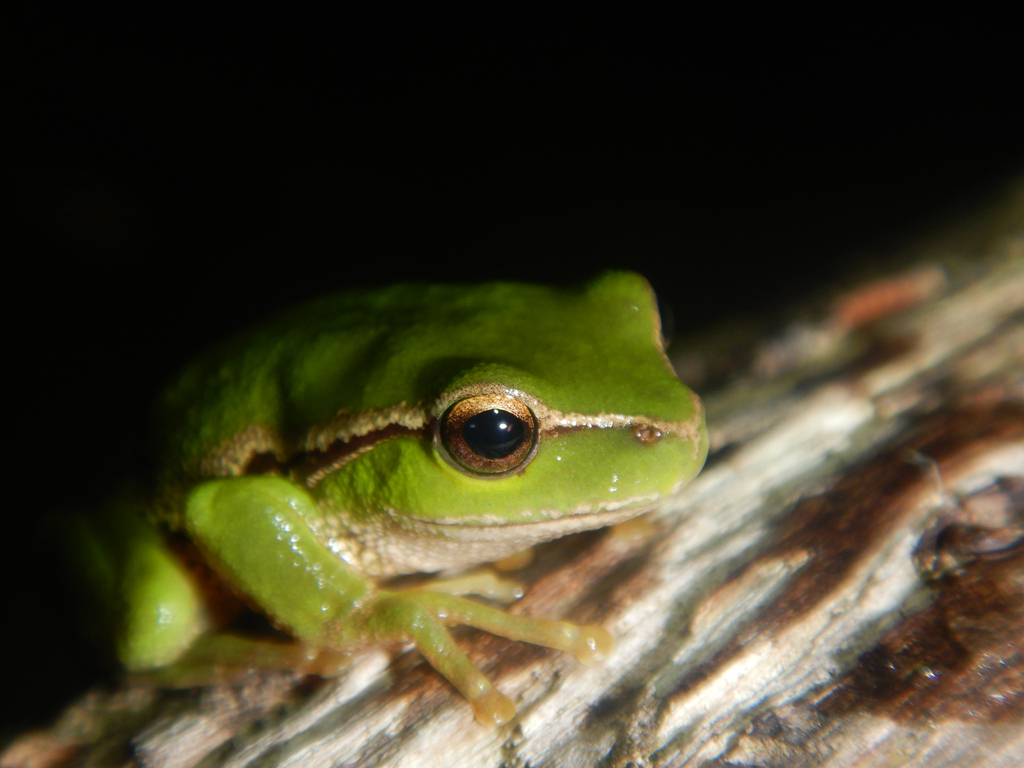
Photo: Bryce Watts-Parker
Feravox · The Voice of the Wild
Southern Leaf Green Tree Frog
Dryopsophus nudidigitus
Least Concern
Southern Leaf Green Tree Frog (Dryopsophus nudidigitus) lives in rainforest streams across south-eastern Australia. Its conservation status is Least Concern.
The southern leaf green tree frog, Dryopsophus nudidigitus, is a diminutive arboreal amphibian that scarcely exceeds 40 mm (1.6 in) in length. Adults typically display a vivid green dorsal hue, though occasional brown individuals are recorded, while metamorphs are uniformly dull brown. A distinctive black stripe runs from the nostril down the side of the head, widening toward the posterior, and a bright gold line mirrors this path just above it, giving the frog a striking facial accent. Its tympanum is indistinct, a key field mark that separates it from its close relative, the leaf green tree frog (D. phyllochroa). In the mist-laden rainforests and wet or dry sclerophyll forests of south-eastern Australia, from just south of Sydney down to eastern Victoria, these frogs cling to vegetation bordering streams and creeks, rarely venturing far from flowing water. Males announce the arrival of spring and summer with a call that begins with a prolonged note followed by a rapid series of shorter notes, echoing the vocal pattern of their northern counterpart. Beyond their vocal repertoire, these frogs exhibit a surprising propensity for hybridisation. Where the ranges of D. nudidigitus and D. phyllochrous meet, from the Royal National Park to around Wollongong, a hybrid zone persists, allowing interbreeding and producing individuals that blur the species’ diagnostic traits. This genetic mingling, set against a backdrop of pristine waterways, underscores the frog’s adaptability and the subtle complexities of amphibian speciation in a landscape where streams dictate both life and song.
Real recorded sounds, 11 nature games and a free Daily 5, 1v1 quiz duels, conservation wins and a safe Kids mode. Free on Feravox.