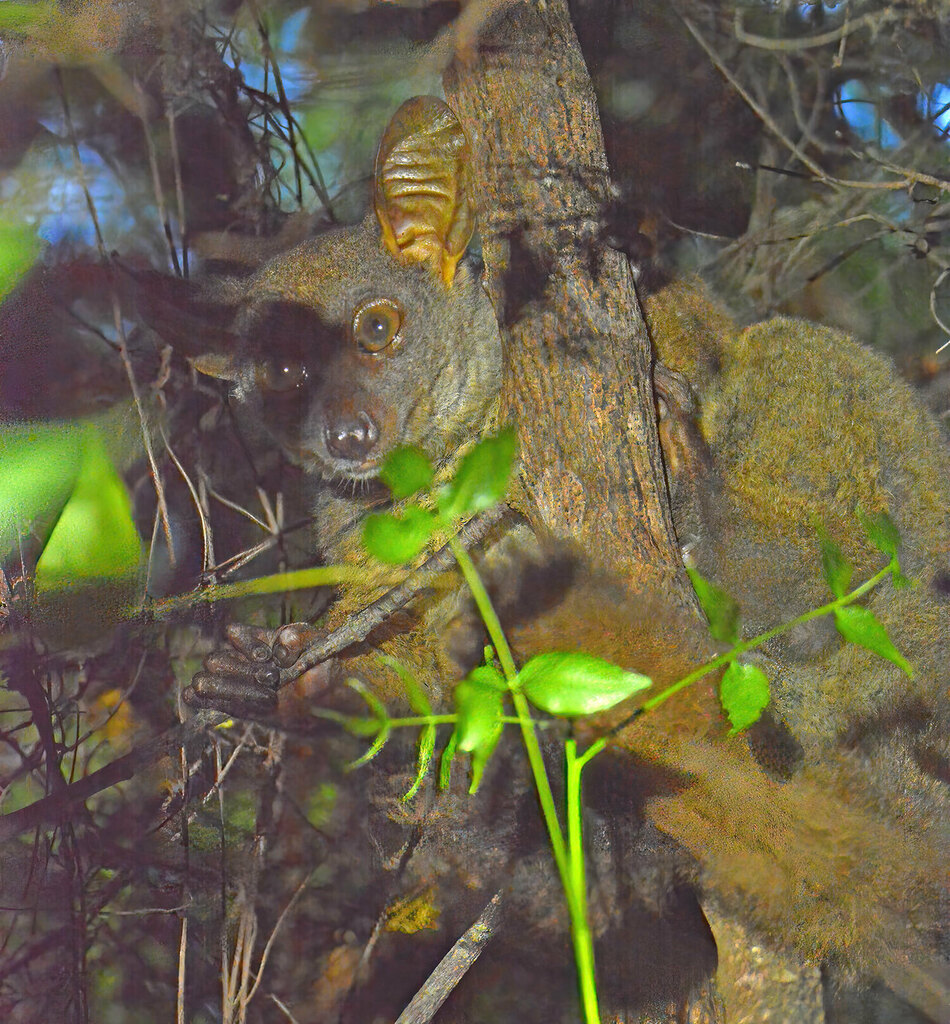
Small-eared Greater Galago (Otolemur garnettii) lives in tropical rainforest across Sub-Saharan Africa. It feeds on insects and fruit. Its conservation status is Least Concern.
Fascinating facts about the Small-eared Greater Galago
- Northern greater galagos can land on their hind feet first when they leap, a trait not seen in their larger brown relatives. They are active at night and spend the day sleeping alone in trees, emerging only after dark. As quadrupeds they hop short distances between branches, using the hind-first landing to negotiate the forest canopy with agility.
- The tip of the male's penis ends in a set of curves that no other galago species possesses, making it a reliable diagnostic feature. The organ measures about 18 mm in length and the shaft remains even in width from base to tip. A visible baculum sits at the tip and the glans bears spines that are less densely packed than those of the brown greater galago.
- Males weigh about 19 % more than females because they grow for a longer period, a phenomenon known as bimaturism. The average male weighs 794 g while the average adult female weighs 734 g, giving the species a clear size gap between the sexes. This sexual size dimorphism is reflected in the overall body-mass range of 0.5-1 kg for the species.
- Pregnancy in the northern greater galago lasts exactly 130 days and females normally give birth to a single baby, with twins being an uncommon outcome. After delivery the mother transports the newborn in her mouth to a nest and then leaves to forage, returning periodically to nurse. The infant remains dependent until it is weaned by the fifth week of life. Full sexual maturity is not reached until about twenty months of age, extending the early developmental period.
- When water sources contain molluscs, northern greater galagos have learned to fish for them, adding an aquatic skill to their otherwise terrestrial diet. Their overall diet is roughly an even split between fruit and insects, and as nocturnal, predominantly arboreal primates they spend daylight hours sleeping alone in trees and become active after dark to forage.
Sources
Every fact above was checked against these pages, and kept only where one of them states it.
At a glance
RangeSub-Saharan Africa
HabitatTropical rainforest
DietInsects and fruit
About the Small-eared Greater Galago
In the moonlit forests of Africa, the Small-eared Greater Galago embarks on a nocturnal ballet, its large, round eyes gleaming like lanterns as it leaps with effortless grace from branch to branch. With a soft, whooping call, it announces its presence to the night, a diminutive yet charismatic figure that weaves through the shadows with an air of quiet confidence. As it moves, its long, slender limbs unfold and refold with a fluidity that belies its tiny stature, a testament to the remarkable agility of this enchanting, nocturnal primate.
Hear the Small-eared Greater Galago, and 4,400+ more
Real recorded sounds, 11 nature games and a free Daily 5, 1v1 quiz duels, conservation wins and a safe Kids mode. Free on Feravox.