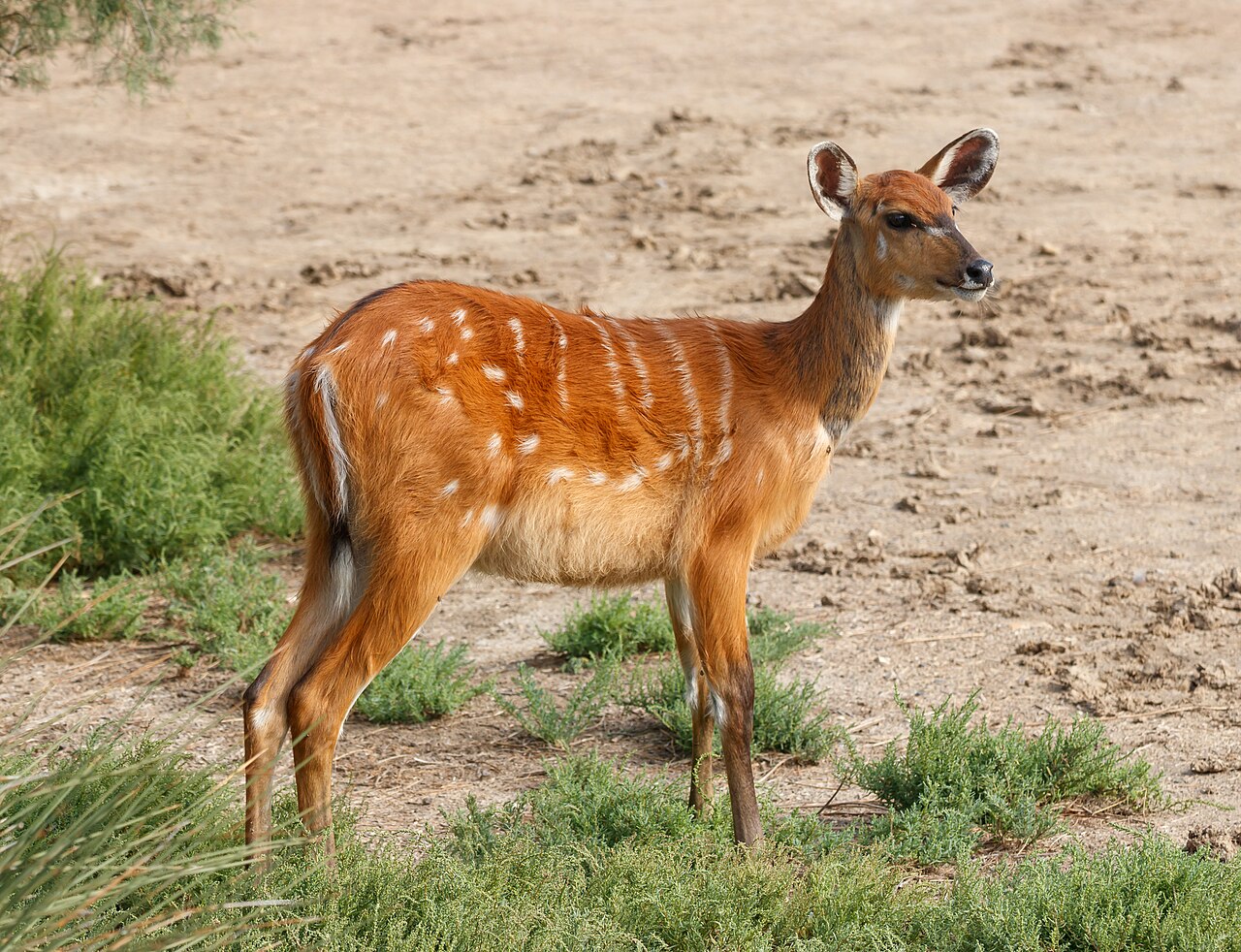
Sitatunga (Tragelaphus spekii) lives in marshy wetlands across Central African swamps. It feeds on aquatic plants leaves. Its conservation status is Least Concern.
Fascinating facts about the Sitatunga
- Its feet are built like swamp shoes: the hooves stretch up to 16 cm long in the hind legs and 18 cm in the front, are banana-shaped and splayed. The coat is rubbery, shaggy and water-repellent. This combination lets the sitatunga walk slowly and almost noiselessly in water-logged vegetation.
- Genetically it sits shoulder-to-shoulder with the bongo and bushbuck, forming a clade that split from the greater kudu about 8.6 million years ago. That closeness lets it hybridise with both relatives, bushbuck-sitatunga crosses are viable and bongo-sitatunga hybrids are fertile.
- Males tower over females: body length reaches 136-177 cm versus 104-146 cm for females, shoulder height 81-116 cm compared with 72-90 cm, and weight 76-119 kg versus 24-57 kg. Their spiraled horns grow 45-92 cm long, while females lack horns entirely. This stark dimorphism reflects a mating system where large, horned males compete for females.
- At night the sitatunga fills the swamp with low barks and coughs that can travel across the water, a sound both alarm and location marker. Males bark more often, while females emit a higher-pitched bark. They are semi-social, non-territorial and mostly sedentary, forming loose pairs or small groups of up to nine individuals. These vocal habits let individuals stay in touch where sight is of very little value.
- The IUCN lists the sitatunga as Least Concern, yet a 1999 estimate put the total population at 170,000, a figure experts now think is too high. About 40 % of that (based on the over-estimate) lives in protected wetlands such as the Okavango Delta, Dja Faunal Reserve and Bangweulu Swamps. The gap between perceived abundance and uncertain numbers underscores how its hidden swamp habitat makes reliable counts difficult.
Sources
Every fact above was checked against these pages, and kept only where one of them states it.
At a glance
RangeCentral African swamps
HabitatMarshy wetlands
DietAquatic plants leaves
About the Sitatunga
In the dense, shadowy recesses of the African marshlands, the sitatunga moves with an air of quiet elegance, its long, splayed hooves barely rippling the surface of the water as it glides effortlessly through its domain. With eyes alert and watchful, this enigmatic creature navigates the tangled vegetation with a stealth that belies its impressive size, its shaggy coat blending seamlessly into the dappled light and shade of its surroundings. As it rises onto its hind legs to reach the tender shoots of the treetops, the sitatunga embodies a gentle, refined beauty, its very existence a testament to the enduring magic of the wild.
Hear the Sitatunga, and 4,400+ more
Real recorded sounds, 11 nature games and a free Daily 5, 1v1 quiz duels, conservation wins and a safe Kids mode. Free on Feravox.