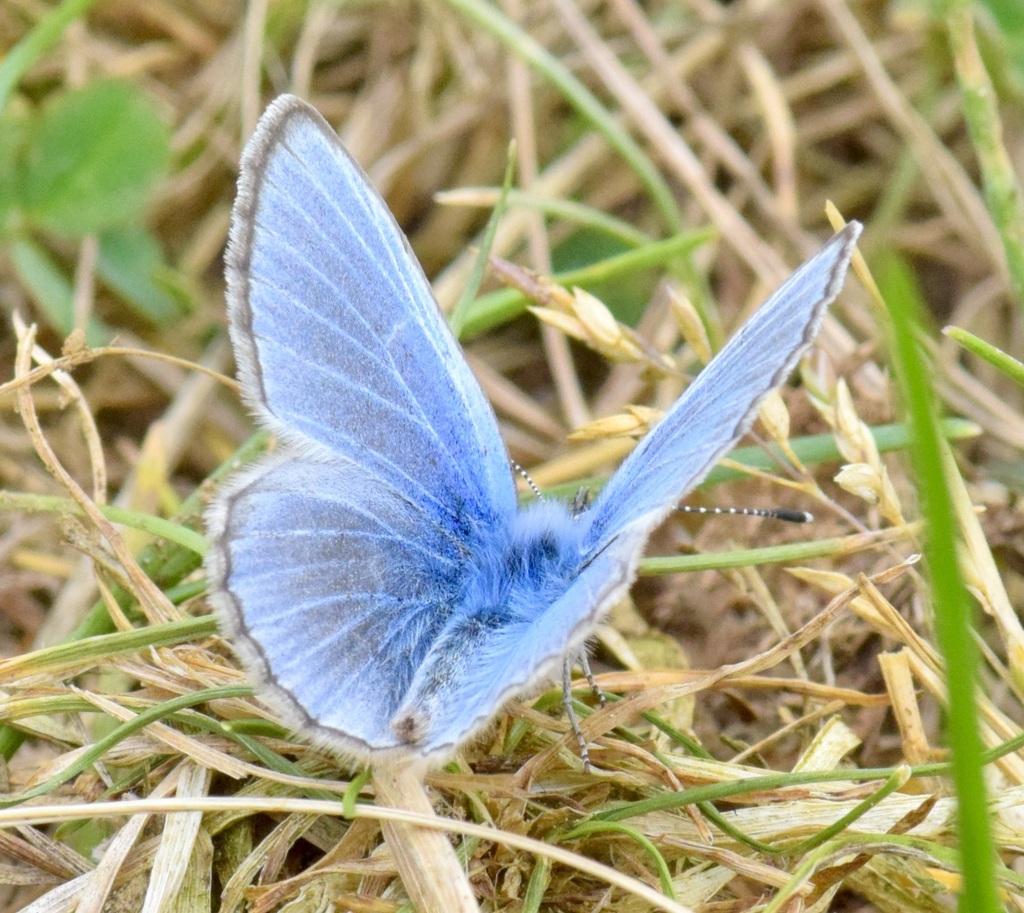
Silvery Blue (Glaucopsyche lygdamus) lives in open grasslands across North America. It feeds on legume flowers only.
Fascinating facts about the Silvery Blue
- The silvery blue is a small North American butterfly with a wingspan of 18 to 28 mm. The male's upperside is an iridescent silvery blue with narrow dark borders, while the female is a darker blue with wide borders. Both sexes have a white fringe, and the grayish underside carries a row of round black spots ringed in white.
- Its range starts in central Alaska and reaches southern California, Baja California, Arizona, New Mexico and western Kansas, then runs across the northern United States as far east as Nova Scotia. It turns up in alpine meadows, shale barrens, dunes, open woods and prairies, and it is found over most of Canada.
- Females lay their eggs singly on flower buds and young leaves of host plants such as lupines and other members of the pea family. The caterpillars feed on flowers, seedpods and young leaves, and ants tend them. The chrysalids hibernate through the cold season.
- Adults drink nectar from flowers, and males patrol near the host plants in search of females. There is a single flight a year, from March to June at low elevations and from June to August at high elevations. Many regional forms exist, including the Mojave silvery blue and the Palos Verdes blue.
- The silvery blue has a famous lost relative. The Xerces blue was once thought to be a subspecies, but genomes from old museum specimens show it was a distinct species that diverged at least 850,000 years ago. It is regarded as the first butterfly to go extinct in historical times, and its last individuals were collected in San Francisco dunes in 1941.
Sources
Every fact above was checked against these pages, and kept only where one of them states it.
At a glance
RangeNorth America
HabitatOpen grasslands
DietLegume flowers only
About the Silvery Blue
As the silvery blue butterfly dances across the sun-drenched meadows, its iridescent wings beat at a hypnotic pace, casting a spell of wonder over the landscape. With each delicate flutter, the butterfly weaves an intricate path, its tiny body suspended in mid-air as it sips nectar from the vibrant wildflowers that dot the terrain. In this fleeting, ephemeral world, the silvery blue is a master of movement, its ethereal beauty leaving an indelible mark on the natural world.
Common questions
Where does the Silvery Blue live?
Habitat: open grasslands. Range: North America.
Hear the Silvery Blue, and 4,400+ more
Real recorded sounds, 11 nature games and a free Daily 5, 1v1 quiz duels, conservation wins and a safe Kids mode. Free on Feravox.
More insects and spiders to discover