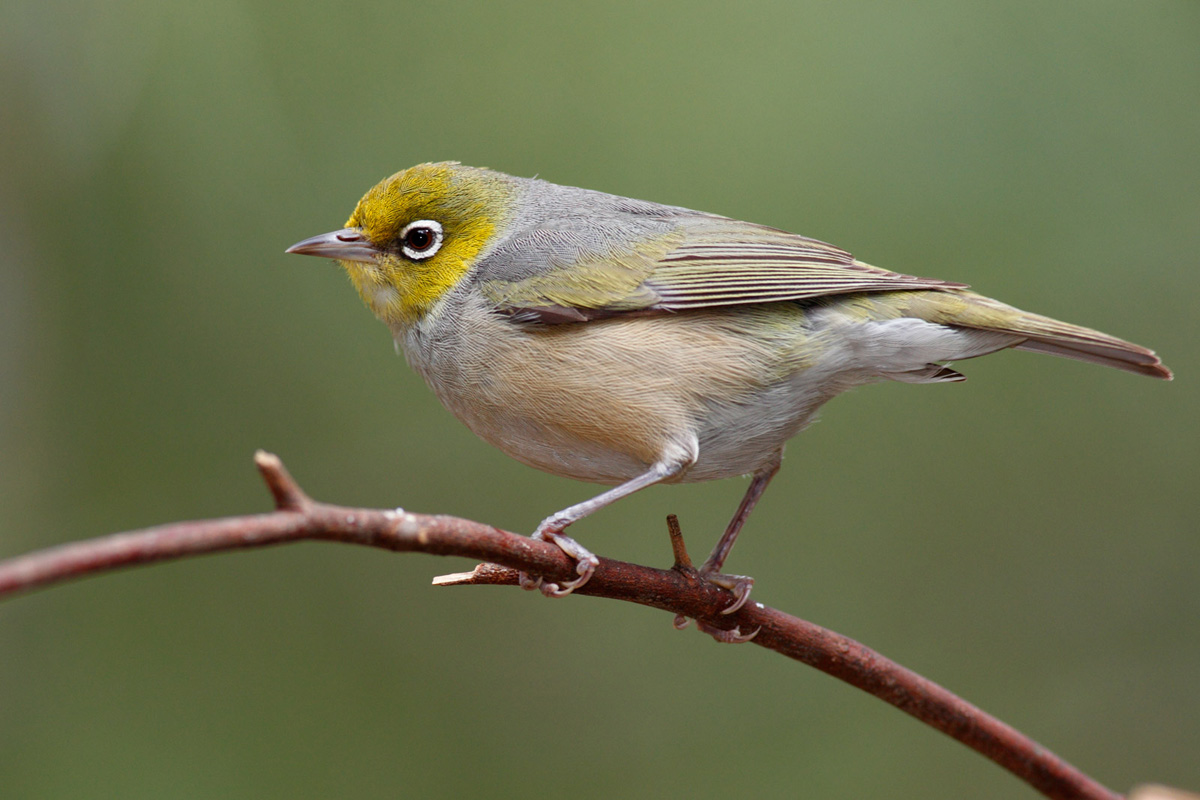
Silvereye (Zosterops lateralis) lives in temperate forests across Australia, New Zealand. It feeds on insects and nectar. Its conservation status is Least Concern.
Hear the Silvereye
A real field recording of the Silvereye, made in the wild.
The silvereye first appeared in New Zealand in 1832, but a large flock was blown eastward by a storm in 1856, dramatically raising its local numbers. Because the bird arrived without human assistance it is regarded as a self-introduced native and receives full protection under New Zealand law. Its Māori name, tauhou, literally means "new arrival", reflecting this history of sudden colonisation.
Although the silvereye reached New Zealand without human aid, it is legally treated as an indigenous species and enjoys native-bird protection. This status persists despite its self-introduced origins, ensuring that any threats to its populations are managed under native-species legislation. The bird's Māori name, tauhou, underscores its perception as a newcomer that has become part of the native fauna.
The sperm of the silvereye measures a total length of 69.71 μm, comprising a head of 13.01 μm, a midpiece of 52.75 μm and a flagellum extending to 56.69 μm. These precise dimensions illustrate the minute scale of its reproductive cells, consistent with the bird's overall tiny size of just 11-13 cm in length and about 10 g in weight. Such detailed measurements are recorded for this species in scientific studies.
Tasmanian silvereyes undertake a remarkable crossing of the Bass Strait, a journey that is impressive for birds only 11 to 13 cm long and weighing about 10 g. After making the sea crossing they spread into mainland habitats in Victoria, New South Wales and south-eastern Queensland. In those new areas many individuals continue further north, while the most northerly birds stay resident year-round.
Silvereyes display partial migration that is influenced by genetics, with some birds travelling long distances and others remaining year-round. Allelic variation at the CLOCK gene is linked to whether an individual becomes migratory. In late summer the species gathers in flocks and many birds head north along coasts and mountain ranges, foraging by day and covering great distances at night.
Sources
Every fact above was checked against these pages, and kept only where one of them states it.
In the dappled light of the forest, the silvereye flits with effortless ease, its iridescent feathers glimmering like shards of molten silver as it darts between the leafy branches. With a flick of its tail, it pivots in mid-air, its bright, inquisitive eyes scanning the surroundings for the sweet nectar and succulent insects that sustain it. As it moves through its realm, the silvereye embodies a spirit of restless curiosity, its very existence a testament to the enduring allure of the natural world.
Advertisement
Hear the Silvereye, and 4,400+ more
Real recorded sounds, 11 nature games and a free Daily 5, 1v1 quiz duels, conservation wins and a safe Kids mode. Free on Feravox.