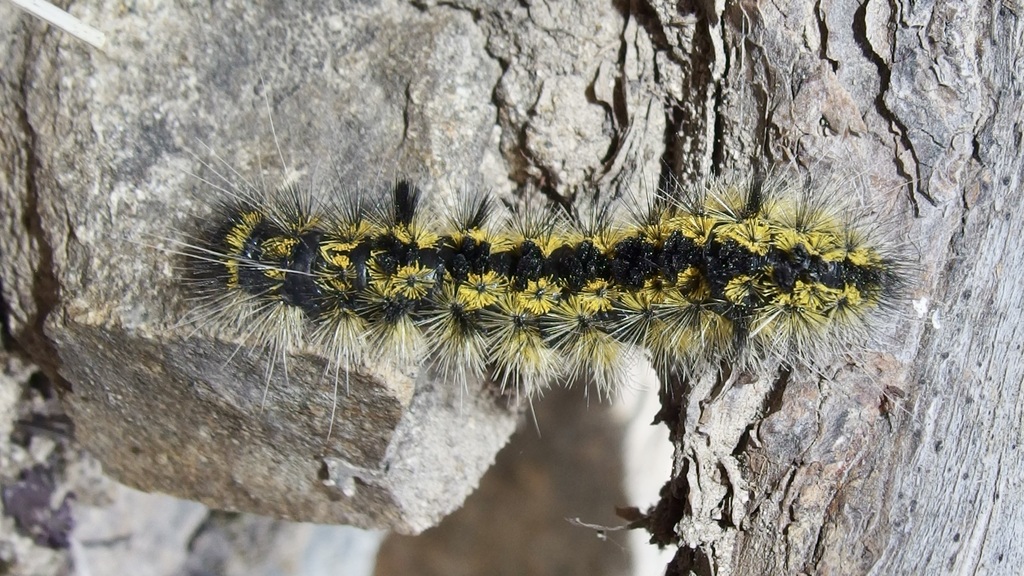
Silver-Spotted Tiger Moth (Lophocampa argentata) lives in tropical forests across North America. It feeds on alfalfa and clover.
Fascinating facts about the Silver-Spotted Tiger Moth
- The young caterpillars are brown or reddish-brown and covered in dense hair, especially bundles of black and yellow hairs along their backs. These hairs are not just decorative; they can cause irritation if they touch human skin. The same irritating hairs are present on the pupae, extending the defensive trait into the next life stage. This means handling the larvae or their cocoons may result in a painful skin reaction.
- Silver-spotted tiger moths complete a single generation each year. In mid-summer the adults deposit clusters of eggs on pine needles and small branches of their host trees. Those eggs hatch after roughly three weeks, releasing larvae that will soon begin feeding. This timing ensures the larvae emerge when fresh foliage is abundant for growth.
- After hatching, groups of larvae spin communal silk tents on the needles of their host conifers and stay inside throughout the winter months. When spring arrives they abandon the tents and each caterpillar feeds alone on the foliage. Later in the season, each larva pupates in a brown cocoon that it attaches to a plant or drops to the forest floor. This seasonal shift from group shelter to solitary feeding prepares them for successful metamorphosis.
- Adult silver-spotted tiger moths have brown forewings marked with irregular silvery spots that are each outlined in black and arranged in loose rows. The spots vary in size, with the costal spot being the largest and the marginal row uniformly round.
- The silver-spotted tiger moth inhabits a broad swath of western North America, ranging from British Columbia down to southern California and extending eastward through Arizona, Nevada, New Mexico, Colorado, Utah, Wyoming and possibly into northern Mexico. Within this range it occupies both coastal forests and the Rocky Mountain region, where the subspecies L. subalpina is found. The species also includes a Californian subspecies, L.
Sources
Every fact above was checked against these pages, and kept only where one of them states it.
At a glance
RangeNorth America
HabitatTropical forests
DietAlfalfa and clover
About the Silver-Spotted Tiger Moth
As the sun dips below the horizon, the Silver-Spotted Tiger Moth stirs, its delicate wings unfolding like a whispered promise, as it takes to the evening air with a gentle, lilting flight. With a subtle sheen to its fur-like body and a sprinkling of silver spots that shimmer like moonlit dew, this moth navigates the shadows with an ethereal grace, its antennae twitching as it seeks out the sweet, heady scent of blooming flowers. In this fleeting, crepuscular world, the Silver-Spotted Tiger Moth reigns, a master of the twilight realm, its beauty and mystery waiting to be unraveled by the patient observer.
Hear the Silver-Spotted Tiger Moth, and 4,400+ more
Real recorded sounds, 11 nature games and a free Daily 5, 1v1 quiz duels, conservation wins and a safe Kids mode. Free on Feravox.
More insects and spiders to discover