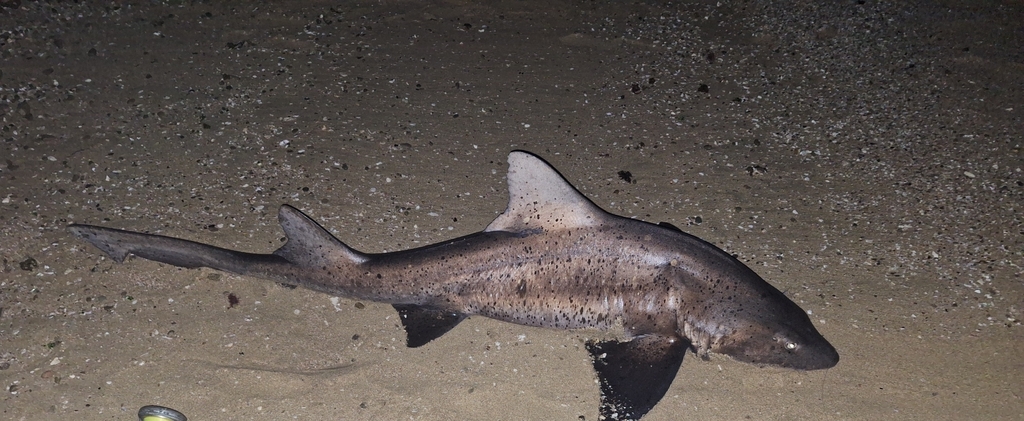
Photo: Andreas De Beer
Feravox · The Voice of the Wild
Sharptooth Houndshark
Triakis megalopterus
Least Concern
Sharptooth Houndshark (Triakis megalopterus) lives in sandy coastal bays across Southern Africa coast. It feeds on crustaceans, bony fish, cephalopods. Its conservation status is Least Concern.
The sharptooth houndshark, Triakis megalopterus, is a stout, gray-to-bronze predator that prowls the shallow, sandy bays of southern Africa, from southern Angola to South Africa’s Eastern Cape. Its most striking feature is a set of massive, rounded fins, especially the broad, sickle-shaped pectoral fins of adults, that give it a wing-like silhouette as it glides just above the seabed. A short, blunt snout frames a wide mouth lined with tiny, pavement-like teeth, each crowned by a sharp central cusp capable of both gripping slippery fish and crushing the hard shells of crabs and lobsters. Growing up to 2 m (6.6 ft) and 40 kg (88 lb), females outsize males, and the skin often hangs loosely, revealing a subtle pattern of irregular black spots that can range from sparse to dense in mature individuals. By night, this active swimmer becomes a stealthy hunter, pursuing crustaceans, bony fishes and cephalopods, most notably the crab Plagusia chabrus and Octopus vulgaris, sometimes chasing prey right onto the shore. In summer, groups gather in the shallow waters of False Bay, likely for reproductive purposes, as pregnant females dominate these aggregations. The species is aplacental viviparous; after a 20-month gestation, females birth 6–12 pups between late May and August, then skip another two or three years before reproducing again. A surprising quirk is its occasional daytime foray to feed on mass-spawning chokka squid (Loligo reynaudii), a brief departure from its usual nocturnal routine, hinting at a flexibility that belies its otherwise slow-growing, long-lived nature.
Real recorded sounds, 11 nature games and a free Daily 5, 1v1 quiz duels, conservation wins and a safe Kids mode. Free on Feravox.