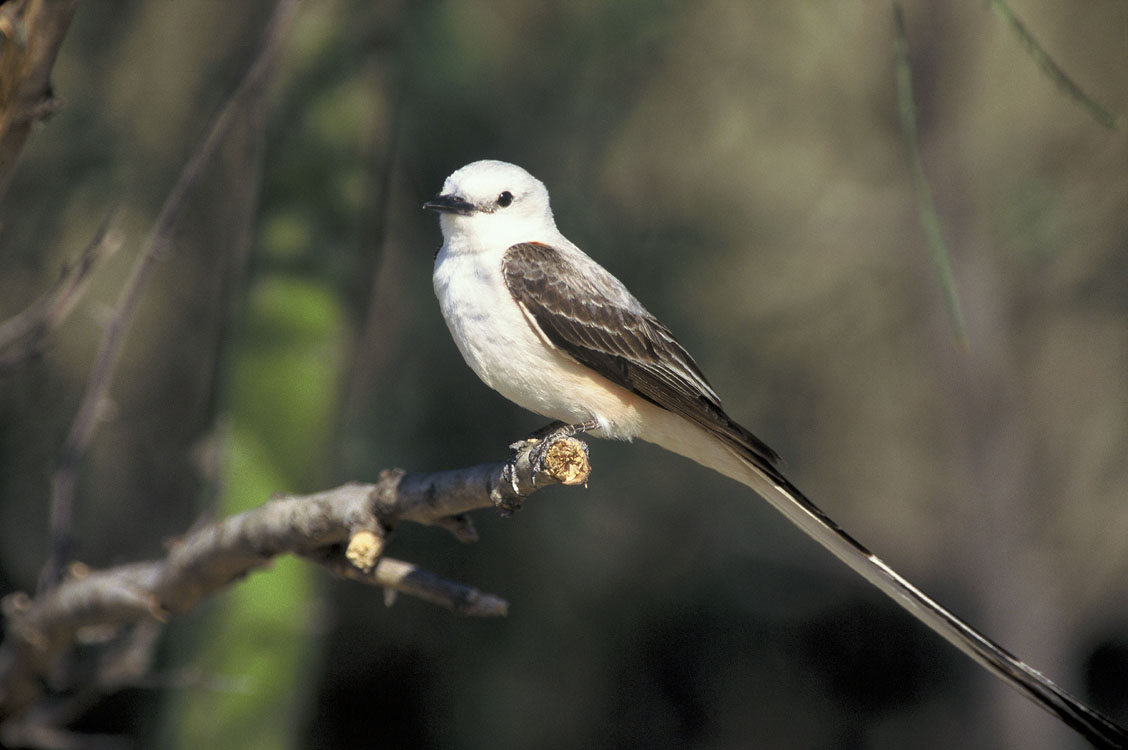
Scissor-Tailed Flycatcher (Tyrannus forficatus) lives in open grasslands across North and Central America. Its conservation status is Least Concern.
Fascinating facts about the Scissor-Tailed Flycatcher
- Males of the scissor-tailed flycatcher can reach a total length of about 38 cm; females are noticeably shorter because their tails are roughly 30 % less long than those of males. The species has a wingspan of 38.1 cm and weighs up to 43 g, giving it a lightweight build suited to agile flight.
- Before heading south for the winter, scissor-tailed flycatchers gather in massive pre-migratory roosts that can hold as many as one thousand birds together. These large flocks then move through Texas and eastern Mexico on their way to the non-breeding range that stretches from southern Mexico down to Panama. The concentration of birds in these roosts provides safety in numbers and facilitates the long journey across the continent.
- In a narrow strip of eastern Arkansas and western Tennessee, scissor-tailed flycatchers share breeding territory with western kingbirds, creating a hybrid zone where the two species live side by side. Within this overlap they may compete for the same ecological niche, a situation that has arisen as both birds have expanded their breeding ranges eastward over the past fifty years.
- The scissor-tailed flycatcher holds official status as Oklahoma's State Bird, a symbol celebrated across the state. It breeds in open shrubby country with scattered trees across Texas, Oklahoma, Kansas, western Louisiana, Arkansas, Missouri, far eastern New Mexico and northeastern Mexico. In autumn the birds gather in large pre-migratory roosts before travelling south through Texas and eastern Mexico.
- During the breeding season the male scissor-tailed flycatcher puts on a spectacular aerial display, soaring high while his extraordinarily long, forked tail streams behind him. This performance occurs in the open shrubby territories where they build cup nests in isolated trees or shrubs, sometimes even on telephone poles near towns. The display not only highlights the bird's distinctive black-and-white tail but also serves to attract a mate and deter rivals.
Sources
Every fact above was checked against these pages, and kept only where one of them states it.
At a glance
RangeNorth and Central America
HabitatOpen grasslands
DietInsects and spiders
About the Scissor-Tailed Flycatcher
As the sun rises over the open plains, the Scissor-Tailed Flycatcher takes to the skies, its long, forked tail streaming behind it like a banner, a striking silhouette against the dawn light. With a fluid, effortless motion, it dances through the air, its agile form twisting and turning in pursuit of the insects that fill its days with purpose. In its graceful, aerial acrobatics, this bird embodies the very essence of freedom, a true master of the wind-swept skies it calls home.
Hear the Scissor-Tailed Flycatcher, and 4,400+ more
Real recorded sounds, 11 nature games and a free Daily 5, 1v1 quiz duels, conservation wins and a safe Kids mode. Free on Feravox.
Scissor-Tailed Flycatcher photographed on Feravox