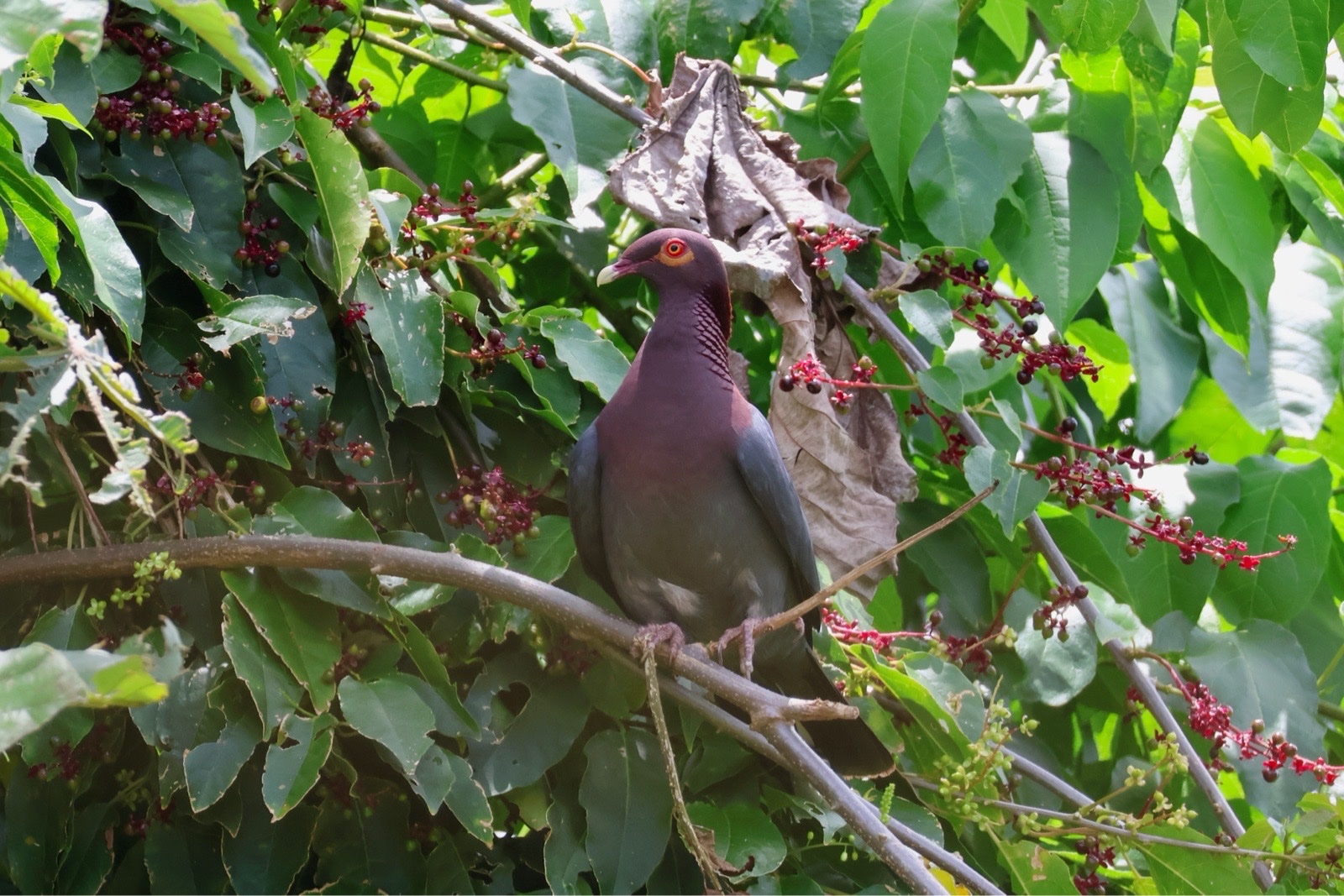
Scaly-naped Pigeon (Patagioenas squamosa) lives in rainforests and drier lowland woodlands, often near settlements across Greater Antilles (except Jamaica and Bahamas) and Lesser Antilles. Its conservation status is Least Concern.
Hear the Scaly-naped Pigeon
A real field recording of the Scaly-naped Pigeon, made in the wild.
The scaly-naped pigeon is a relatively large bird, measuring 14-16 in, and its overall plumage is slate-grey. A distinctive maroon band encircles its neck, while the nape shows a scaly pattern that gives the species its name. Around the red eyes a bare patch of skin is visible; in males this patch is reddish, in females it leans toward yellow. The legs and the base of the bill are vivid red, contrasting with the lighter colour of the rest of the bill. These combined markings make the pigeon unmistakable in the Caribbean forests where it lives.
The scaly-naped pigeon occupies the Greater Antilles, except Jamaica and the Bahamas, and extends through the Lesser Antilles. Within this range it favours rainforest interiors but is also recorded in drier lowland woodlands, showing a degree of habitat flexibility. Its presence is especially noticeable near human settlements, where it can become locally common. This distribution pattern reflects the species' ability to exploit both pristine forest resources and altered landscapes, allowing it to persist across a mosaic of Caribbean environments.
Scaly-naped pigeons are typically solitary or form small groups, a social structure that reduces competition for limited fruit resources. They forage both in the canopy and on the ground, often feeding alongside Rock doves, Eared doves and Zenaida doves, which indicates a tolerance for mixed-species foraging flocks. Like most doves, they are highly vigilant; when a threat is perceived they will quickly take flight, a behaviour that helps them avoid predation in the dense forest understory.
Reproduction in the scaly-naped pigeon involves the construction of a nest primarily in trees, where the female lays one to two eggs. This modest clutch size reflects a strategy of investing in a small number of offspring, each of which receives parental care in a relatively secure arboreal environment. The choice of tree nests also reduces exposure to ground predators and aligns with the species' preference for forested habitats.
The diet of the scaly-naped pigeon is centred on the fruits and seeds of trees, making it an important seed disperser within Caribbean forest ecosystems. By consuming a variety of fleshy fruits, the pigeon transports seeds away from the parent plant, facilitating forest regeneration. Its reliance on arboreal food sources ties its survival closely to the health of forest habitats.
Sources
Every fact above was checked against these pages, and kept only where one of them states it.
RangeGreater Antilles (except Jamaica and Bahamas) and Lesser Antilles
HabitatRainforests and drier lowland woodlands, often near settlements
DietFruits and seeds of trees
About the Scaly-naped Pigeon
Patagioenas squamosa, commonly called the scaly-naped pigeon, is a large slate-grey pigeon measuring 14-16 in with a striking maroon neck collar and a scaly-patterned nape. It inhabits the Greater Antilles (excluding Jamaica and the Bahamas) and the Lesser Antilles, favouring rainforests but also occupying drier lowland woodlands and areas near human settlements. The bird is usually seen alone or in small groups, foraging in trees and on the ground, often alongside other dove species. Its diet consists mainly of fruits and seeds, linking it closely to forest health. Nesting occurs in trees where one to two eggs are laid, and the species' wary nature prompts rapid flight when threatened, a behaviour that has helped it persist across a range of Caribbean habitats.
Advertisement
Hear the Scaly-naped Pigeon, and 4,400+ more
Real recorded sounds, 11 nature games and a free Daily 5, 1v1 quiz duels, conservation wins and a safe Kids mode. Free on Feravox.