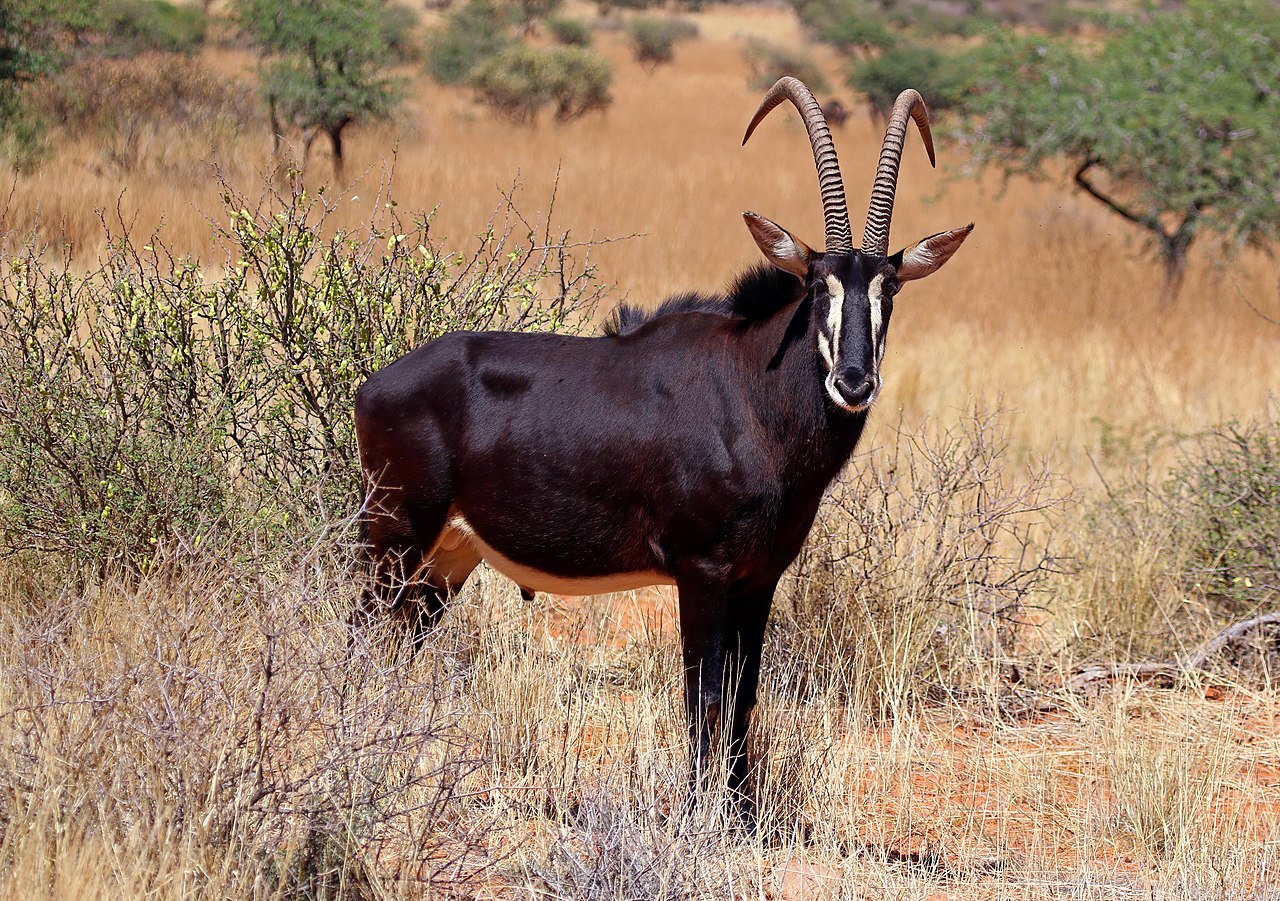
Sable Antelope (Hippotragus niger) lives in dry woodland and savanna across East and Southern Africa. It feeds on grasses and leaves. Its conservation status is Least Concern.
Fascinating facts about the Sable Antelope
- Only 450 Matsetsi sable antelopes remain in Zimbabwe, a crash from 24,000 in 1994, while South Africa holds about 7,000 individuals in farms and reserves. Those numbers show how a once abundant subspecies can vanish in a few decades, warning that habitat loss and hunting can push local populations to the brink despite the species overall being listed as Least Concern.
- Male sable antelopes can tip the scales at 235 kg (518 lb) and stand 117-140 cm tall at the shoulder, while females are slightly lighter at 220 kg (490 lb) and a bit shorter. Their massive horns stretch 81-165 cm in bulls versus 61-102 cm in cows. Such size and weaponry let them fend off lions and other predators.
- Tree leaves compose 90 % of a sable antelope's diet, with a preference for foliage on termite mounds and mid-length grasses like Urochloa nigropedata. Because water is vital, they trek every two to four days to drink, often traveling up to two miles from a source.
- In the wild a sable antelope lives about 19 years, extending to 22 years when cared for in captivity. This longevity, combined with a slow reproductive pace, gestation of 8-9 months and a single calf weaned at roughly 8 months.
- Sable herds usually contain 10 to 30 females and their calves, all overseen by a single dominant bull. When a herd swells, it splits into smaller family groups, while expelled teenage males form bachelor bands of up to 12.
Sources
Every fact above was checked against these pages, and kept only where one of them states it.
At a glance
RangeEast and Southern Africa
HabitatDry woodland and savanna
DietGrasses and leaves
About the Sable Antelope
In the scorching savannas, the sable antelope roams with majestic elegance, its dark, velvety coat glistening in the sunlight as it strides effortlessly across the grasslands, its slender legs devouring great distances with each fluid step. With horns that curve like scimitars, this regal creature navigates its domain with a quiet confidence, its large, watchful eyes ever-vigilant for the predators that lurk in the shadows. As it moves, its very presence seems to embody the wild beauty and untamed spirit of the African wilderness, a true marvel of evolution and adaptation.
Hear the Sable Antelope, and 4,400+ more
Real recorded sounds, 11 nature games and a free Daily 5, 1v1 quiz duels, conservation wins and a safe Kids mode. Free on Feravox.