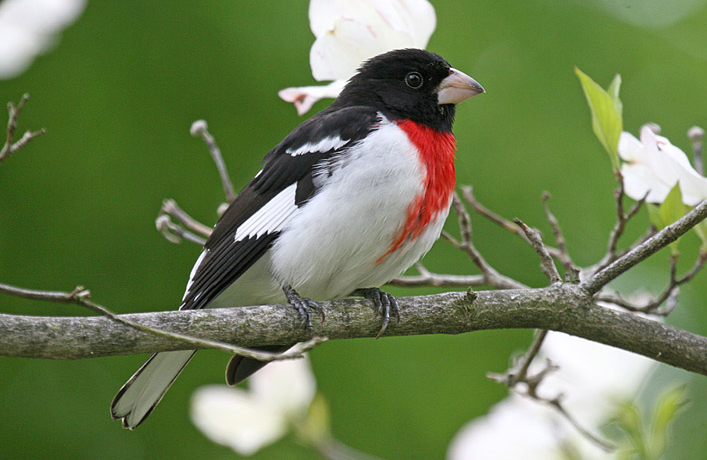
Rose-Breasted Grosbeak (Pheucticus ludovicianus) lives in deciduous forest across Eastern North America. It feeds on insects and seeds. Its conservation status is Least Concern.
Hear the Rose-Breasted Grosbeak
A real field recording of the Rose-Breasted Grosbeak, made in the wild.
Fascinating facts about the Rose-Breasted Grosbeak
In the wild, rose-breasted grosbeaks live on average up to 7.3 years, yet some individuals have reached almost 13 years, while captive birds can survive a full 24 years. This stark contrast shows how predation and collisions cut lifespan in nature, but also that the species has the physiological capacity for long life when those pressures are removed.
During breeding, more than half of a rose-breasted grosbeak's diet is animal matter, 52% of stomach contents are invertebrates, mainly beetles, while the rest is split between wild fruits (19.3%), weed seeds (15.7%), cultivated fruits and grains (6.5%) and other plant parts (6.5%). This balanced diet fuels rapid nestling growth of at least 3 g per day and highlights the bird's role in both insect control and seed dispersal across its range.
Rose-breasted grosbeaks build their cup nests anywhere from 0.8 m to 16.7 m above ground, averaging about 6 m high, usually on branches near woodland openings. Clutches range from 1 to 5 eggs, most commonly 3-4, and incubation lasts 11-14 days. early fledging at 9-13 days.
Rose-breasted grosbeaks are the only eastern U.S. migratory songbird shown to start making sperm far south of their breeding grounds. Males arrive a few days to a week before females.
Since 1966 the species has been losing ground in the east, dropping more than 1.5% each year, while the western part of its summer range is growing at a matching rate of over 1.5% annually.
Sources
Every fact above was checked against these pages, and kept only where one of them states it.
As the Rose-Breasted Grosbeak flits through the lush canopy, its vibrant plumage flashes like a burst of sunset, drawing the eye with an irresistible allure. With each deliberate wingbeat, it navigates the dense foliage with a quiet confidence, its stout bill probing the leafy undergrowth for hidden seeds and succulent insects. In its stately migrations between North and Central America, this avian gem weaves a subtle yet captivating narrative of resilience and beauty, its very existence a testament to the enduring wonders of the natural world.
Advertisement
Hear the Rose-Breasted Grosbeak, and 4,400+ more
Real recorded sounds, 11 nature games and a free Daily 5, 1v1 quiz duels, conservation wins and a safe Kids mode. Free on Feravox.