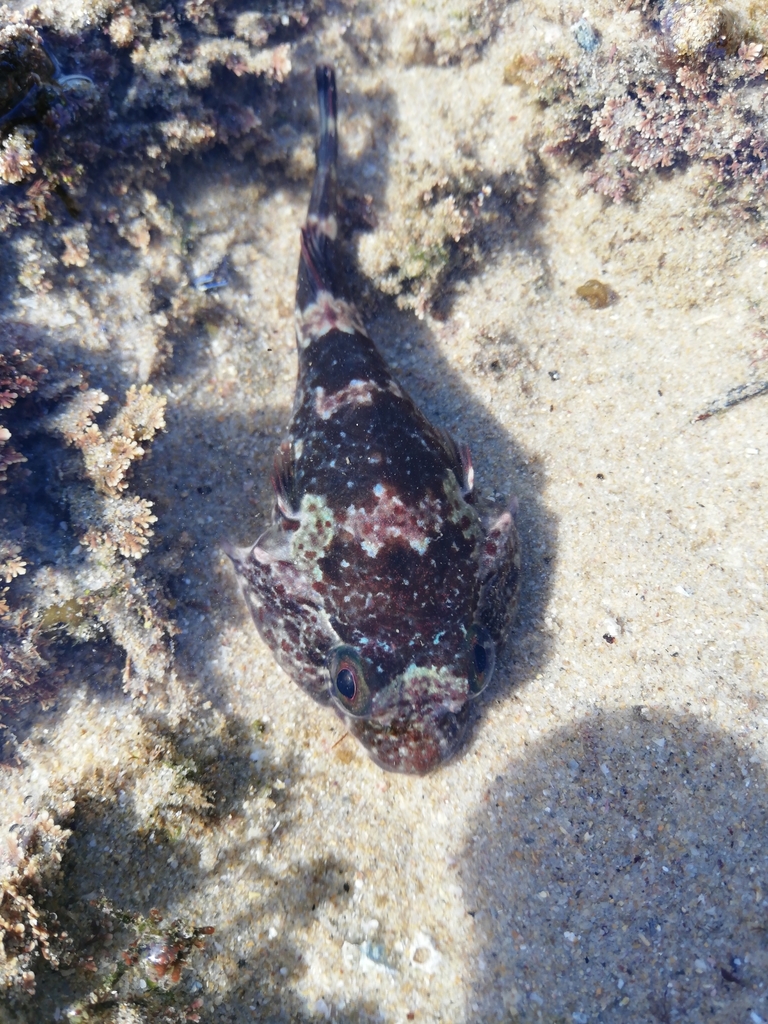
Photo: Christiaan Viljoen
Feravox · The Voice of the Wild
Rocksucker
Chorisochismus dentex
Least Concern
Rocksucker (Chorisochismus dentex) lives in intertidal rock pools across Namibia to northern Natal. It feeds on patellid limpets and sea snails. Its conservation status is Least Concern.
The rocksucker, Chorisochismus dentex, is the heavyweight of the clingfish world, reaching up to 30 cm (12 in) in total length. Its broad head tapers into a narrow tail, and its large eyes peer from a mottled canvas of greenish or reddish hues that shift with the light. The fish’s most arresting feature is its disproportionately massive, fang-like upper front teeth, which give dead, dried specimens a sea-monster reputation among beachcombers. Found along the southern African shoreline from Namibia to northern Natal, South Africa, the rocksucker makes its home in intertidal rock pools and shallow reefs down to at least 15 m (49 ft). It favors flat boulders but will also slip into kelp beds and the crevices of underwater caves, clinging to surfaces with a suction disc that lives up to its name. Juveniles start life hunting tiny crustaceans, but by the time they reach 4–8 cm (1.5–3 in) they undergo a dramatic dietary shift. Adults become specialist predators of patellid limpets, which can make up nearly three-quarters of their intake. In a flash that lasts about a second, the fish lunges, flips the firmly attached limpet with its teeth, swallows it whole, and later regurgitates the empty shell. Remarkably, a 12.2 cm (4.8 in) individual has been recorded swallowing a 3.1 cm (1.2 in) limpet, demonstrating a feeding prowess that belies its modest size, and hinting at the hidden power of this seemingly unassuming clingfish.
Real recorded sounds, 11 nature games and a free Daily 5, 1v1 quiz duels, conservation wins and a safe Kids mode. Free on Feravox.