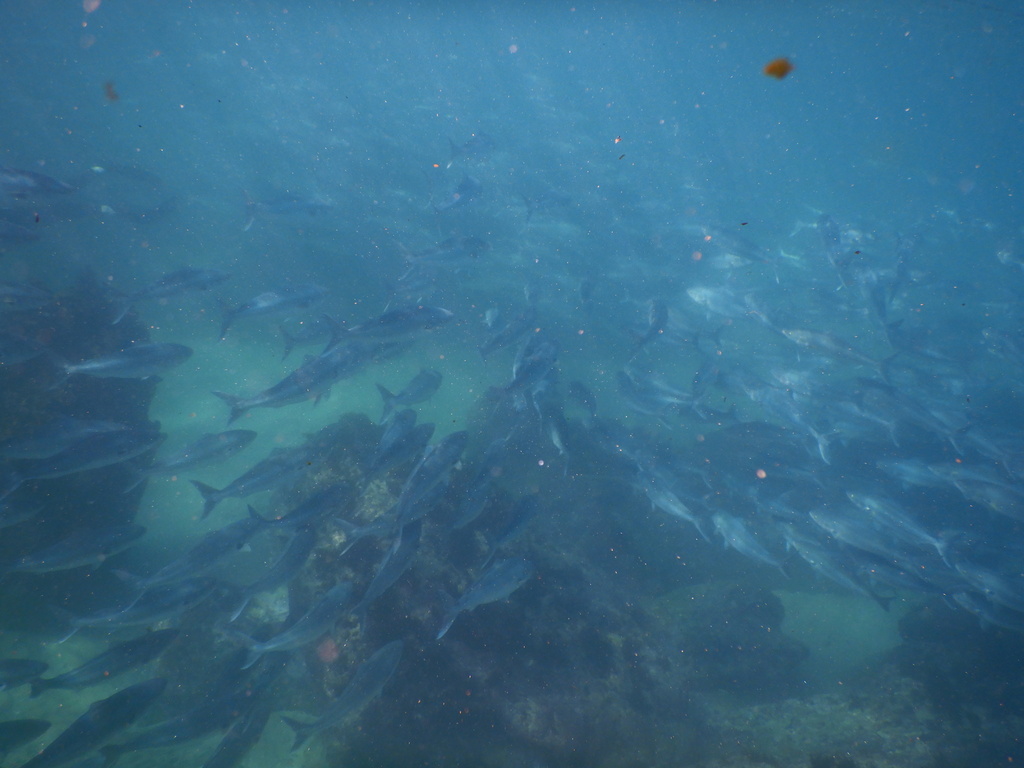
Photo: Bryce Watts-Parker
Feravox · The Voice of the Wild
Australian Salmon
Arripis trutta
Not Evaluated
Australian Salmon (Arripis trutta) lives in coastal beaches and estuaries across southwestern Pacific. It feeds on small pelagic fish and krill.
The Australian salmon, Arripis trutta, cuts a sleek silhouette in the sun-dappled waters of the Tasman Sea. Its dark bluish-green back fades to a silvery belly, while juveniles flash golden bars that dissolve into large spots as they mature. A vivid yellow pectoral fin and black-margined dorsal and caudal fins frame a body that can reach 89 cm, though most individuals hover around 47 cm. Nine dorsal spines, 15–17 soft rays, and a distinctive bony ridge with serrated edges beneath each eye set it apart from its congeners, and a higher gill-raker count (33–40) distinguishes it from the closely related A. truttacea. These migratory predators traverse thousands of kilometres, forming massive schools off exposed coastlines and even entering rivers. Juveniles linger in sheltered bays and estuaries, feeding on crustaceans and polychaetes, while adults shift to small pelagic baitfish such as pilchards, sprats and anchovies. A striking dietary transition recorded from the 1950s-60s krill- and squid-dominated menu to a 21st-century reliance on baitfish mirrors the southward extension of the warm East Australian Current since the 1990s, turning the species into a living barometer of oceanic warming. Their schooling behavior not only corrals prey to the surface but also draws seabirds like the white-fronted tern, nicknamed the “kahawai bird”, creating a dynamic energy conduit through the pelagic food web.
Real recorded sounds, 11 nature games and a free Daily 5, 1v1 quiz duels, conservation wins and a safe Kids mode. Free on Feravox.